
The most reliable way to measure what an audience actually cares about is to look at what it searches for at 2 AM. Not the think-pieces it shares. Not the takes it quote-tweets. I mean the stuff people quietly type into a search bar when no one’s watching, the revealed-preference data that doesn’t show up in any media strategy deck.
During the quarterfinals, I noticed “World Cup WAGs 2026” was trending alongside match result queries. Not instead of them. Alongside them. And I found that interesting, in the way that fandom sociology finds things interesting: not as evidence that the audience is shallow, but as evidence that the audience has decided this tournament contains more than ninety minutes of football.
What we’re really watching, when we track the women in those stands, is a particular kind of parasocial contract. The audience isn’t passive. It has voted, with its attention, to make certain women co-protagonists of a story that the official broadcast keeps insisting is only about the men on the pitch. That’s not a media failure. That’s the audience correcting the narrative.
Spain is already in the final. They beat France 2-0 on July 14, and MetLife Stadium on Sunday belongs to them, half of it anyway. The other half belongs to whoever survives today’s semifinal in Atlanta: England or Argentina. As I write this, the result isn’t in, which means we’re previewing all possible futures at once, a bracket of WAG storylines that won’t resolve until around 5 PM ET.
So let’s run through both timelines.
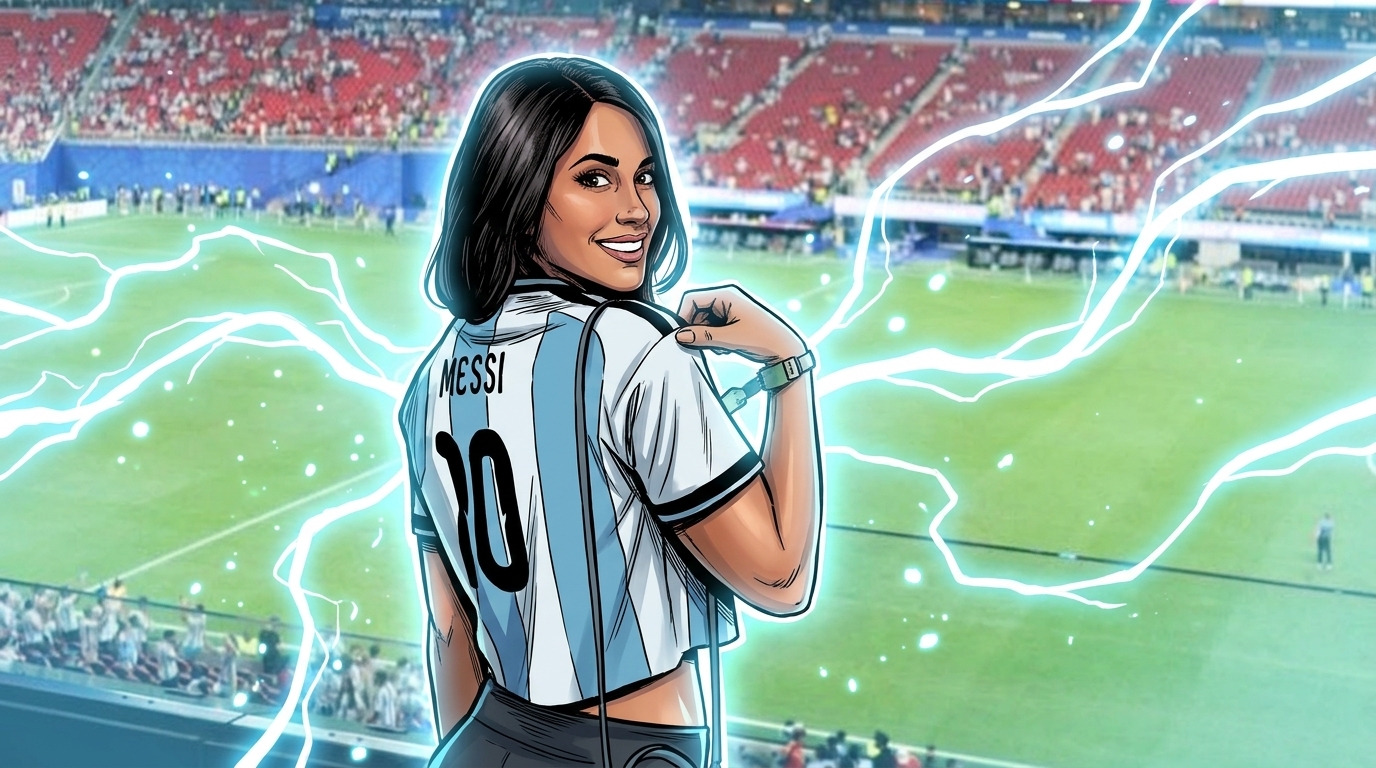
If Argentina advances (and I want to be upfront: I have no idea whether they will), then the final’s co-star is Antonela Roccuzzo. Wife of Lionel Messi. Forty-something million Instagram followers. A pre-tournament bikini post that pulled 2.4 million likes in under twenty-four hours. She has been at every Argentina match with their three sons, all in Messi #10 jerseys, and her captions after wins have developed their own cadence. After Argentina’s Round of 16 victory over Egypt in Atlanta, she posted “Let’s go Argentina. @leomessi no more words left” alongside family photos that felt less like a content play and more like a person whose vocabulary has genuinely maxed out. After Messi’s record-breaking World Cup goal, she wrote “What a privilege to see you make history again and again.” Brand partnerships with Tiffany and Alo. The full package of modern fame adjacency. But the thing I keep coming back to is that she generates more search traffic than most of the players on the squad. The media didn’t decide that. The audience did.
https://www.instagram.com/p/DagROAlGI4m/
If England advances, the storyline fractures into something more ensemble. Kate Kane has been in the stands for every Harry Kane match this tournament, reliably photographed in customized Kane kit. Ashlyn Castro, Jude Bellingham’s influencer girlfriend, was caught in a visible moment of PDA with Bellingham after England’s 4-2 win over Croatia, and I’d be lying if I said I didn’t spend four minutes reading the comment section on that particular post. Megan Davison, Jordan Pickford’s wife, and Lauren Fryer, Declan Rice’s partner, round out what would be a proper ensemble cast in the MetLife stands. The England WAG story has always been more distributed than singular, which either makes it harder to track or more interesting to watch depending on your media consumption habits.
The Spain side has its own emerging figures. Inés García, girlfriend of Lamine Yamal, is 21, a fashion and lifestyle influencer from Seville who made the relationship public in May 2026. Alejandra Dorta, Pedri’s girlfriend, came into the public picture in December 2025 and has kept a relatively private Instagram since. Paddy Noarbe, Marcos Llorente’s wife, has been with him since high school (a different kind of story entirely, one that doesn’t generate the same algorithmic heat but probably matters more to the people inside it).
And then there’s Georgina Rodriguez. Fiancée of Cristiano Ronaldo, 73 million Instagram followers, Netflix documentary subject. Portugal was eliminated by Spain in the Round of 16, which means Georgina won’t be at MetLife. But her reaction to the exit — a reposted Nike Football tribute with a red heart, a declaration that Ronaldo “will remain the king of the game and the best in history” — became its own content moment. She generated real online traffic from an absence. That’s a particular kind of cultural gravity.
https://www.instagram.com/reel/DaUcwUQCKma/
The strongest counterargument here is that none of this has anything to do with football, and we should probably be covering the actual tactical battle at MetLife instead of the women watching it. That argument has some merit. But I’m not sure it accounts for how meaning actually gets made around a tournament like this. People don’t just watch the World Cup. They watch everything the World Cup contains: the grief of the exit post, the superstition of the matching jerseys, the impossible task of captioning a partner’s record-breaking World Cup goal. The audience has decided that’s part of the story. Sunday’s final will be on the pitch. But a significant portion of what people will actually remember about it will happen in the stands.