
We’ve been watching this build for four years: the bids, the expansion debates, the roster cycles, the qualifying drama across six confederations. It arrives tomorrow. The 2026 FIFA World Cup opens Thursday at Estadio Azteca in Mexico City, with Mexico facing South Africa at 3:00 PM EDT. Shakira and Burna Boy perform the opening ceremony. Forty-eight teams. A hundred and four matches. Sixteen host cities spread across three countries. The United States plays Friday night at SoFi Stadium.
You need a guide. Here is one.
The Azteca Opens the Tournament and the Weight of That Is Real
There is no stadium on earth that carries more World Cup history than Estadio Azteca, and Mexico opening the tournament there is not incidental. The venue hosted two full World Cups: 1970, when Pelé’s Brazil won the Jules Rimet Trophy on that pitch, and 1986, when Diego Maradona scored both the Hand of God goal and the Goal of the Century against England in the quarterfinals, then lifted the trophy in the final. It is the only stadium to have hosted the World Cup final twice — the only ground in history where two separate tournaments ended with a champion being crowned on that pitch. Opening the 2026 tournament there was the right call by FIFA, even if FIFA doesn’t always make those.
The Mexico-South Africa matchup in Group A (which also includes Czechia and South Korea) carries a secondary layer that most broadcast teams will spend the first thirty minutes explaining: these two sides played the 2010 World Cup opener at Soccer City in Johannesburg, finishing 1-1. Siphiwe Tshabalala scored what became one of the defining goals of that tournament. Per ESPN’s preview, that match began a World Cup that South Africa hosted on the continent of Africa for the first time. Sixteen years later, Mexico opens on home ground. The symmetry is one of those things the sport generates without trying.
Mexico arrives here in form that is difficult to dismiss. Javier Aguirre (on his third tour as the national team’s manager, which says something about the cycles of Mexican soccer) has his side undefeated across eight matches since November 2025. The goalkeeper is Guillermo Ochoa, who turns 40 during the tournament and has been making World Cup saves since 2006. The youngest player is Gilberto Mora, who is 17 and could become the sixth-youngest player in World Cup match history if Aguirre gives him minutes.
South Africa comes in quieter. Hugo Broos manages a possession-oriented side that qualified narrowly, edging Nigeria and Benin in the African qualifying process, and managed just three goals across their last four matches. They are not here to go quietly, but they are probably here to survive long enough to figure out how.
The broadcast window is Fox Sports (US), 3:00 PM EDT Thursday. The opening ceremony with Shakira and Burna Boy precedes the match. If you have any reason to watch soccer, or to watch large spectacle, you should have the television on.
What Makes This USMNT Different From Every Squad Before It
There is a version of American soccer fandom that has been burned enough times to resist the framing of “this time is different.” That version is reasonable. It is also, at this particular moment, not fully accounting for what has actually changed about the player pool.
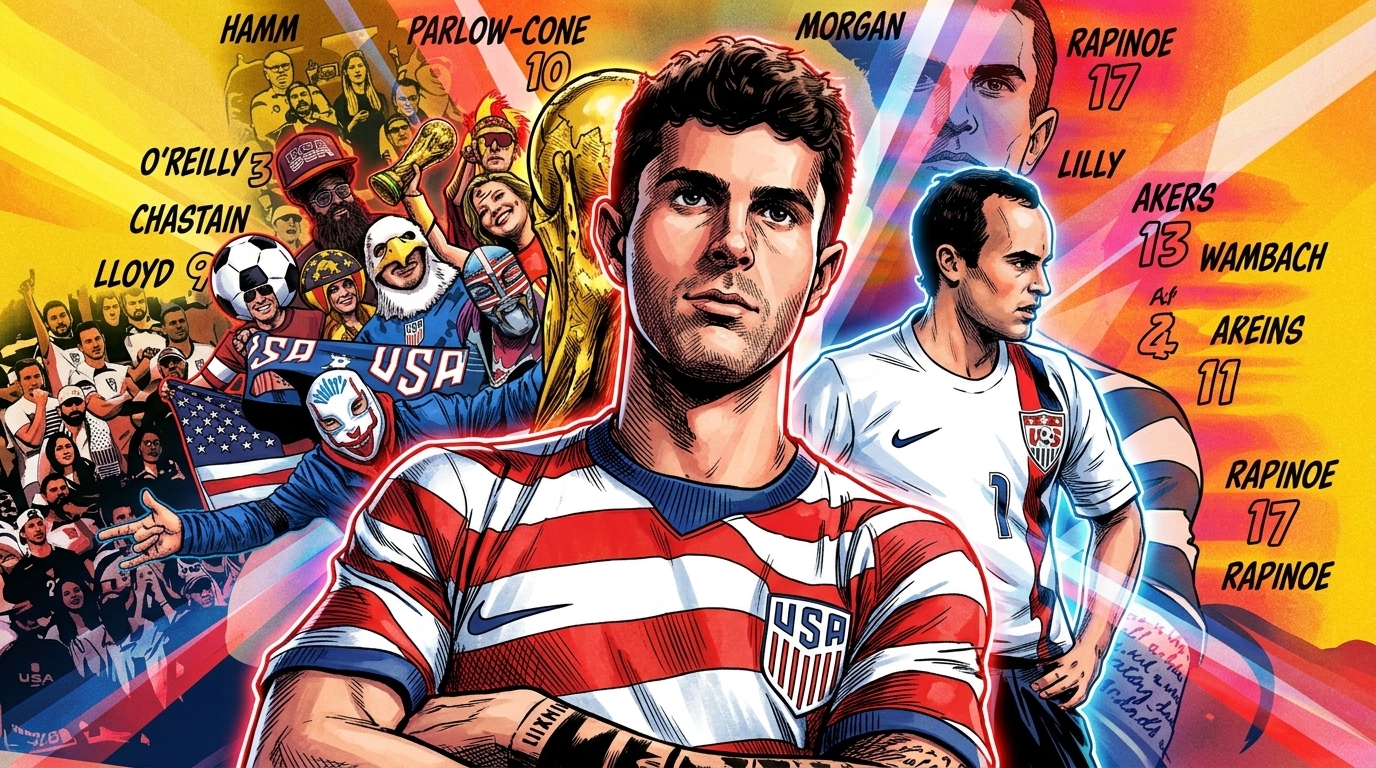
The USMNT that plays Paraguay on Friday night at SoFi Stadium (9:00 PM ET / 6:00 PM PT) is built almost entirely from players who compete at the highest levels of European football. Christian Pulisic plays for AC Milan in Serie A. Folarin Balogun is an attacker with European club experience and a dual-national profile that gives Pochettino genuine options up front. Weston McKennie, Tyler Adams, Giovanni Reyna: the midfield spine is drawn from leagues that don’t give roster spots to players on reputation alone. This is not the squad that lost to Trinidad and Tobago in 2017 and missed a World Cup. The infrastructure is different.
Mauricio Pochettino, the Argentine manager with Premier League history at Tottenham and Chelsea now on his first World Cup assignment, has built something through Pochettino’s roster choices that reflects a genuine tactical identity rather than the improvisational pragmatism that defined earlier American squads. Whether that identity holds against tournament-level pressure is a different question.
The warmup record is not flattering. The USMNT lost three of four friendlies leading into the tournament, including defeats to Germany, Portugal, and Belgium, before defeating Senegal 3-2. You can interpret that result set as alarming or as a function of playing elite opposition in the final preparation window. Pochettino’s teams have historically needed time to settle into tournament rhythms. This is his first opportunity to demonstrate that pattern at the international level.
Paraguay provides the first test. Gustavo Alfaro, hired in 2024, oversaw a qualifying run that produced just one loss across twelve matches and included seven clean sheets. The one significant uncertainty heading into Friday: Julio Enciso, Paraguay’s creative midfielder and primary playmaker, is doubtful after a muscle injury sustained against Nicaragua. If Enciso is out, Paraguay becomes considerably more predictable in the final third.
https://twitter.com/USMNT/status/2029195295376974034
Pulisic’s goal drought heading into the tournament is the subplot the broadcast will return to repeatedly, and not without reason. He is the player the tournament needs to carry the American narrative. The bracket is built in a way that gives the USMNT a realistic path. Whether Pulisic finds the net early matters more than it should for a team with this much midfield depth.
What Does the 48-Team Format Actually Mean for Upsets?
The expansion from 32 to 48 teams means more unfamiliar qualifying nations enter the group stage, more matches are played between sides with large competitive gaps, and the probability of at least one significant group-stage upset per day is materially higher than in any prior tournament. Sixteen additional teams from less-dominant confederations means the bracket’s middle tier is deeper and more volatile than it has ever been.
The 48-team question has been live since FIFA announced the expansion. The argument against it was always about dilution: more teams means more mismatches, more empty passages of play, less tension in the group stage. The counterargument, which the first week of group play will test: more teams means more genuine contenders from Africa, Asia, and CONCACAF who have developed meaningfully since 2014 and who are no longer simply making up numbers in the bracket.
The format change that matters most to the tournament’s daily rhythm: the 48-team expansion uses 12 groups of four teams each, with the top two from every group advancing automatically and the eight best third-place finishers claiming the remaining spots in a new Round of 32. That third-place threshold creates a pressure that the old format didn’t sustain past the first matchday. Every team that drops its opener is immediately facing an existential calculation about what it needs from the next two matches. Teams cannot absorb a passive opening performance the way 32-team group stages allowed. The tactical conservatism that produced extended stretches of careful play in earlier tournaments has less buffer here — survival is more visibly at stake from match one.
The 104-match schedule across 16 host cities, spread across the United States, Canada, and Mexico, also means there will be moments of logistical friction that a 32-team, concentrated tournament didn’t generate. That is the known cost. The return, if the first round delivers what the format promises, is a tournament with more meaningful matches and fewer days where the schedule is going through the motions.
What to Watch For in the First Four Days
The Azteca opener is the anchor: a historic venue, a loaded ceremonial context, two sides with real 2010 history, and the Mexico crowd, which will be unlike anything most viewers have experienced watching a World Cup match on television. The Azteca at full capacity for a Mexico group-stage opener is a particular kind of atmosphere, and Thursday afternoon is going to produce it.
From there, the first four days function as a calibration exercise. How does the expanded bracket actually feel to watch? Which of the teams from smaller confederations look competitive and which look overmatched? Does Pochettino’s USMNT arrive at SoFi Friday night with the settled intent that pre-tournament losses to Portugal and Belgium couldn’t confirm? Does Pulisic, in front of a home crowd in Los Angeles, find the form that makes the American bracket path feel real rather than theoretical?
The answers begin Thursday at 3:00 PM EDT. Everything we’ve been tracking across the qualifying cycle: the roster construction, the coaching appointments, the expansion debates, all of it becomes evidence starting tomorrow. Watch the Azteca opener. Find a bar for the USMNT match Friday night. And keep an eye on Group A; Czechia and South Korea in the same group as Mexico and South Africa means no automatic byes into the round of sixteen.
The next four years of conversation about American soccer starts Friday in Los Angeles. That is worth planning around.