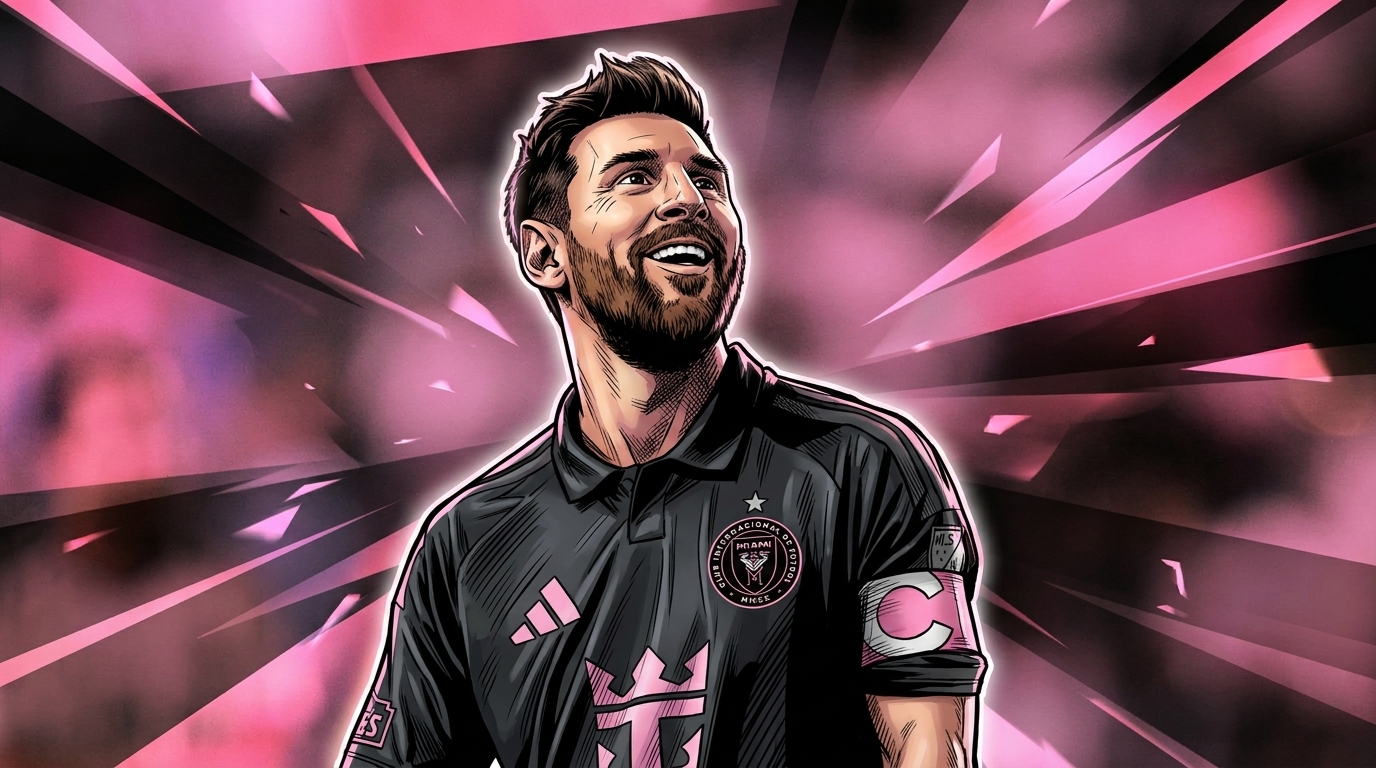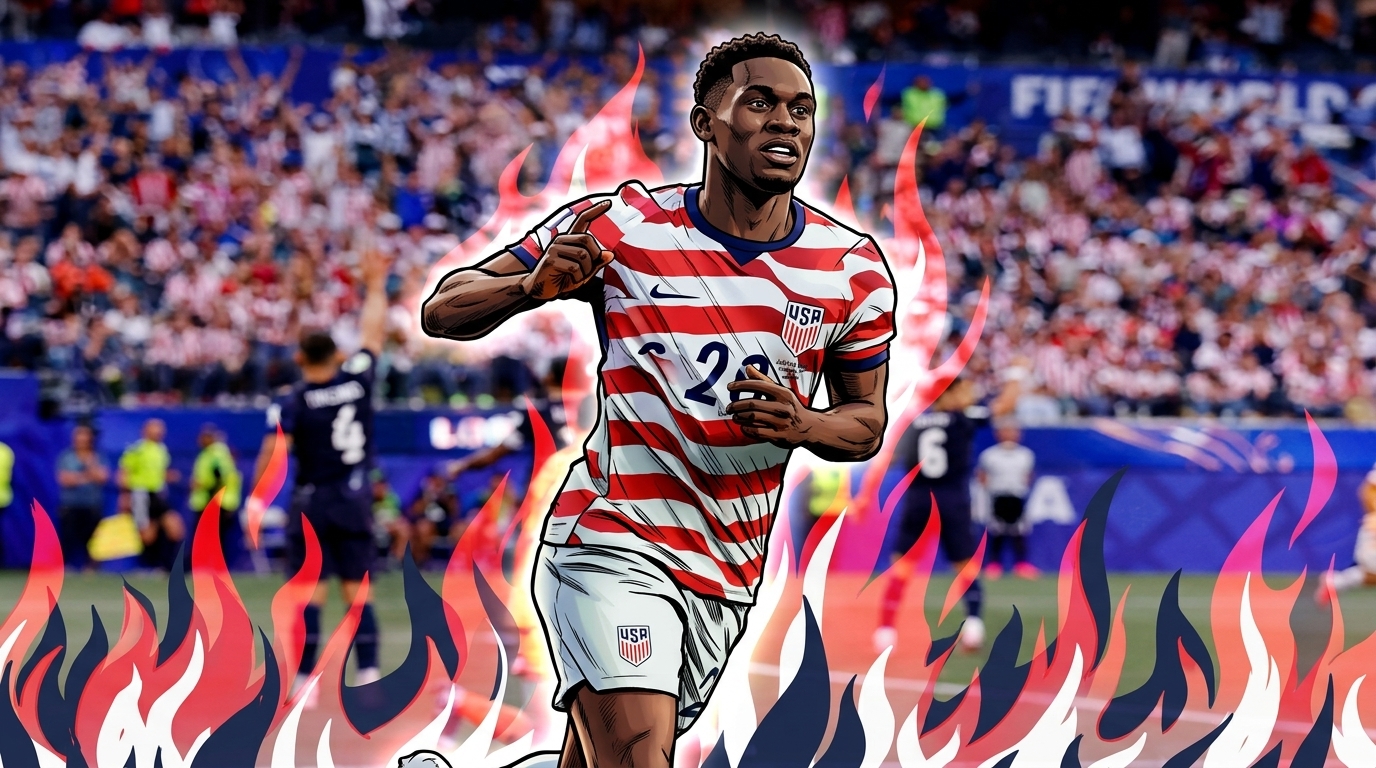

We’ve been waiting for this guy for a long time. Not Balogun specifically — most American soccer fans had only a vague sense of him until about 18 months ago — but for what he represents: a center forward who actually scores in big moments, who doesn’t disappear when the lights get bright, who makes the USMNT look like a team with a real striker rather than a collection of midfielders playing musical chairs up front. On June 12, 2026, at Los Angeles Stadium in a 4-1 demolition of Paraguay, Folarin Balogun became that player for real.
Two goals. Five shots, three on target. A WhoScored match rating of 8.42. Player of the Match in a World Cup opener on home soil. England’s Under-21 alumni watch him in a USMNT jersey, and somewhere in FA headquarters, someone is staring very hard at a spreadsheet they can no longer change.
Why Did Folarin Balogun Choose the USMNT Over England?
Balogun was born in Brooklyn in July 2001 and moved to London at two months old. He spent 20 years in England — joined Arsenal’s academy at age 8, earned 28 caps for England youth sides through the Under-21 level — yet held FIFA-eligible nationality in three countries: USA by birthplace, England by residency, Nigeria by heritage. In May 2023, FIFA approved his one-time switch to the USMNT.
The explanation he gave was simple, and it held up: family, birthplace, a sense of belonging to the country on his passport. “My decision to represent the United States,” he said when the switch was confirmed, “it came together with my family. We decided it would be the right thing for me, to represent the country I was born in.” That framing matters. This wasn’t a cynical calculation about playing time (England’s senior striker depth is famously difficult to crack) — or at least, that wasn’t the whole story. Balogun grew up in north London and trained at Hale End for over a decade, but Brooklyn is on his birth certificate, and apparently that meant something to him.
England fans may dispute the sentiment. Twenty-eight youth caps is not nothing — that’s years of development, coaching, identity formation in the Three Lions system. And yet the FA never capped him at senior level, which is the only cap that would have locked him in. The window stayed open, and Balogun walked through it.
https://x.com/ESPNInsights/status/2065620353670381832
His club trajectory supports the case he made the right call either way. After Pulisic’s road to this World Cup helped drag this USMNT into a new era of offensive credibility, Balogun arrived as the missing piece up top. He moved from Arsenal to Monaco for €40 million in the summer of 2023 — the same window the USMNT switch was finalized — and has spent the past three years developing in Ligue 1 under the kind of workload that sharpens a finisher. He arrived at the World Cup not as a prospect but as a proven goal-scorer. The Paraguay game was confirmation, not introduction.
What Does Balogun’s Emergence Mean for US Soccer?
It solves the most persistent structural problem the USMNT has carried for a generation. Since the Clint Dempsey and Jozy Altidore era faded, the United States has cycled through forwards who were fine — industrious, clever off the ball, occasionally dangerous — but who couldn’t be counted on to convert the chances a quality midfield creates. Christian Pulisic has shouldered that attacking burden longer than one player should have to, dropping into positions and taking on responsibilities that belong to a striker.
Balogun is built differently. His first goal against Paraguay — a Pulisic assist, finished from 14 yards — showed composure. His second was something more: a Tillman through ball, a first touch to control, a dribble left to create the angle, a left-foot strike curling into the top-left corner in first-half stoppage time. That’s a striker reading the moment and executing under pressure, not a player stumbling into a tap-in. Pulisic, who has been generous in his praise of teammates throughout the tournament, didn’t undersell it: “The kid’s insane. He’s lethal right now. We’re really lucky to have him.” (And then, pointedly: “Everyone will look at the goals, but the way he’s fighting against these center backs.”)
That last part is the detail that separates a finishing stat line from an actual Number 9. Balogun led the line physically, won aerial duels, dragged Paraguay’s center backs around the box to create space for Pulisic and Reyna on the wings. The 4-1 scoreline flatters it slightly — the own goal at the seventh minute gave the US an unusually comfortable cushion — but Balogun’s contribution was genuine in both directions of the pitch.
He said after the match: “I feel like today is a great opportunity, and I just want to continue to show the fans I made the right decision. I’m completely proud, and I want to continue to make the fans proud as well.” That’s not a player talking about one good game. That’s a player establishing an obligation he intends to honor.
The 1930 Record Nobody Expected America to Break
Balogun became the first American to score multiple goals in a World Cup match since 1930 — a 96-year gap spanning the entire modern history of global soccer, from the inaugural FIFA World Cup in Uruguay through every era of American soccer development, decline, and slow rebuild. He broke it in the country’s first home World Cup in his debut appearance.
The magnitude of that gap is worth sitting with for a moment. Nineteen thirty was a different sport in a different world — no European powers participated in that first tournament, it was organized on the fly, the game bore limited resemblance to what we watch today. The US went 3-0 in the group stage and lost to Argentina in the semis, scoring freely against overmatched opponents. Then nearly a century passed without an American replicating it. That’s how rare multi-goal World Cup performances are for this country, and how completely the striker position has been an unsolved problem.
Balogun did it with 5 shots and a WhoScored rating of 8.42 — which is to say, he didn’t do it by accident or volume. Two goals from five attempts is an excellent conversion rate in any context. Two goals from five attempts in a World Cup opening match is the kind of debut that reframes everything that comes after. Gio Reyna’s rocky road back to the squad added the icing in the 90th-plus minute, but the story of June 12 belonged to Balogun before halftime.
https://x.com/WhoScored/status/2065686696872521970
The England dimension makes this sharper, and it’s hard to pretend otherwise. England has spent the better part of a decade searching for a clinical center forward — a player who arrives in the box and reliably finishes, who doesn’t require the team to build an entire system around covering for his deficiencies. They’ve had talented wide forwards, creative midfielders, and squad strikers who do half the job. What they haven’t had is the player Balogun is becoming. He was eligible for them, was in their youth system for years, wore the badge through 28 camp cycles — and now he’s scoring twice in a World Cup match against Paraguay while wearing red-and-white USMNT stripes. The timing is impeccable (and not in a way that feels good if you work at the FA).
Balogun was understated about the night: “A real dream, it’s a dreamy night. I’ve not been able to take it all in.” And then, in the same breath, something that suggested he had thought about this exact moment for a long time: “I visualized my debut in the World Cup scoring, but the reality did surpass that.” Visualization is a technique. Surpassing it is execution.
What Comes Next: The Australia Test
The USMNT faces Australia today — June 19, 3 PM ET at Lumen Field in Seattle — in what shapes up as the decisive game for Group D positioning. A win puts the US in firm control ahead of the June 25 Turkey match and all but guarantees advancement from the group; a loss complicates things significantly. This is the game where Balogun’s performance against Paraguay either becomes a pattern or a data point.
Australia will prepare differently for the USMNT than Paraguay did. The Socceroos have seen the tape. They know Balogun works off Pulisic’s movement, that Tillman’s through-balls are a threat, that the US wants to get the ball into the box early on his left side. The response to a two-goal World Cup debut is not more open space — it’s a tighter defensive structure, earlier pressure, a higher defensive line to cut off the through-ball service.
What changes in those conditions is where we find out what Balogun actually is. Paraguay gave him room to run. Australia, if they set up correctly, won’t. His ability to hold up play against physical center backs, to drift and create his own angles rather than running onto balls in space, to convert from more difficult positions — that’s the test a single dominating performance can’t answer.
What we know from June 12: he’s ready for this stage, he finishes under pressure, and he’s already making history. What we find out on June 19 is whether he can do it when the opposition has studied him. The World Cup has a way of answering those questions faster than you’d like.
The US hasn’t had a striker like this in a very long time — possibly ever, in the modern era. He chose Brooklyn over Islington, a country he’s never really lived in over one that raised him. As origin stories go, it’s genuinely strange. As soccer decisions go, it’s looking very smart. For everyone involved, including England, the watch starts now.