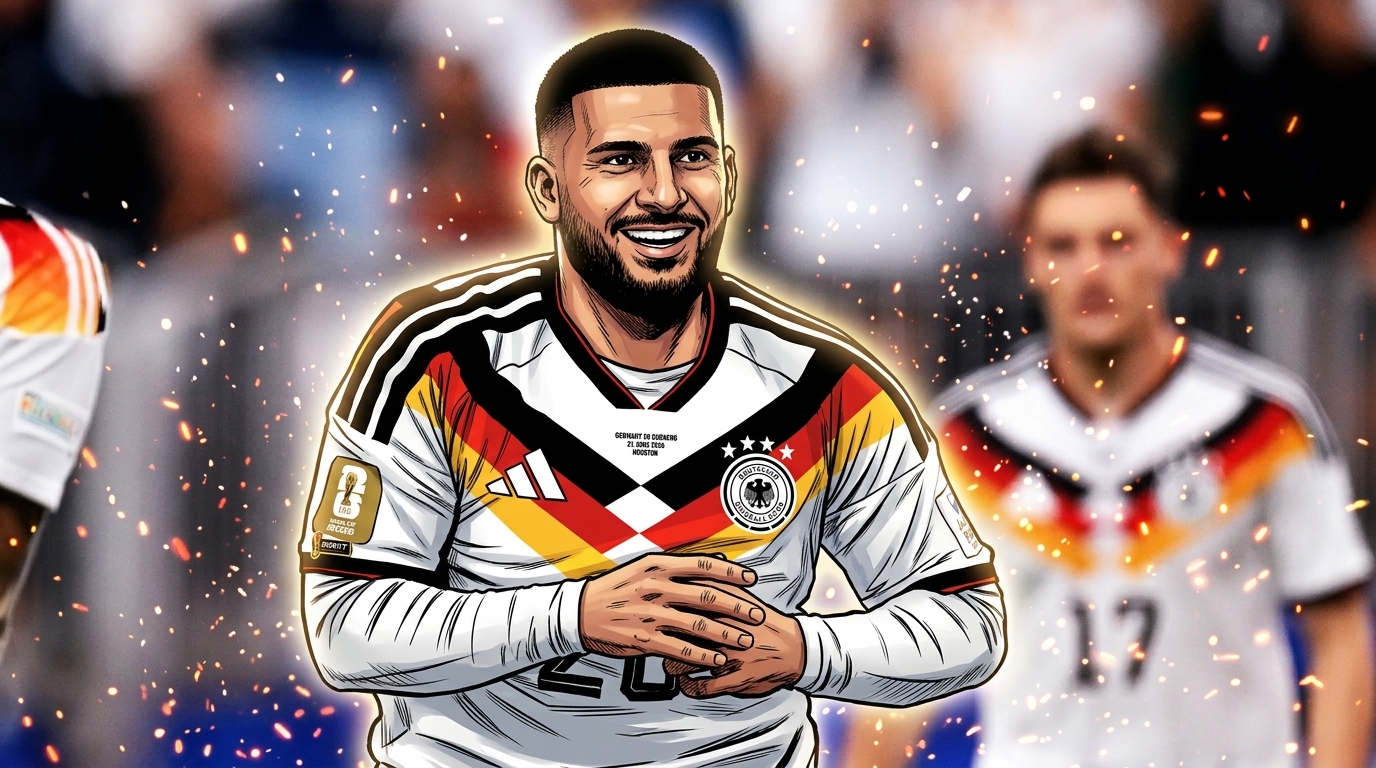

Germany’s 12-year absence from the World Cup knockout stage ended in the 94th minute at BMO Field in Toronto, and the guy who finished it spent his mid-20s working factory shifts while playing regional football nobody watched.
Deniz Undav came off the bench at the hour mark against Ivory Coast, Germany trailing 1-0 to Franck Kessie’s half-hour opener — and proceeded to do something only three players in World Cup history had done before him: score both the equalizer and the winner as a substitute in the same match. The equalizer came at 68 minutes, a volley off a Nadiem Amiri cross. The winner came in the 90th plus four, composed and cold-blooded in the 94th minute. Germany 2-1.
That’s the match. Here’s the actual story.
Germany won the World Cup in 2014. Since then they have been eliminated in the group stage — twice. In 2018, a loss to South Korea sent them home to national humiliation. In 2022, they beat Costa Rica 4-2 in their final group game, finished third anyway, and flew home again. Twelve years without reaching the knockout round. For a program that defined itself by tournament survival, grinding results out in semifinals and finals and winning the whole thing, that stretch wasn’t a rough patch. It was an identity crisis with a passport.
Julian Nagelsmann inherited the rebuild. The Germany that showed up against Ivory Coast is not Joachim Löw’s Germany, the team that clung to 2014’s tactical framework until it calcified. This is a squad with genuine depth, a system that doesn’t require any single player to carry it, and a bench capable of deciding games in the final five minutes of regulation.
That last point is not a coincidence. It’s the whole argument.
Undav didn’t get his first senior Germany call-up until age 27 — no youth international caps, cut by Werder Bremen’s academy as a teenager. That’s not a feel-good footnote. It’s the evidence that Nagelsmann is building something different. A team deep enough that the guy who wasn’t supposed to be here scores twice as a substitute, then tells the camera “it’s important that everyone sees that even the players from the bench can decide games.” That’s not an accident of lineup construction. That’s a philosophy producing results.
I’ll admit I went into this match expecting Germany to win comfortably and make it feel inevitable, the way dominant sides sometimes do. They didn’t. They were outplayed in the first half, went to halftime down a goal, and needed a triple substitution at the hour mark to shift the game. The Deniz Undav World Cup winner didn’t feel inevitable at all. It felt like a team that had a solution for every problem finding the right one at the right time. That’s a different kind of dominance, and honestly, a more interesting one.
https://twitter.com/itvfootball/status/2068454045405118676
The Bundesliga numbers back the trust Nagelsmann placed in him. Nineteen goals for VfB Stuttgart in 2025-26, second in the Bundesliga only to Harry Kane. Nine senior Germany caps before Toronto. A career built entirely outside the traditional pathway, in Belgian football and regional leagues and factory shifts. And now this.
Germany’s World Cup 2026 Group E campaign has six points from two matches, following the 7-1 demolition of Curaçao in their opener on June 14. The knockout stage isn’t just possible. It’s almost certain. But more than the math, the manner matters: this is what a finished rebuild looks like, and Deniz Undav just handed the rest of the tournament the proof. For broader World Cup coverage, and for context on how chaos defines this tournament, see Saudi Arabia’s 1-0 shock of Spain.
Germany is back. The factory worker did it.