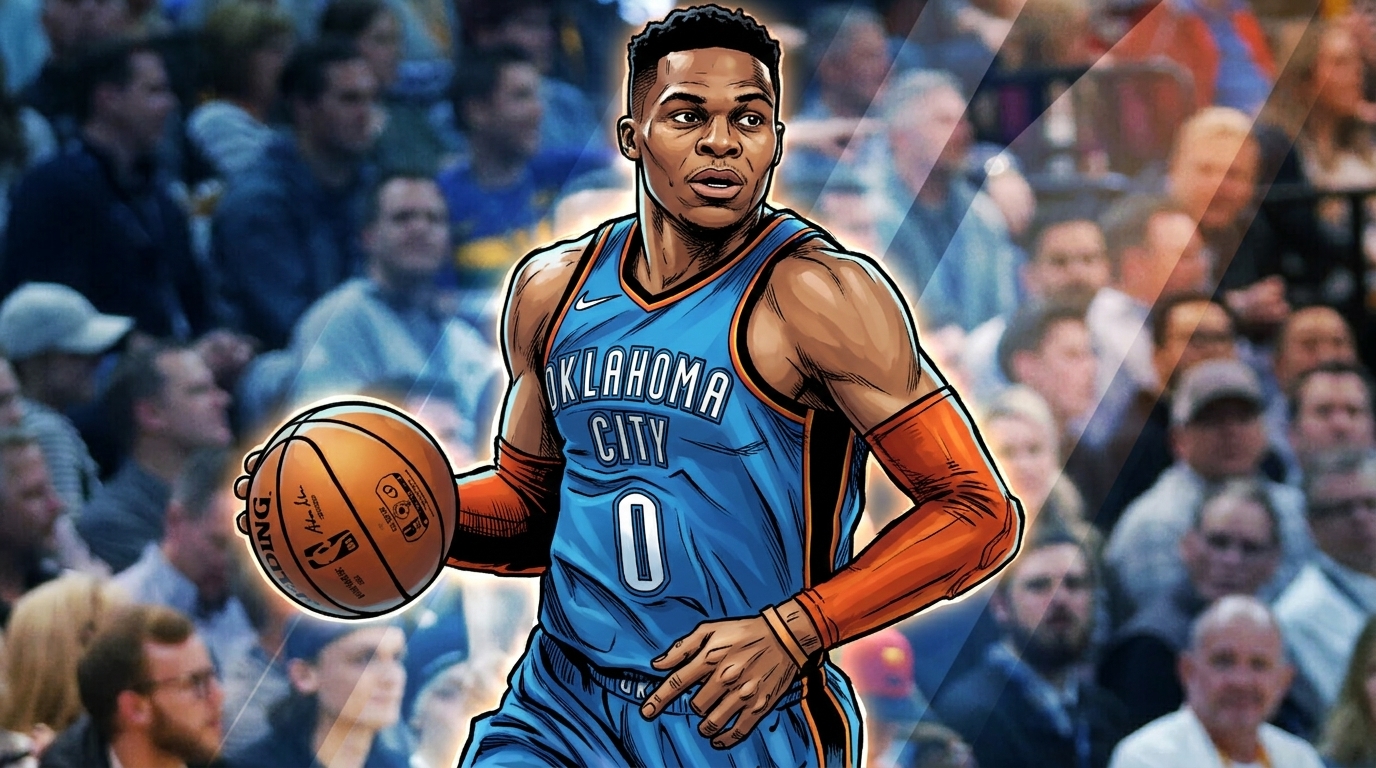

Hand the same career totals to Russell Westbrook’s biggest believer and his harshest critic, and ask each to build a case. They will use identical numbers. They will land on opposite verdicts. That tension is the actual story of Westbrook’s retirement, announced Aug. 12 after 18 NBA seasons, on his own terms, in a video narrated by Michael B. Jordan.
The record everyone is talking about — 209 career triple-doubles, the most in league history — is exactly the kind of number that should end an argument. It hasn’t. And the reason it hasn’t tells you more about how to evaluate a career than the triple-doubles themselves ever could.
What Do Russell Westbrook’s Defining Stats Actually Prove?
Run the counting stats together and a pattern shows up fast. The 209 triple-doubles are the regular-season record. He made nine All-Star teams and nine All-NBA teams. He won two scoring titles. He finishes fifth all time in assists with 10,351, and 14th all time in scoring with 27,176 points. Add the 2017 NBA MVP award, earned the same year he became the first player since Oscar Robertson’s 1961-62 season to average a triple-double across a full year, a feat Westbrook then repeated three more times.
He spent 11 of those 18 seasons with the Oklahoma City Thunder, the team that drafted him, before closing his career across six more franchises: Houston, Washington, the Lakers, the Clippers, Denver, and finally the Sacramento Kings. The style never changed. Only the jersey did.
Every one of those numbers is a monument to volume. None of them is really about touch, or shot selection, or restraint. Westbrook’s whole statistical identity is a guy who took the same aggressive, ball-dominant approach into year one and year eighteen and refused to bend it, whether the results that season were an MVP trophy or a minimum contract offer. That stubbornness is the actual engine behind the record. It’s also the first thing his critics reach for.
The Efficiency Case Against the Compiler Label
The counterargument doesn’t dispute the totals. It disputes what they cost. During one Lakers season, Westbrook posted a true shooting percentage of 51.2% while carrying a usage rate above 30% — a combination so inefficient that The Ringer’s Kevin O’Connor found only two real comparisons in Basketball-Reference’s database at that usage/efficiency tier: Michael Jordan’s farewell season in Washington and Kobe Bryant’s last tour in Los Angeles. That’s the company you keep when you shoot as much as ever with far less to show for it. Westbrook ranked 181st league-wide in true shooting that year, not far off shooting like an average bench guard, except he was doing it on nearly a third of his team’s possessions.
That’s the case against the record as proof of greatness: a player who never adjusted his shot diet even as his shooting stopped supporting it. High usage held constant while efficiency declined is not a neutral fact. It’s the same refusal-to-change instinct that built the triple-double record, just viewed from the losing side of the ledger.
https://twitter.com/BleacherReport/status/2087608779688821171
Reaction to the retirement split along the same fault line. Dejounte Murray called Westbrook the greatest point guard in NBA history, ranking him above Magic Johnson and Steph Curry. LeBron James and other current players also weighed in on the triple-double record specifically, a reaction CBS Sports covered in detail, treating it as the defining line of his legacy. Nobody in that conversation is wrong about the number. They just disagree about what it proves.
Will Nikola Jokic Break Russell Westbrook’s Triple-Double Record?
Jokic tied Westbrook’s combined regular-season-plus-playoff triple-double total at 221 in April 2026, and he’s on pace to pass the regular-season-only record of 209 as soon as the 2026-27 season. That means Westbrook’s signature number, the one he just retired with, could stand alone as the outright record for barely a year before it becomes someone else’s.
That timeline is unusually short. Career records tied to counting stats usually get decades of runway before a credible threat shows up. Jokic tying the combined mark took him a fraction of the seasons it took Westbrook, and he did it as a center running an offense through a completely different mechanism, vision and touch rather than sheer downhill force. The record isn’t just contested. It’s aging out in real time.
https://twitter.com/overtime/status/2087626704403493222
Why 209 Was Never Going to Settle the Debate
This is where the divisive resume gets sharper instead of softer. A player who never won a championship, who ranked 181st league-wide in true shooting during a stretch when he was shooting more than almost anyone else in the league, doesn’t get to point to a counting-stat record and call the argument closed. That much was true before this year. Now add that the record itself has a shelf life measured in months, and Westbrook doesn’t even get to hold it uncontested for a full offseason.
None of that erases what the number represents. Nine All-Star selections and an MVP season don’t happen to compilers. Fifth all time in assists doesn’t happen to a player who can’t see the floor. The same stubbornness that kept his usage rate high through declining efficiency also kept him producing at a rate the league had not seen since Robertson, across four separate seasons instead of one. Westbrook’s final year, 64 games with the Kings averaging 15.8 points and 6.7 assists, came with minimum offers on the table from Sacramento and Washington. He turned them down anyway, at 37, and walked instead of hanging on for a diminished farewell tour. Even that decision reads as the same trait running one more time: all in on his own terms, whether or not the market agreed with him.
He’ll be a Hall of Famer, and one of the more argued-about Hall of Famers the league has produced. That argument was never going to end with a single stat, and Jokic closing in on the record before the ink dries on Westbrook’s career only confirms it. The debate outlives the number. It always was going to.
More from our NBA coverage.