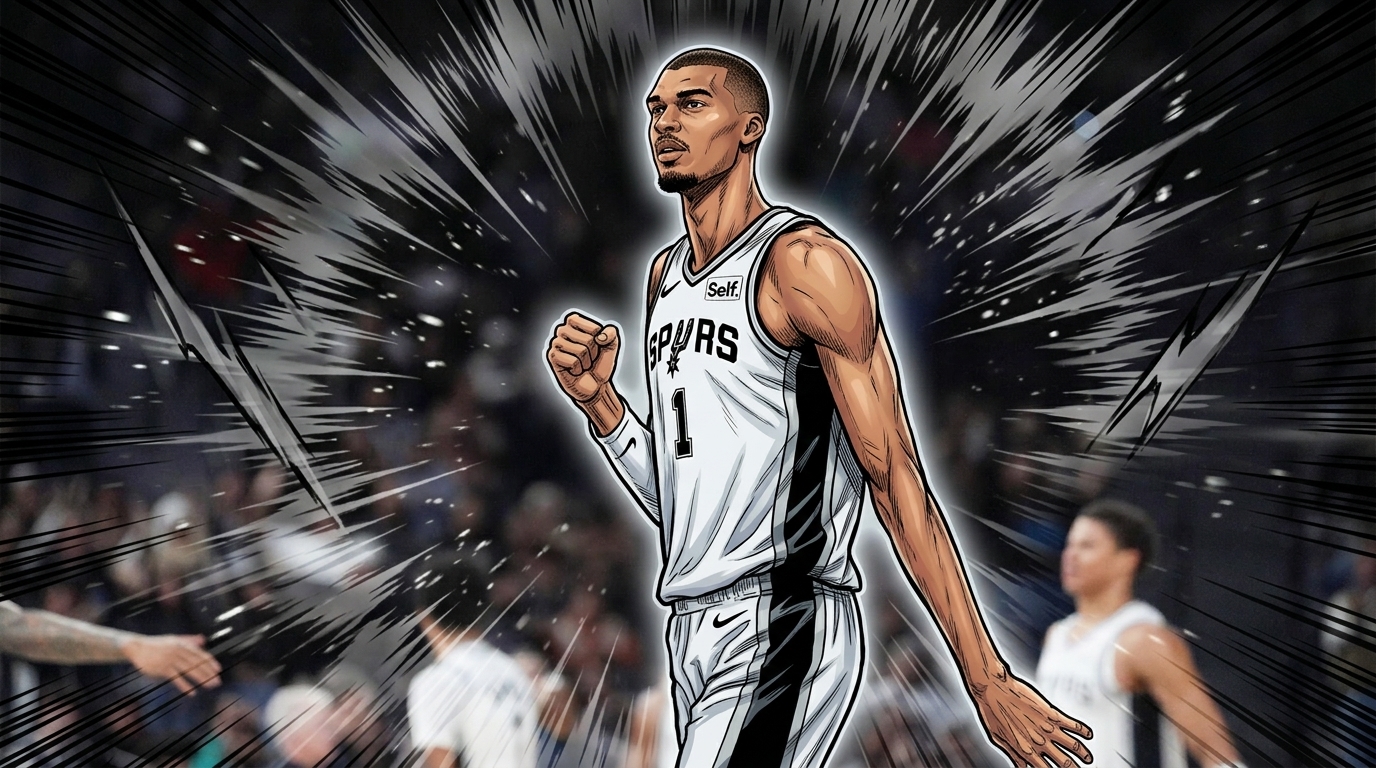

Victor Wembanyama left $51 million on the table and I cannot believe the people who are supposed to be on his side are treating it like a betrayal.
On July 10, Wembanyama signed a five-year, $252 million extension with the San Antonio Spurs. He took the 25% designated player max. The supermax — the 30% escalator — would have landed at approximately $303 million. He chose to leave that gap open so the Spurs could build a real team around him instead of spending every available dollar on his contract. His only public comment was “Spurs family, I’m here to stay. Whatever it takes.” That is the entire statement of a man who has thought this through and doesn’t feel the need to explain himself to anyone who hasn’t.
https://x.com/ShamsCharania/status/2075712917098611093
I want to be clear about what Wembanyama actually did here. He watched what Jalen Brunson did with the Knicks — took roughly $113 million less than his max, which freed up enough cap room for New York to trade for Mikal Bridges and Karl-Anthony Towns, and the Knicks ended up winning the NBA Finals. Wembanyama looked at that blueprint and decided he wanted to replicate it in San Antonio. That’s not naivety. That’s a twenty-two-year-old who understands how the machine works better than most thirty-five-year-old analysts do.
Then the NBPA held a press conference.
New executive director David Kelly, in one of the more impressive feats of institutional self-contradiction I’ve witnessed, said this: “Our position would be that the system should not require a player to carry all that burden. It should not put a player in a position where he has to carry the burden in order to keep a team together. A system that does that, we have a problem.” He also said: “We are not fans of the second apron. We did not propose the second apron. We should have done a better job of fighting back against the second apron.”
I read that, and I genuinely don’t know who Kelly thinks he’s mad at. He correctly identifies the second apron as the villain. He correctly identifies that the system is broken. Then he implies, without quite saying it, that Wembanyama made the wrong call by responding rationally to that broken system. That’s like blaming someone for wearing a seatbelt because cars shouldn’t crash. The problem is the crash, David. Not the seatbelt.
Kendrick Perkins had the more honest version of the counterargument: “I have never given advice to young players to say ‘Hey, leave a dime on the table.’” He also made the point that this sets a precedent for Stephon Castle and Dylan Harper, the younger Spurs on the way to their own extensions. That’s a real concern. If the expectation calcifies — that stars should take less so teams can compete — younger players will feel quiet pressure to follow suit, and the ones with less leverage than Wembanyama won’t be able to say no as cleanly. That’s worth taking seriously.
That argument almost lands. Then you look at Donovan Mitchell. Mitchell signed a four-year, $273 million extension with Cleveland this summer — the highest average annual salary in NBA history. He also left money on the table relative to a potential five-year supermax. The reaction to Mitchell’s deal? Celebration. Coverage about his legacy, his commitment to the Cavaliers, his market value. Nobody called it a bad precedent. Nobody went on television and said Mitchell was setting a dangerous example for younger players. The asymmetry is the whole story.
Shannon Sharpe, who people keep misreading as criticizing Wemby, actually aimed his shot directly where it belongs: at the owners. “I guarantee them tickets still ain’t going to get no cheaper. Even though Wemby took a $50 million hit.” And: “NBC, Amazon, ESPN, tell me which ones of them gave a discount? Because these players are taking a discount.” That’s the correct frame. The money Wembanyama didn’t take doesn’t evaporate. It stays inside the franchise. The owners didn’t build a more affordable product. They pocketed the difference.
The second apron rules exist because the league and the owners’ side pushed for hard penalties on high-spending teams during the last CBA negotiation, and the NBPA — by Kelly’s own admission — didn’t fight back hard enough. That failure is now calcified into the rules of the sport. Wembanyama is operating inside those rules. He made a rational, generous, forward-looking decision to try to win a championship instead of maxing out a contract that the broken system would have made nearly impossible to build around. The NBPA’s anger is legitimate. Directing it at Wembanyama is bullshit.
Wembanyama doesn’t owe the union a worse team. He owes himself a ring.
He won’t get one from the NBA’s owners, who will absolutely keep raising ticket prices. But at least he’ll have a roster.