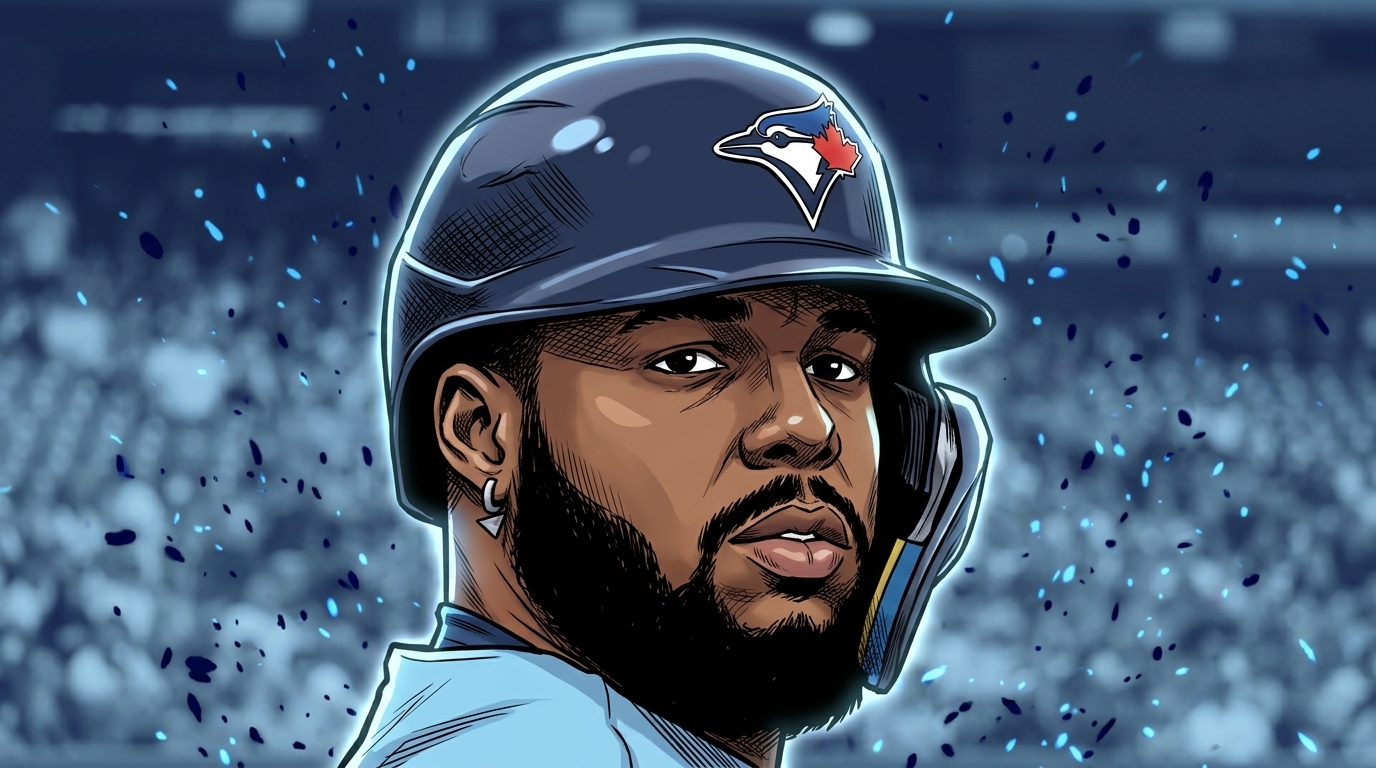

Vladimir Guerrero Jr. signed a $500 million extension to be the untouchable face of the Blue Jays, and his Hall of Fame case is fading in real time while the team he signed up to save sits last in the AL East. The 14-year deal (a $325 million signing bonus, a term running through 2039, second only to Juan Soto’s Mets contract in present value) was Toronto’s proof that a franchise outside the biggest markets could keep its guy for life. This season, Guerrero is hitting in the .260s with an OPS still hovering below .710 and just six home runs: modest numbers for a $500 million cornerstone, and a strange line to attach to a legacy this expensive.
The Blue Jays sit last in the AL East, roughly 12 games behind the division-leading Rays, and Guerrero’s Hall of Fame case is fading the way these things usually fade, through an accumulation of ordinary months that used to be reliably offset by worse ones elsewhere on the roster. June was the low point — a .498 OPS during the exact stretch Toronto fell out of wild-card position, complicated by lower-back tightness that flared on June 19th against the Cubs and lingered for nearly a month. He’s posted a .773 OPS since, a real recovery and also nowhere close to the player who finished second in AL MVP voting in 2021 after leading all of baseball with 48 home runs.
What turns this from a slump into a referendum is that fans still voted Guerrero in as an All-Star Game starter, on reputation and residual goodwill, and he turned it down. “It’s very difficult for me. But I really have to take care of myself and I’ve got to put my team first for the second half,” he said, citing the back. It’s a candid statement, and also the only honest assessment anyone in the organization has offered about the season: an acknowledgment, from the player himself, that the second half is the whole point, and the exhibition game wasn’t worth the risk.
Then came July 21st, the kind of game that ends up in every future version of this story. Guerrero went 0-for-4 with runners on base in all four at-bats, his third hitless game in his last five, in a 7-1 loss to Tampa Bay; a sold-out Rogers Centre crowd booed him after an eighth-inning strikeout swinging, needing someone to blame and finding the $500 million guy standing right there. He hasn’t hit a home run in that building all season. His last one at Rogers Centre came in Game 6 of the 2025 ALCS against Seattle, back when the team still had a pulse in October.
A beat writer was close enough to the box score to do the arithmetic in real time.
https://twitter.com/KeeganMatheson/status/2079377939934708122
That’s the shape of it. A five-year run, 2021 through last October, when Guerrero led all of MLB in postseason OPS (1.289), total bases, RBI, extra-base hits, and runs, is collapsing into a single ugly number that updates after every plate appearance. Manager John Schneider says Guerrero “wants to be the guy” and is frustrated with himself, which is a diplomatic way of saying the team isn’t moving off him, mostly because it can’t; you don’t bench a $500 million extension in year one, you wait for the second half, and if the second half doesn’t come, you wait for next year, and the waiting is the whole plan. I’ve read that Schneider quote a few times now, and it gets sadder on each pass; it’s the only honest thing left for anyone in the building to say.
Toronto built this contract like an actuary building a decline curve, front-loading the good years and assuming the bad ones would arrive on a schedule Guerrero could still hit around. Instead the decline showed up early, right alongside the trade deadline reshuffling every other contender is currently exploiting, and a payroll already past the $245.3 million luxury-tax line Toronto is already over; the easy fixes other rebuilding teams reach for aren’t available here. There’s no trading out of this. The entire architecture of the roster assumes Guerrero is the foundation, not the crack running through it.
A 132 career OPS+, five All-Star selections, two Silver Sluggers, and a Gold Glove don’t evaporate because of one bad summer, and this piece isn’t arguing the case is dead. But “he’s better in the second half” was supposed to be a scouting report, not a standing alibi renewed every July, and at some point a franchise player either turns the season around or the season becomes the evidence against him. Right now it’s the latter, and the crowd at Rogers Centre has already delivered its verdict. Guerrero just has more than a decade left on the deal to argue with it.