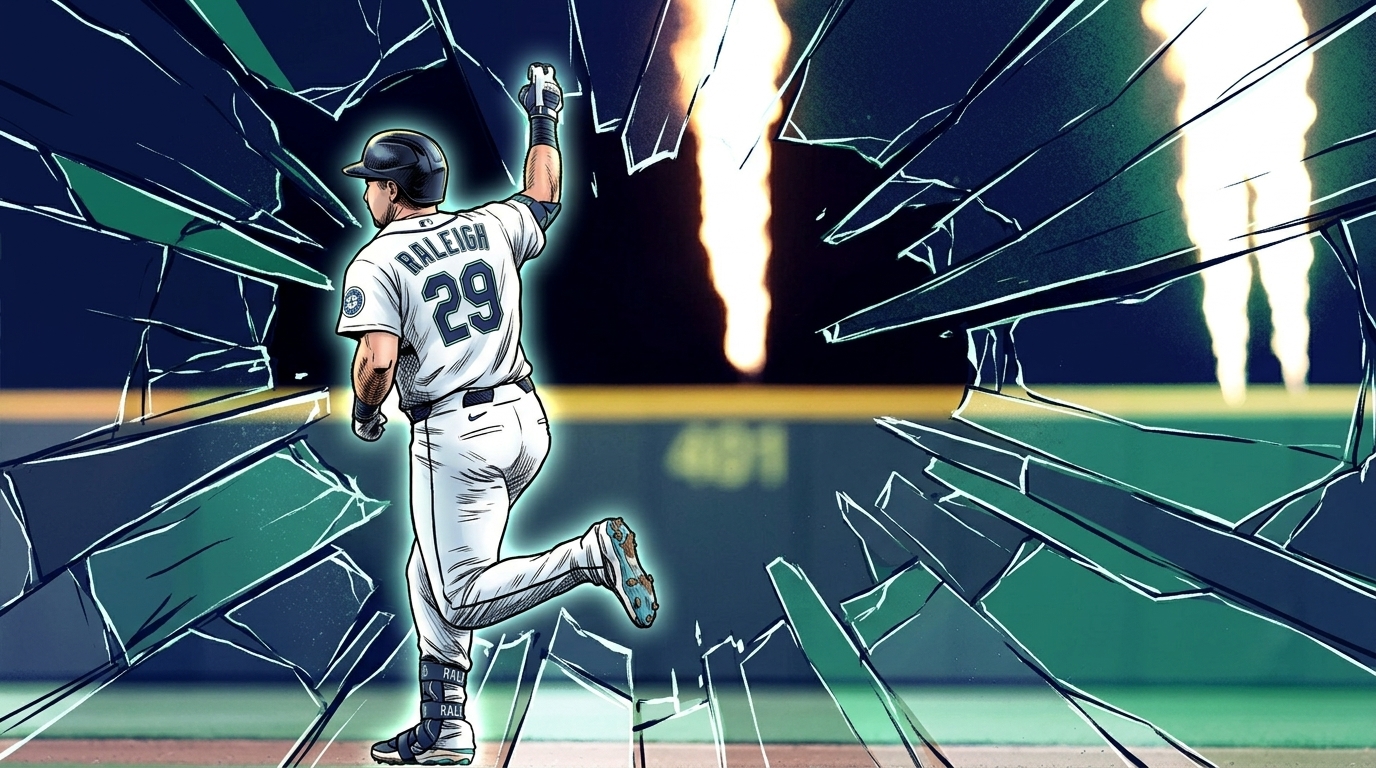

Cal Raleigh hit 60 home runs last season, one of seven players in major league history to reach that number, and broke three separate franchise records doing it; this season he’s hitting somewhere around .158, and the two explanations Seattle keeps offering don’t come close to covering it.
The 60 homers led all of baseball and did more than pad a highlight reel. Raleigh passed Ken Griffey Jr.’s single-season franchise record, Mickey Mantle’s switch-hitter record, and the all-time mark for a catcher, and finished runner-up in AL MVP voting behind Aaron Judge. That’s the kind of season a player is supposed to build a decade on top of.
Instead, the 60-homer season is starting to feel like a fluke, and not the good kind you brag about at reunions. Raleigh’s OPS has fallen from .948 to .579, a drop severe enough that Sports Illustrated devoted a full investigation to explaining it, and his 14 home runs this year sit next to a batting line that would have been unthinkable twelve months ago.
The underlying numbers are worse than the batting average suggests. His hard-hit rate dropped from roughly 50 percent to the mid-30s, his barrel rate fell from 19.5 percent to 12.3, and his exit velocity is down several miles an hour. Those aren’t the fingerprints of a bad month. They’re the fingerprints of a hitter whose swing stopped doing what it did a year ago, and nobody in the organization has said why with any real confidence.
What they’ve offered instead is an alibi, and it’s a partial one. The official version starts with a right oblique strain, first felt in early May, aggravated days later, and formalized on May 14 as the first injured list stint of Raleigh’s six-year career. That’s a real injury, and the kind that legitimately scrambles a hitter’s timing for weeks. Treated as the whole explanation, though, it’s a receipt that only covers part of the bill; the Mariners have been handing it over as if it settles the account, and it doesn’t.
An oblique injury doesn’t explain a .158 batting average by itself. It explains missed time and some rust on the return. It does not explain four-seam slugging cratering from .594 to .189, or a career-worst hitless streak in May that stretched well into the thirties of at-bats. Even SI, in the piece making the injury case, called it “the most obvious dividing line” in his season and then admitted in the same breath that it “doesn’t fully explain everything that followed.”
The other alibi is the World Baseball Classic, which had Raleigh catching for Team USA instead of resting over the winter. Fatigue from that is plausible as a contributing factor. It is a much harder sell as the reason his strikeout rate is sitting at 32.2 percent in August, months removed from the tournament and well past the point his oblique should have stopped mattering.
Raleigh, to his credit, isn’t running from any of it. Days after a five-game losing streak left Seattle four games out of a wild-card spot, he told Yardbarker: “I’m awful. I’ve got to find a way to be better and to help bring the guys along. We’re not playing well. That starts with me.” Nobody in the Mariners’ front office has been that direct about the gap between the explanation and the result.
Seattle is still hanging on despite him, not because of him: 62-68, third in the AL West, with roughly a 32 percent shot at the playoffs that exists mostly because nobody else in the division has pulled away either. More from our MLB coverage if that number keeps climbing, or if it doesn’t.
Mike Petriello ran the numbers this month and landed somewhere the Mariners have been avoiding all season:
https://twitter.com/mike_petriello/status/2087676755360485456
A decline that size, coming off a platform season that size, doesn’t happen to a healthy hitter having a rough year; it happens to a hitter something is actually wrong with. “Oblique strain” is just the version of that sentence the Mariners could put a return date on.
The 60-homer season isn’t gone. It’s sitting on a bobblehead in the T-Mobile Park team store, priced accordingly. The .158 is what’s actually on the field, and nobody in the building has produced a receipt that covers the difference.