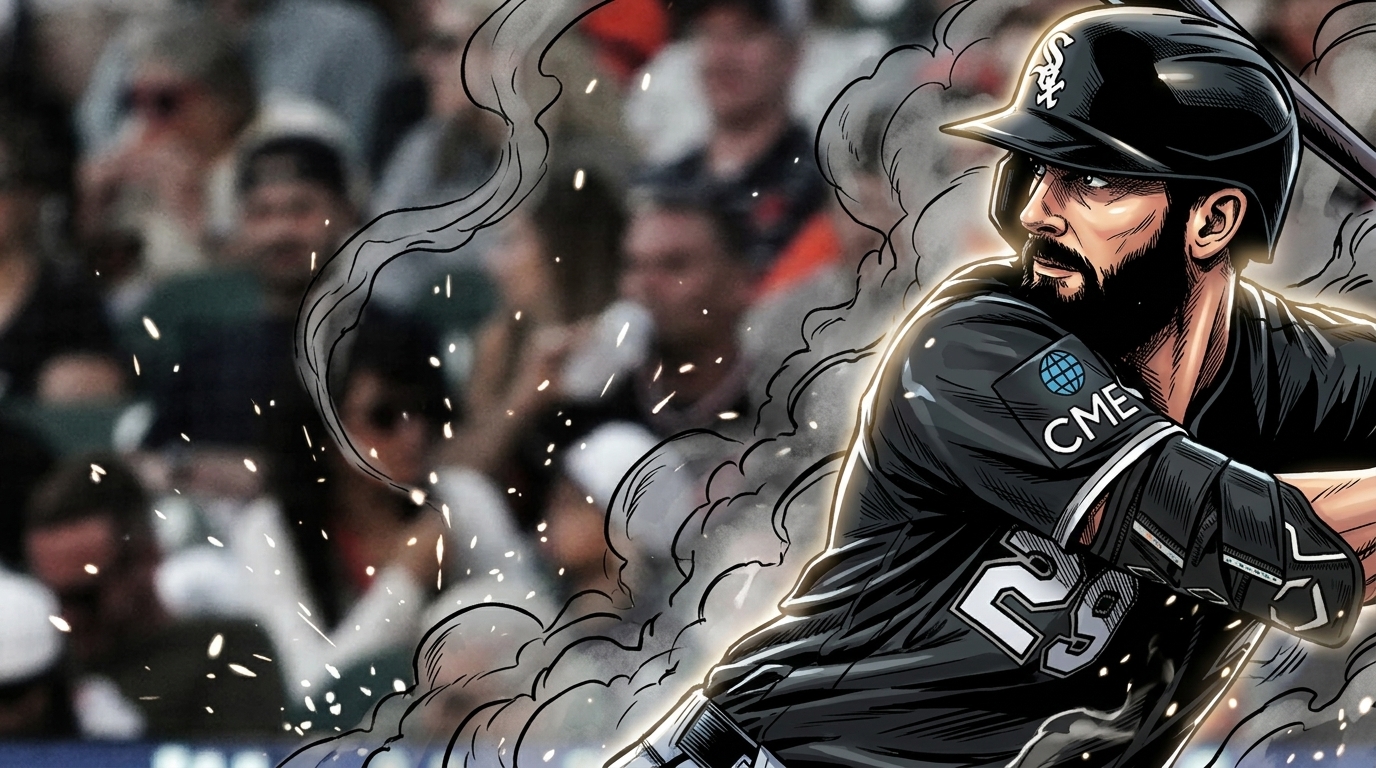

If you’d handed a scout Tristan Peters’ exit-velocity readings from spring training and Munetaka Murakami’s on the same day, they would have picked the same player to run a five-game home run streak first — and it would not have been Peters. Peters has done it anyway, tying a White Sox franchise record on Wednesday night. Murakami beat him to it back in April.
That’s the part worth sitting with. Two rookies, built on completely different offensive blueprints: one a contact hitter riding the best two months of his career, the other a max-effort power bat with some of the scariest exit-velocity readings in the sport, have now matched the same rare feat in the same season, on a team that isn’t scraping for relevance but leading the AL Central. This isn’t a rebuild stumbling into a silver lining. It’s two rookies arriving at the same record from opposite directions, and what that says about how repeatable each guy’s version of it actually is.
How Rare Is a Two-Rookie Home Run Streak?
It’s happened 13 times in major-league history for a rookie to homer in five straight games, and two of those 13 belong to the same 2026 White Sox roster: Murakami in April, Peters this week. No team has produced two separate rookies with a five-game home run streak in the same season since at least 1900.
Peters got there against Texas, turning a fifth-inning pitch from Rangers right-hander Robby Ahlstrom into a two-run shot as part of a 3-for-3, three-RBI night in a 10-4 win, enough to tie the franchise mark for consecutive games with a home run.
https://twitter.com/MLB/status/2092811345443918071
Before this year, Ron Kittle was the only White Sox rookie who’d ever done it, back in 1983. The full list of players who’ve hit the mark now reads Frank Thomas (twice), Paul Konerko, A.J. Pierzynski, Carlos Lee, Greg Luzinski, Kittle, and, for the first time in franchise history, two rookies in the same season: Murakami and Peters.
https://twitter.com/UnderdogMLB/status/2092792024001097952
Peters and Murakami Got Here Completely Differently
Peters’ path to that home run started five years ago, not two, on a junior college field in Arizona. He played at Chandler-Gilbert Community College in 2019, signed with the Savannah Bananas in 2021, and was still wearing that uniform when the Milwaukee Brewers took him in the seventh round of that year’s draft, per WBEZ’s reporting on his path to Chicago. From there it got complicated fast: Milwaukee traded him to San Francisco at the 2022 deadline, San Francisco flipped him to Tampa Bay three months later, and Peters didn’t debut in the majors until August 8, 2025, with the Rays. Tampa Bay designated him for assignment that December. The White Sox picked him up for cash.
Months later, he hit for the cycle: July 10 against Oakland at Rate Field, a double in the third, an RBI single in the fifth, a two-run homer in the seventh, and a triple down the right-field line to finish it in a 14-1 win. It was the first White Sox cycle since Jose Abreu in 2017, the seventh in franchise history, and, because Peters hits ninth, just the fifth cycle ever completed from the bottom of a lineup. Roughly twelve hours later he was in Philadelphia as an All-Star injury replacement for Nick Kurtz, walking the red carpet in a suit with a Savannah Bananas patch sewn into the lining, his wife Erin and infant daughter Elaine beside him.
None of that reads like a power-hitting profile, and the numbers back that up. Peters is hitting .349/.438/.730 in August after posting a .303 average with an .841 OPS and 20 doubles before the break, the profile of a hitter who finds the barrel more than he overwhelms the baseball. He’s also delivered three walk-off plate appearances this season, including one against the Mets, extending this team’s habit of ending games early.
The story of Murakami’s own rookie season reads nothing like it. The NPB import matched the same five-game home run streak in April, reaching 10 home runs in 24 games, the fastest anyone has done that in White Sox history and the fourth-fastest in MLB history. Where Peters is barrel control and feel, Murakami’s underlying numbers during that stretch looked like a physics experiment: a .674 expected slugging percentage, a 96.4 mph average exit velocity, and a barrel rate and hard-hit rate both sitting in the 99th percentile leaguewide, per Statcast figures compiled by CBS Sports.
Is Murakami’s Power Actually Sustainable?
That power comes bundled with swing-and-miss risk that would worry most evaluators. Murakami struck out in 30.8 percent of his plate appearances during that April stretch, worse than roughly 88 percent of the league, and whiffed at a 38.5 percent clip that ranked in just the second percentile. Translated, more than one in three swings came up empty. That’s the trade-off with a max-effort power bat: the same bat speed that produces a 96 mph average exit velocity also produces stretches where the ball never gets there at all.
Murakami offset some of that early by drawing 21 walks, 19 of them unintentional, in just 104 plate appearances, running an OBP north of .400 even while chasing his share of pitches. Whether that discipline survives as pitchers adjust to him is the open question. The raw power isn’t going anywhere — but the floor underneath it, the part that keeps a hitter productive when the barrel isn’t finding everything, is thinner than what Peters has shown.
What Two Rookie Streaks Say About a First-Place Team
Not every young hitter in this lineup is riding a heater. Colson Montgomery, working through a rough week of his own, admitted he’s “been having really bad decisions at the plate,” a line from the Sun-Times’ account of Wednesday’s win, a reminder that rookie production doesn’t move in lockstep, even on the same roster. But two players sharing an unprecedented streak, on a team that’s 67-61 and atop the division race Chicago is now leading with roughly a month to go, isn’t incidental to the standings. The White Sox have spent more than 70 days in first place this season, and if they hold on, it’s their first division title and playoff appearance since 2021, built in part on two rookies who look nothing alike doing the same rare thing in the same year.
Trust Peters’ version of it more the rest of the way. A .730 slugging percentage in August isn’t going to repeat itself in September, and nobody should pretend it will, but the swing producing it, built on contact and barrel control rather than maximum bat speed, doesn’t need a hot streak to stay useful. Murakami’s ceiling is higher when he connects; his floor, given a whiff rate in the second percentile, is the shakier bet down the stretch. Put both rookies on a division leader’s roster in the middle of a pennant race, and the White Sox aren’t just getting lucky twice — they’re getting two different paths to the same value, at the same time, from two players who reached the majors almost nothing alike.