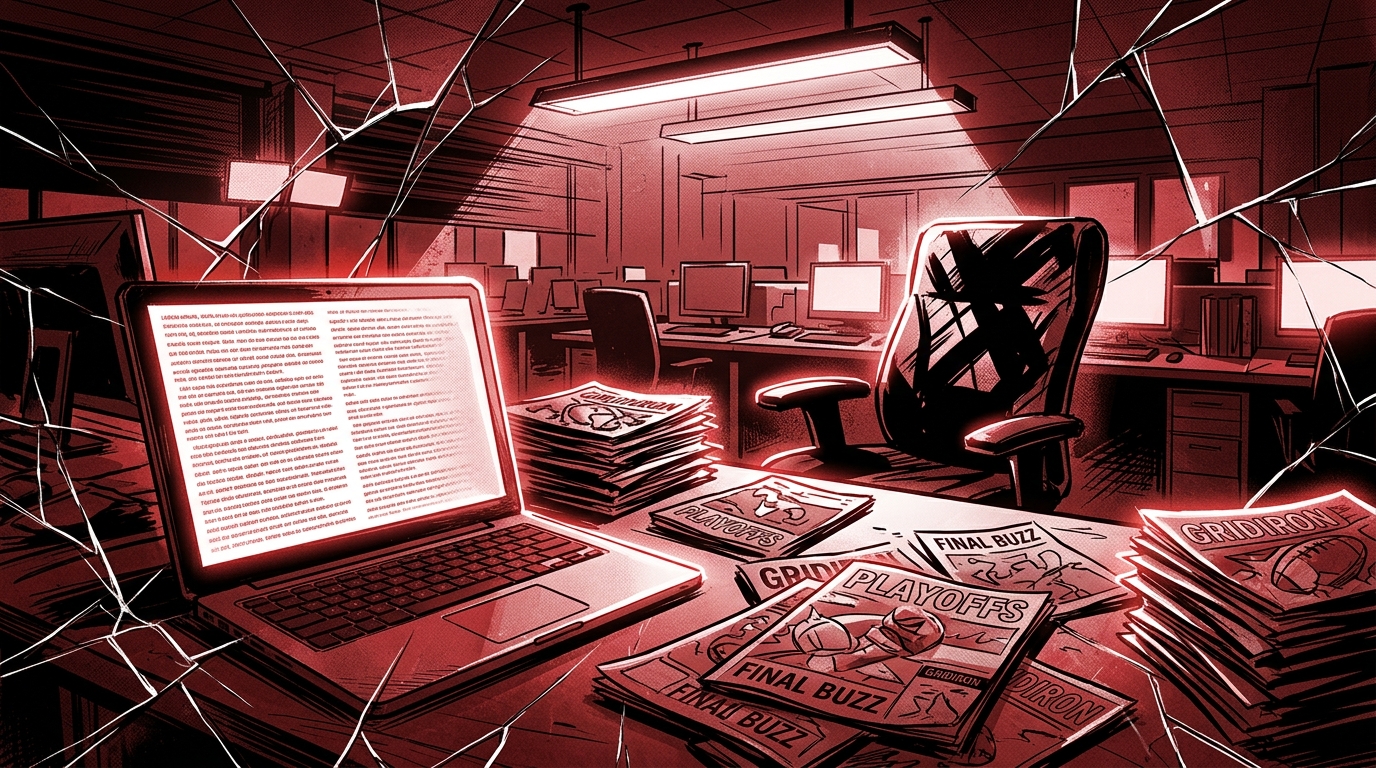

There is a particular kind of building in every American downtown that has been condemned but not yet demolished. The windows are boarded. The roof leaks. A faded sign still advertises the business that closed years ago. Occasionally someone breaks in and strips the copper wiring; occasionally someone spray-paints something rude on the plywood. The city has not gotten around to tearing it down because tearing things down costs money, and the building is not hurting anyone. It is just there, rotting with a kind of municipal permission, and every few months a local news crew shows up to film the newest hole in the wall. This is Sports Illustrated now. The hole is new; the rot is not.
On May 13, Sportico’s Dan Bernstein and Lev Akabas published original reporting revealing that users of the prediction market Kalshi had lost more than $100 million on retail parlay bets in 2026. Two days later, a writer named Parker Loverich published a piece on Sports Illustrated’s prediction market vertical titled “Who is really winning on Kalshi parlays according to the data”; it contained the same figures, the same analysis, and the same conclusions as the Sportico article. It did not credit Sportico. It did, however, reproduce Bernstein’s request for comment to Kalshi — a detail so specific to his reporting that it essentially amounted to a confession typed up in the third person.
Bernstein noticed:
The husk of the Sports Illustrated brand is stealing entire stories from people without credit, seemingly using AI. This becomes very obvious when it’s stealing data only you’ve reported! Even copied my request for comment.
SI deleted the article within 90 minutes. Then it deleted Loverich’s author profile. Then Loverich’s X account disappeared. Then his LinkedIn vanished. Then SI’s entire prediction market vertical, which had not published anything since May 4, was gutted from the site. The speed of the demolition was impressive; it suggested that everyone involved understood exactly what had happened and how indefensible it was. The condemned building lost another wall, and the response was to pretend the wall had never existed.
Editor-in-Chief Steve Cannella offered the institutional defense, which was itself a masterpiece of structural engineering. Loverich, he explained, worked for an “On SI” affiliate site — one of approximately 200 independent satellite operations that publish under the SI.com domain on a revenue-share basis. The prediction market vertical was “managed by an independent publisher who is expected to abide by Sports Illustrated’s editorial guidelines.” SI has a “zero tolerance policy” for violations. Stories must be “created by humans, not AI.”
This is the defense: the name on the building is ours; the people inside it are not. The sign says Sports Illustrated, but if you read the fine print (and who among us reads the fine print on a sports blog) you would know that you are actually reading content from an anonymous third-party publisher who rents the brand like a storage unit. Cannella called the “On SI” branding “one significant marker” helping readers distinguish affiliate content from legacy SI material. If you have ever successfully distinguished an “On SI” article from a real SI article while reading on your phone, you are a more attentive consumer than anyone I have ever met.
The truly astonishing part is that this is the second time. In 2023, under previous ownership by The Arena Group, SI published articles by entirely fabricated authors — AI-generated writers with AI-generated headshots and AI-generated biographical details. That scandal led to the CEO’s firing and helped accelerate the company’s collapse. Minute Media picked up the brand; the promise, implicit or otherwise, was that the adults were now in charge. Less than three years later, the adults have produced a scandal that is functionally identical, except this time the AI plagiarized a specific person’s work rather than generating slop from whole cloth. This is not progress; it is a lateral move on the hierarchy of journalistic sin.
The 200-satellite-site model is the problem, and everyone involved knows it. You cannot slap your name on 200 independent operations, pay them through revenue share, technically require them to follow your editorial guidelines, and then act shocked when one of them uses AI to steal someone else’s reporting. The incentive structure demands it. The publishers are paid based on traffic; AI-generated content is cheaper and faster than real reporting; the editorial oversight is, by design, minimal. Bernstein told Futurism it was “frustrating” to see his work plagiarized by a high-trafficked brand. Frustrating is generous. The correct word is predictable.
Sports Illustrated is a name that means something to people over 40 and nothing to anyone younger. The swimsuit issue is a memory; the longform features are a memory; the writers who made the name worth remembering left years ago. What remains is a URL, a licensing agreement, and a zero-tolerance policy that has now been violated in roughly the same way twice in three years. The condemned building is still standing, but at this point you have to wonder what exactly the sign is even advertising.