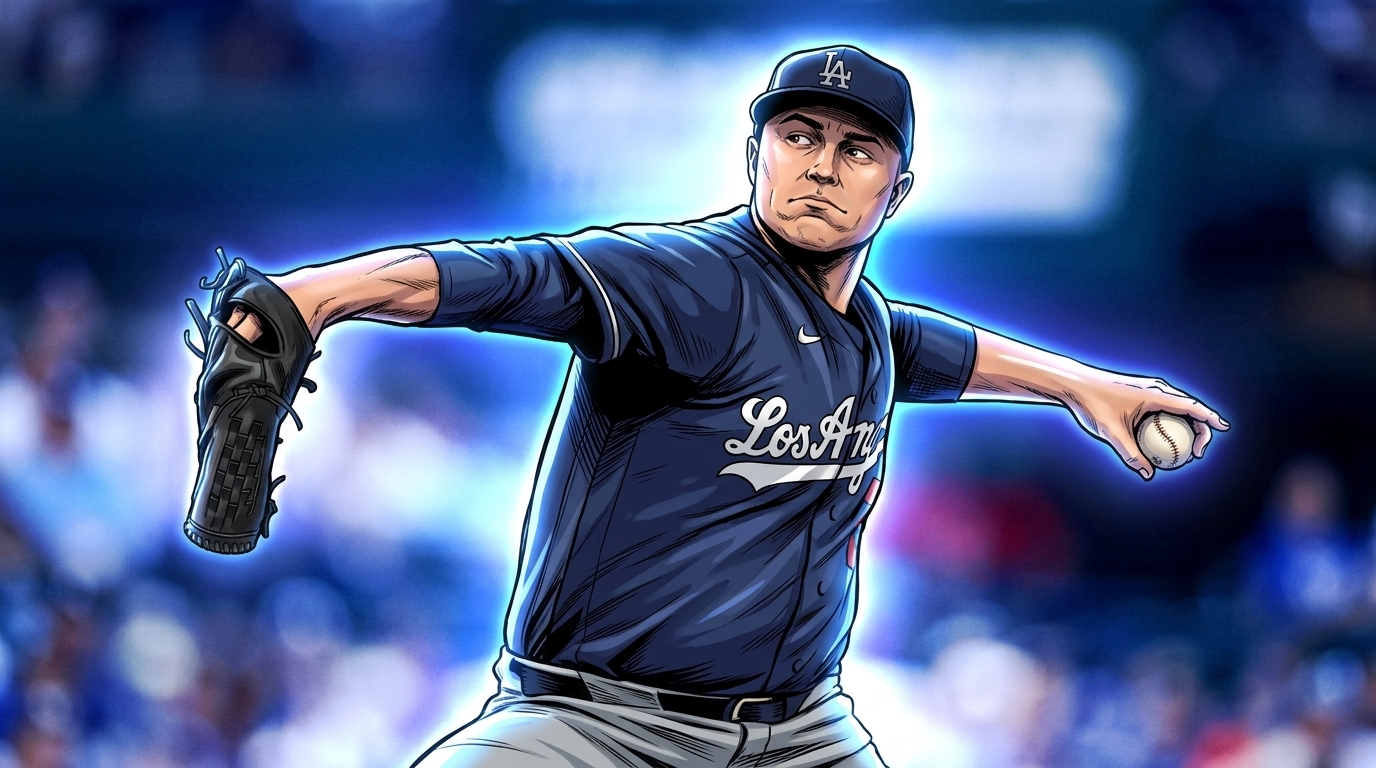

Tarik Skubal’s first start for the Los Angeles Dodgers went almost exactly the way a back-to-back Cy Young winner is supposed to pitch: six innings, four hits, two earned runs, two walks and six strikeouts on 85 pitches against the Chicago Cubs at Wrigley Field. One start doesn’t settle a trade. It rarely does. But it took Skubal exactly one outing to make the trade that brought him to Los Angeles look like Detroit left real value on the table.
I say that as someone who’s contractually obligated, by birth and zip code, to root against everything this franchise does. The data doesn’t care about my feelings, and neither should you.
What Skubal Actually Did in Six Innings
Start with the pitch count, because it says more than the box score does. Skubal threw 85 pitches and 51 of them were strikes, which means three of every five pitches he threw got put in the zone or drew a swing. That’s the profile of a pitcher who isn’t nibbling, isn’t feeling out an unfamiliar mound or a new catcher, isn’t easing into a new league mid-outing. He retired the first six Cubs hitters he faced without incident, as MLB.com noted afterward — two full innings of nothing before Chicago touched him at all.
Six strikeouts in six innings is a strikeout an inning, the same pace that carried him to 241 punchouts a year ago. Two walks in 85 pitches works out to one free pass roughly every 42 pitches, tight enough that Chicago never built a rally out of the strike zone. Whatever went wrong for the Dodgers in this one, it wasn’t Skubal losing the plate.
Was the One Mistake Really a Mistake?
The clean version of the story is that Skubal made one mistake all night. The real version is a little messier, and it says more about how dominant he actually was.
Dansby Swanson hit the actual mistake — a first-pitch fastball to open the third inning that Swanson turned around at 102.8 mph and sent 401 feet for his 17th home run of the season. That’s a mistake pitch, no qualifiers. Skubal will watch that one back and know exactly which pitch he wants again.
The second run isn’t that. Nico Hoerner’s two-out infield chopper in the sixth found enough grass to score and make it 2-1, and there’s a real difference between a pitch a hitter demolishes and a ball that simply lands where nobody’s standing. Two-out infield choppers turn into outs far more often than they turn into runs. This one didn’t, and that’s not something Skubal controls the way he controls the strike zone. Treat the homer and the chopper as one mistake and you’re being generous to the Cubs and a little unfair to what actually happened: one bad pitch, and one ball that found a hole with two outs against a pitcher who’d retired everybody else.
How Did Tarik Skubal Perform in His Dodgers Debut?
Skubal allowed two earned runs on four hits across six innings in his Dodgers debut against the Cubs on August 4, striking out six and walking two on 85 pitches in a 5-1 loss to Chicago at Wrigley Field in his first start since being traded from Detroit.
The final score belongs to the bullpen, which allowed three more runs after Skubal left the game — not to the two runs he actually surrendered. That distinction carries real weight here, because the case for this trade rests on Skubal’s individual performance holding up, not on the Dodgers winning every night he takes the ball.
He gave Los Angeles a start that would look strong on any pitcher’s résumé, on a mound he’d never thrown from, in front of a crowd that booed him at lineup introductions and again during his first mound appearance at Wrigley. Skubal said afterward that he loves the fans regardless, which is either genuine professionalism or the fastest possible pivot from a guy who’d been wearing a Tigers uniform just days earlier.
The Return Still Doesn’t Add Up
Detroit sent Skubal to Los Angeles for outfielder Zyhir Hope, the Dodgers’ No. 3 prospect and No. 19 overall in MLB Pipeline’s rankings, plus right-handers River Ryan and Brady Smith, two more well-regarded arms in a farm system MLB Pipeline rates among baseball’s deepest. That’s a real package for a rental pitcher who was months from free agency. It’s also a package for a two-time reigning AL Cy Young winner, and one start in, the gap between those two descriptions is already showing.
Run the résumé. Skubal won the pitching triple crown in 2024, the first AL pitcher to do it since Justin Verlander in 2011, going 18-4 with a 2.39 ERA and 228 strikeouts. In 2025 he followed it with 241 strikeouts and a 68 percent quality-start rate against a league average around 51 percent, meaning Skubal gave his team a strong start roughly two times out of three while most of baseball was doing it barely half the time. That number surprised me the first time I checked it, and it held up the second and third time too. He won 26 of 30 first-place Cy Young votes, the first pitcher to repeat as AL Cy Young winner since Pedro Martinez in 1999 and 2000, and only the second Tiger to win the award twice, after Denny McLain in 1968 and 1969.
He’s now throwing in the same rotation as Shohei Ohtani, which changes the math on this whole deal. Los Angeles built a rotation that already includes a historically dominant Shohei Ohtani and then added a second Cy Young-caliber arm behind him. That tells you the front office wasn’t hedging against a rebuild. It was stacking. The Dodgers’ own account posted the trade terms the day the deal closed:
https://twitter.com/Dodgers/status/2083946067574596094
Set that next to Skubal’s first start and the return already looks smaller than it did on paper.
None of this means Detroit was wrong to trade him. You don’t keep a starter who’s about to walk for nothing, and a rebuilding club takes the players it can get. But you don’t get to call a return fair after watching the pitcher you gave up go six strong on a road mound, in his first start, in a new uniform. One outing isn’t a verdict on Zyhir Hope’s ceiling or River Ryan’s future. It’s a verdict on how good the guy Detroit gave up already is, and one start in, the Dodgers didn’t overpay.