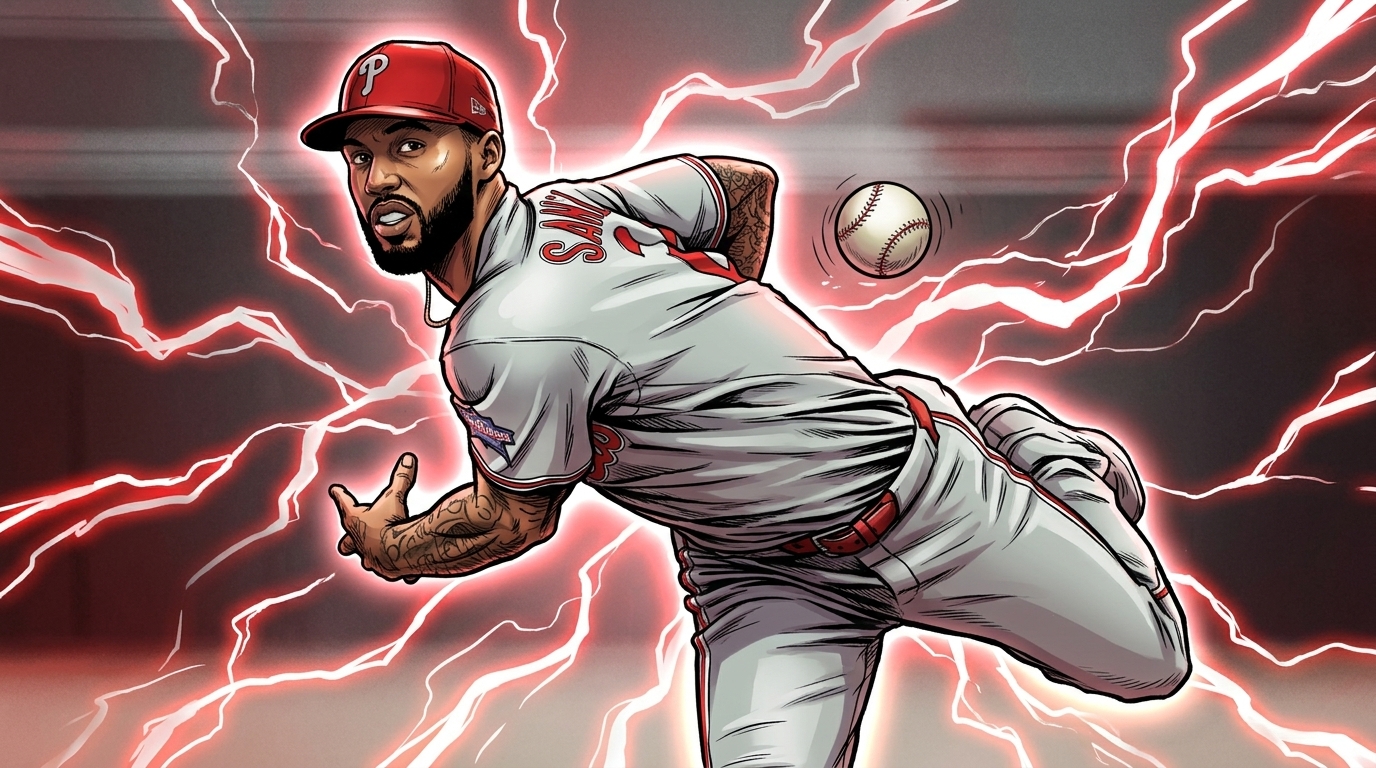

The longest Live Ball Era scoreless innings streaks belong to Orel Hershiser (59 innings, 1988), Don Drysdale (58⅔, 1968), and a short list of mid-career breakthrough pitchers — not rotation aces. Cristopher Sánchez’s 44⅔ innings ranks 7th all-time in the Live Ball Era as of June 2026. That placement matters more than the raw number. Line up every name on that list and the same biographical signature keeps appearing. Sánchez matches it almost perfectly.
I want to introduce a framework I’ve been calling the Discovery-to-Exposure Window: the interval between when a pitcher finds a technical key that genuinely breaks opposing hitters and when the league’s scouting apparatus builds a working counter. Every serious MLB pitching streak historical comparison traces this window. The great streaks don’t belong to pitchers who were already dominant. They belong to pitchers who became dominant mid-career, ran their discovery hard before the counter arrived, and either found another gear or got exposed. Sánchez is somewhere inside that window right now, and the historical data gives us a surprisingly precise map of what happens next.
The Neighborhood Sánchez Just Moved Into
The all-time list, per Yahoo Sports and MLB.com: Hershiser (59 IP, 1988), Drysdale (58⅔, 1968), Bob Gibson (47, 1968), Zack Greinke (45⅔, 2015), Carl Hubbell (45⅓, 1933), Sal Maglie (45, 1950), Sánchez (44⅔, 2026, active). He passed Zac Gallen’s 44⅓ innings from 2022 to get here. Twelve and a third innings separate him from Hershiser’s all-time record.
Biographical details jump off the page more than the numbers. Hershiser was 29 during his 1988 streak, turning 30 in its final days. Drysdale was 31. Greinke was 31. Maglie was in his early 30s — a pitcher who had spent years bouncing between leagues and arm trouble before putting together the best pitching of his career. Gibson’s 47-inning run came during the Year of the Pitcher at age 32. Veterans, not phenoms. The one outlier is Hubbell, who started his career as an elite arm, but even he ran his famous screwball-heavy dominant stretch at age 30 after a mechanical refinement.
Sánchez is 29 years old, posted a 5.63 ERA in 2022, made his first All-Star team in 2024, and finished second in NL Cy Young voting in 2025 with a 2.50 ERA and 212 strikeouts. Along the way, he broke Grover Cleveland Alexander’s Philadelphia Phillies franchise record of 41⅔ consecutive scoreless innings, set in 1911. The arc is consistent: find something late, run it hard, make teams wonder how they missed you. The historical pattern of who runs the great streaks is the late bloomer who cracked a code.
Why the Great Streaks Belong to the Discoverers, Not the Aces
Any sufficiently prepared scout knows how to attack the aces before April ends. Jacob deGrom was elite by every measure from 2018 to 2022, but the league’s best hitters had a working model from year one. They couldn’t execute, but they knew the plan.
The Discovery-to-Exposure Window opens precisely because the league doesn’t have a working model yet. When Hershiser, already known as a sinker-baller, added mastery of the split-fingered fastball in 1988, opposing hitters spent weeks recalibrating. When Drysdale dropped his arm slot slightly in 1968, hitters who had built their approach against his previous mechanics were suddenly wrong in their pre-pitch read. When Greinke in 2015 refined his arsenal into something that tunneled four pitches through the same visual plane, the adjustment period gave him a runway of dominance before the scouting counter arrived.
In our earlier breakdown of the streak’s underlying data, I covered the mechanical foundation: a spiked index finger grip on his slider that added roughly four inches of drop, and a three-pitch tunnel through sinker, changeup, and slider with identical release points. FanGraphs confirmed that no pitcher with 100-plus innings lowered their SIERA more from 2024 to 2025 than Sánchez. That’s the discovery. What the MLB pitching streak historical comparison framework adds is the next question: how long does the window stay open?
What the Data Says Sánchez Actually Changed
Sánchez’s 2026 line is genuinely staggering. Per SI.com and FanGraphs: 1.47 ERA (first in MLB), 1.80 FIP (first in MLB), 79⅓ innings (leads all starters), 3.3 fWAR (leads all pitchers). His BABIP sits at .337, fourth-worst among qualified starters — historically dominant true-talent numbers running slightly unlucky on contact. Opponents are hitting .153 against his changeup with a .176 slugging percentage — a pitch operating at a level that belongs in the conversation with the best individual offerings in a single season.
Woof. A .176 slugging percentage against one pitch, in one of the most offense-heavy seasons in recent memory — the league slugging average runs over .400. The hitter’s cognitive model has been fully broken.
https://x.com/MLB/status/2059757071654875532
Painter put it precisely when he spoke to NBC Sports Philadelphia: “He’s a dog… He tunnels those pitches. You know what he’s throwing and you still can’t hit it.” That sentence — you know what he’s throwing and you still can’t hit it — is the definition of a pitcher who has found something the league can’t solve at the execution layer, even with full pre-pitch information.
Is This Sustainable — Or Is Sánchez Six Starts From Getting Exposed?
The Discovery-to-Exposure Window predicts the counter arrives within one full calendar year of the discovery. Hershiser’s 1989 season was good, not historic. His World Series heroics in October 1988 came at the end of the run, not the beginning of a new phase. Drysdale’s 1968 record was his last dominant season. Greinke won the ERA title in 2015 and posted solid numbers through 2017, but the ace-level peak was concentrated in that discovery window.
More encouraging comps for Sánchez are Gibson and Hubbell, both of whom sustained elite performance for multiple seasons after their streak. Those pitchers had complete repertoires where the discovery enhanced everything rather than being the only thing.
FanGraphs’ 1.80 FIP says the discovery is real. The question is whether the ceiling stays historic or settles into genuinely elite. With his BABIP already elevated and his ERA still at 1.47, the answer skews toward a pitcher whose floor is now legitimately among the best in baseball.
The Philadelphia Phillies were 9-19 before firing manager Rob Thomson on April 28. Don Mattingly took over; the team has climbed to around .500. Sánchez’s streak started April 30. The data doesn’t do causation, but the timeline is worth noting. Sometimes a pitcher already in their Discovery-to-Exposure Window just needed games that felt like they mattered.
We are watching something that an MLB pitching streak historical comparison places in the company of Hershiser, Drysdale, and Gibson — six names across 88 years of professional baseball. The all-time record sits 12⅓ innings away. The scouting counter is coming, because it always does. But the data says Sánchez has found something real enough to survive the adjustment. The window is open. The only question is how long he can keep it that way.