
We spent parts of May and June hedging our praise for the Phillies with words like “small sample” and “interim bump,” the standard caveats you reach for when a fired manager’s replacement starts winning games nobody expected. Rob Thomson got fired on April 28, after a 9-19 start left Philadelphia looking for someone to blame, and Don Mattingly, promoted straight off the bench coach’s chair, did more than stabilize the roster. By the start of July he’d built the best record in baseball and dragged a 10.5-game deficit against Atlanta down to three. That part actually happened. What’s happened since is the part nobody in Philadelphia wants to talk about.
Dave Dombrowski didn’t dress up the decision when he made it. “This isn’t a blame game… I don’t think we’re playing up to our capabilities. I think we’re a much better club than we played,” the Phillies’ president of baseball operations said the day Thomson was let go. (Front-office executives say some version of that sentence every time they fire someone. This time the roster actually went out and proved him half right.)
Did Firing Rob Thomson Actually Fix the Phillies?
Yes, for a while. Mattingly’s Phillies went 38-18 in one stretch, the best record in the majors, and cut a 10.5-game gap on Atlanta down to three by the start of July. That’s real evidence the pre-firing roster was underperforming its talent level. It just wasn’t a permanent fix, and the weeks since have made that plain.
The stretch itself wasn’t a mirage. Forbes tracked it in real time: 38-18 since Thomson’s firing, a 47-37 record overall, and a division that had looked buried in May suddenly winnable. Three games back of the Braves at the peak isn’t the kind of thing you shrug off as noise. It’s a signal that something about how the team was being run genuinely mattered.
Stretches like that are rare enough that front offices build entire narratives around them. A team goes from ten games under .500 to a division threat in ten weeks, and every existing storyline about the roster’s ceiling gets thrown out along the way. The Phillies spent the winter being described as a team with more talent than urgency. Mattingly, whatever his actual tactical fingerprints were, got the urgency part right for two and a half months. In a division where one bad week can bury a contender, that stretch was worth something real, even if it wasn’t worth the whole season on its own.
What Happened to the Comeback?
It stalled. Since that early-July peak, the Phillies have gone a modest 19-21, a middling stretch that let Atlanta rebuild its lead. Philadelphia now sits at 66-58, seven and a half games back in the NL East.
The Northeast Times summed up the mood in Philadelphia heading into August: still a playoff threat, but no longer the hottest team in the sport. A club that once looked capable of running down a division leader has settled back into being what it looked like on paper in March — good, deep, occasionally frustrating, not obviously better than Atlanta over a full season. (Mattingly is still technically the “interim” manager, a title the Phillies have shown zero urgency about updating, which tells you something on its own.)
Why Luis Arraez Changes the Math
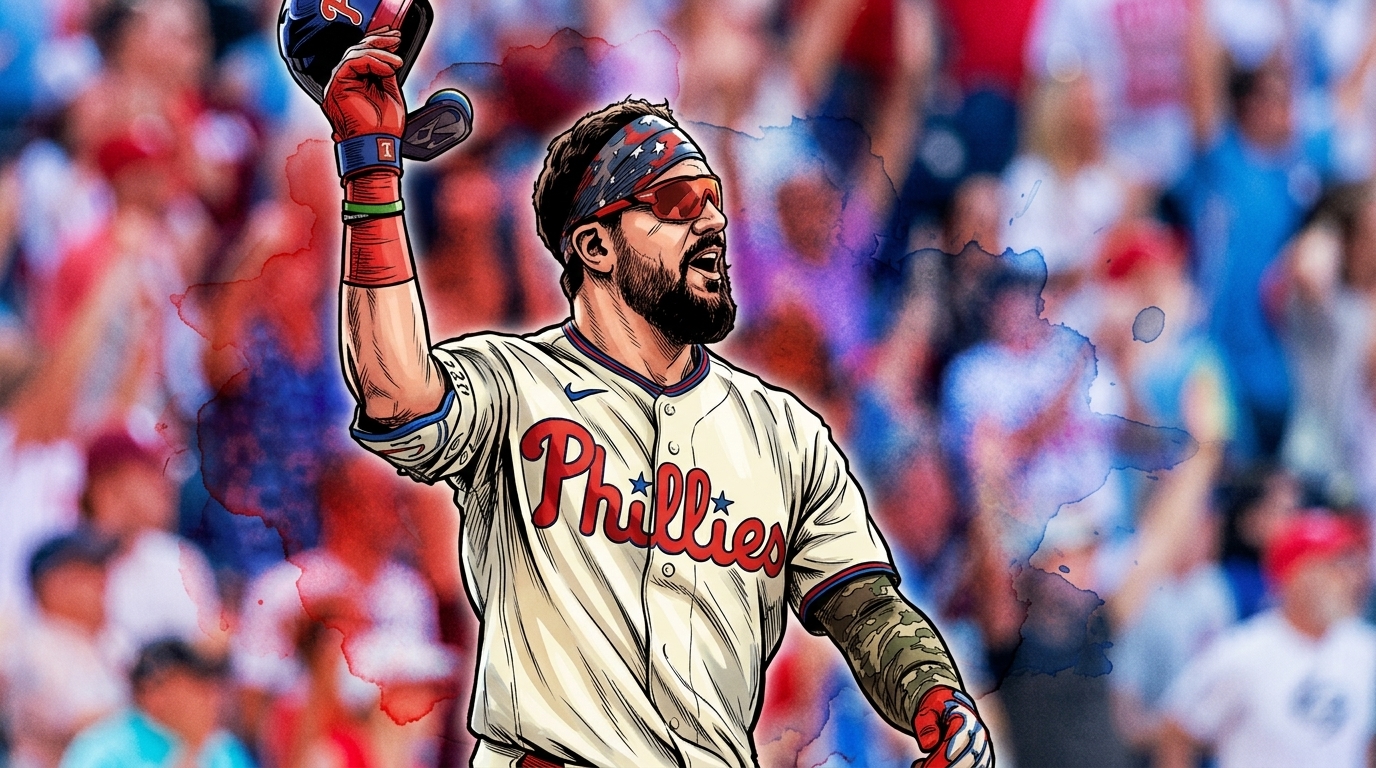
The Phillies acquired Luis Arraez, a three-time batting champion hitting .324, along with RHP Caleb Kilian, from the Giants on August 3 for prospects Ramon Marquez and Marty Gair. The move pushed Bryce Harper back to right field for the first time since 2022 to open second base for Arraez.
Stott slides to third and Bohm moves to first in the same realignment, but Harper is the name people are actually talking about. He last played the outfield regularly before an elbow injury pushed him to first base in 2022, and MLB Trade Rumors reported he’s expected back at first in 2027 once Arraez, a pending free agent, moves on. (Nothing says “team with a plan” quite like shifting a former MVP off a position he’s manned for three seasons because a rental second baseman needs somewhere to stand.)
The Phillies had been connected to pitching all summer too, watching Tarik Skubal end up a Dodger instead while the Dodgers became the shortest World Series favorite in a decade around him, and settled for fixing the lineup instead of the rotation. Arraez debuted immediately, hitting cleanup against Washington on August 4 and going 2-for-4 with a single, a double, and two RBI. The team made the trade official on social media the day of the deal:
https://x.com/Phillies/status/2084312318813274420
It read like standard front-office messaging because it was, but the bat behind it is the actual point. Arraez leads the NL in batting average, exactly the kind of contact profile a lineup needs once its hot streak cools off.
Can the Phillies Still Catch Atlanta?
Probably not the division. A 7.5-game gap is a lot to make up in six weeks, and the Phillies haven’t shown, since early July, that they can pull off a comeback like that a second time. But Philadelphia is tied with Arizona for a National League Wild Card spot, which is the more realistic path to October.
Tight divisional races are playing out all over baseball right now, which is a polite way of saying nobody in the wild-card picture is pulling away either. That’s the field the Phillies actually need to worry about.
A tie with Arizona is not job security. Wild-card math tends to move fast in August, where a three-game losing streak can flip the order overnight. The Phillies’ margin for another cold stretch like the one that just cost them the division is close to zero, which is exactly why the front office went and got a hitter instead of hoping July repeats itself.
I think the honest read on this season is that it already answered its biggest question and is now working on a smaller one. The Thomson firing exposed a real gap between the roster’s talent and its results, Dombrowski was right that this group was better than a 9-19 start, and Mattingly closing that gap to three games by July proved the point. What the stretch didn’t prove is that the fix was permanent, and a 19-21 slide since is the evidence. Arraez doesn’t erase that record. He’s a bet that the front office that read the roster correctly in April can read the lineup correctly in August, plugging an actual hole instead of waiting for the May version of this team to reappear on its own.
Watch the next two weeks against the other wild-card teams, not the scoreboard in Atlanta. That’s the race the Phillies are actually running now, and it’s the one Arraez was brought in to win.