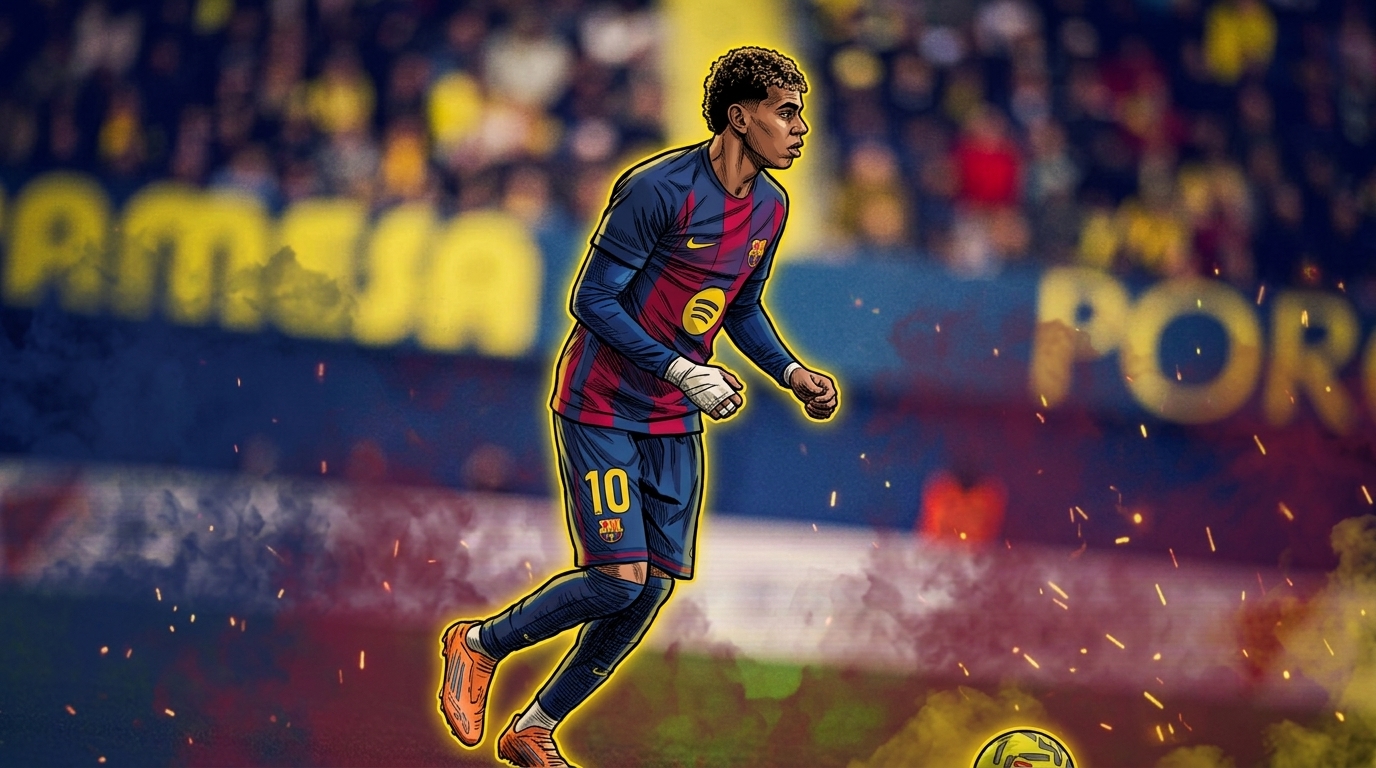

A 21-year-old woman posted a short video of herself and her 18-year-old boyfriend eating at a restaurant. He is Lamine Yamal — probably the most exciting player heading into the 2026 World Cup, twelve days away. She fed him a bite of something. It was playful. The kind of moment couples film on their phones and post without thinking twice.
Then the internet found it, and the discourse began: Yamal is distracted. He should be focused. Does he not understand what’s at stake? And almost as an afterthought — who is this woman, and what does she want from him?
The woman is Inés García, a Seville-based content creator who had 500,000 TikTok followers before anyone connected her name to Yamal’s. She is not a mysterious interloper. She is a person who exists and has a boyfriend and apparently goes to dinner. But that framing — her as subject, with her own life and presence — gets swallowed pretty quickly once the internet clocks who the boyfriend is.
The Video That Broke the Soccer Internet
García and Yamal went public in late May, walking into FC Barcelona’s end-of-season team dinner hand in hand. The dinner video came shortly after. Within days, García had gained roughly 124,000 new Instagram followers — approximately 4,400 per day — and a parallel wave of scrutiny arrived with them. Critics resurfaced an old TikTok clip in which she’d said she recognized footballers by their famous girlfriends, and admitted she probably wouldn’t have noticed Yamal if he weren’t who he is. The internet treated this as a confession. As if most people, before Yamal became Yamal, would have been unable to pick him out of a crowd.
The fake breakup rumors came next. Someone invented a story that García had left a long-term relationship to pursue Yamal. She responded on Instagram Stories: “At what point was it said that I had been in a five-year relationship with my friend Gonzalo, and that I left him to be with another person… if you are going to invent something, make it more consistent.”
That line — dry, precise, completely unbothered in tone — tells you everything about how García has navigated this. But it’s her direct statement on the hate itself that deserves more attention. “The worst part is the overexposure,” she said, “that everyone can criticise you, say anything about you without having any idea, and honestly, I’ve been handling that a little poorly, especially this week.”
That quote is the actual text of this story. Not the dinner video. Not whether Yamal will be “distracted.” The actual story is a 21-year-old describing, plainly, the cost of existing next to a famous person — a cost she didn’t fully anticipate and is working through in public because the internet decided she owed it that access.
https://twitter.com/Nancy_fcb/status/2057002744292966718
We Have Done This Before and We Were Wrong Then Too
The WAG-as-distraction narrative has a well-established tradition of being wrong. In 2006, England’s World Cup campaign in Germany became as famous for the wives and girlfriends camped in Baden-Baden — shopping, photographed, performing glamour while their partners played — as for the football itself. When England went out in the quarterfinals, the WAG circus took a portion of the blame. Rio Ferdinand said it out loud. The framing was: women, proximity, disruption.
Four years later, Spain goalkeeper Iker Casillas was assigned a girlfriend, Sara Carbonero, who was a broadcast journalist covering the tournament. When Spain lost to Switzerland 1-0 in the group stage — their only defeat of the whole campaign — Carbonero was blamed. Her presence pitchside was treated as causally relevant. Spain then won the entire World Cup.
The pattern holds in other sports too. Content creator Morgan Riddle was blamed for Taylor Fritz’s results on the ATP tour — despite the fact that she helped grow the sport’s audience among a demographic it had long struggled to reach. The formula does not require evidence. It requires a woman adjacent to an athlete, a suboptimal outcome, and an audience looking for an explanation.
Yamal is 18 years old. He won the European Championship as a 16-year-old. His coach, Luis de la Fuente, says he arrives with “enough maturity and personality to take on an important role.” He is recovering from a hamstring issue and is expected fit for the tournament. Vinicius Jr., who has himself absorbed years of disproportionate media attention, said of Yamal: “He constantly does unbelievable things on the pitch, and he’s the type of player who could win the World Cup alone.”
The conversation before a tournament featuring arguably the most complete teenager in the sport’s history is about whether a dinner clip is bad optics.
He Is Going to Be Fine
Nobody demanding Yamal “focus” has actually told us what that focus is supposed to look like. Presumably: no girlfriend, no dinners, no casual phone videos. Monastic preparation. The idea that professional athletes at the top of their sport need to be protected from ordinary human activity before a major tournament — that a restaurant meal is a risk variable — is not really analysis. It’s the projection of anxiety onto a person who didn’t ask to carry it.
What García said in her TikTok response cuts cleanest: “Either you live with it or it eats you up.” She also said, with the kind of calm that must have taken some effort: “But this Inés is going to keep going. Because she was active on social media before all this and she’s going to keep doing it now.”
Yamal turns 19 on July 13 — which is to say, during the tournament. He is a teenager being asked to handle the expectations of a country’s football ambitions, the microscope of global sports media, and now, apparently, the question of whether his girlfriend’s dinner content represents a character flaw. The people asking that question have not earned the authority to ask it.
Spain won in 2010 with Sara Carbonero in the frame. Yamal is going to eat dinner, and then he is going to play football, and there is every reason to believe he will be exceptional at the latter regardless of what the internet decides to think about the former.