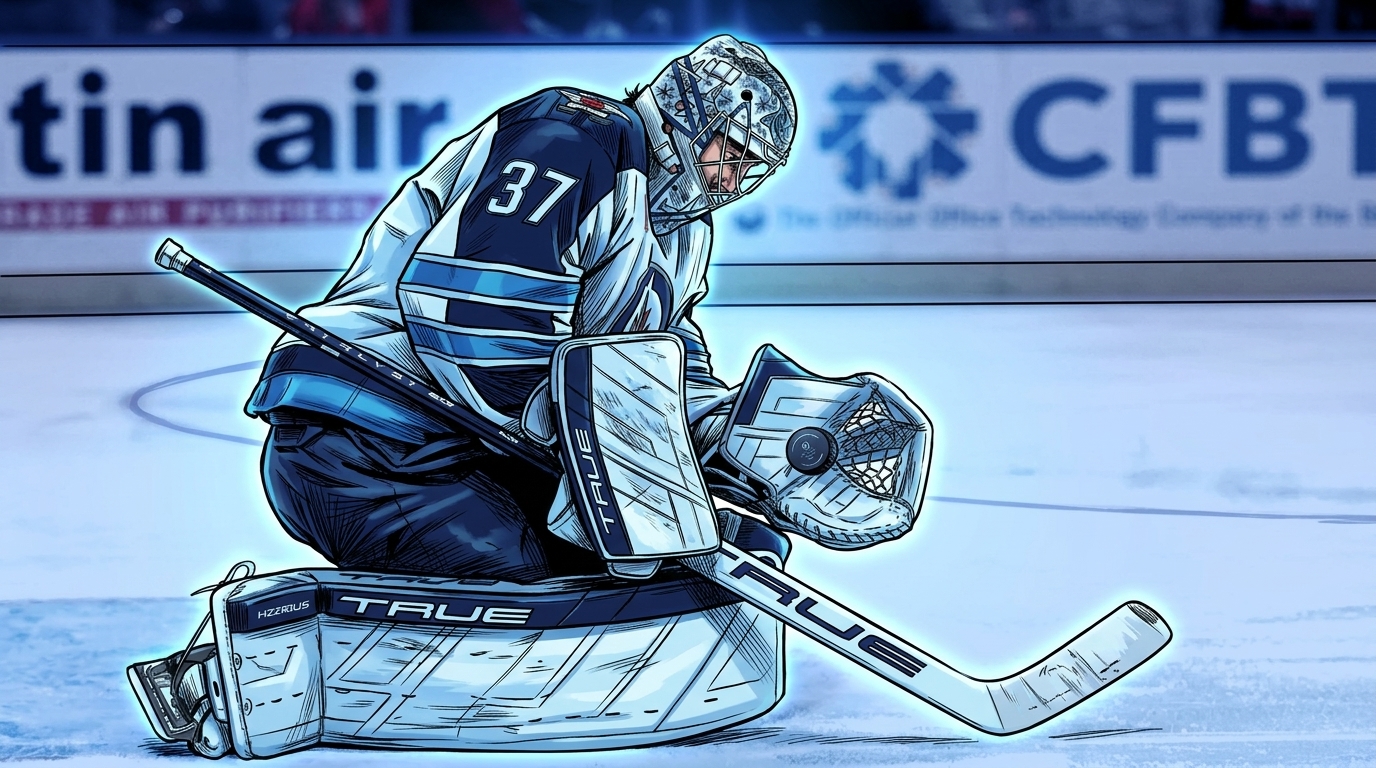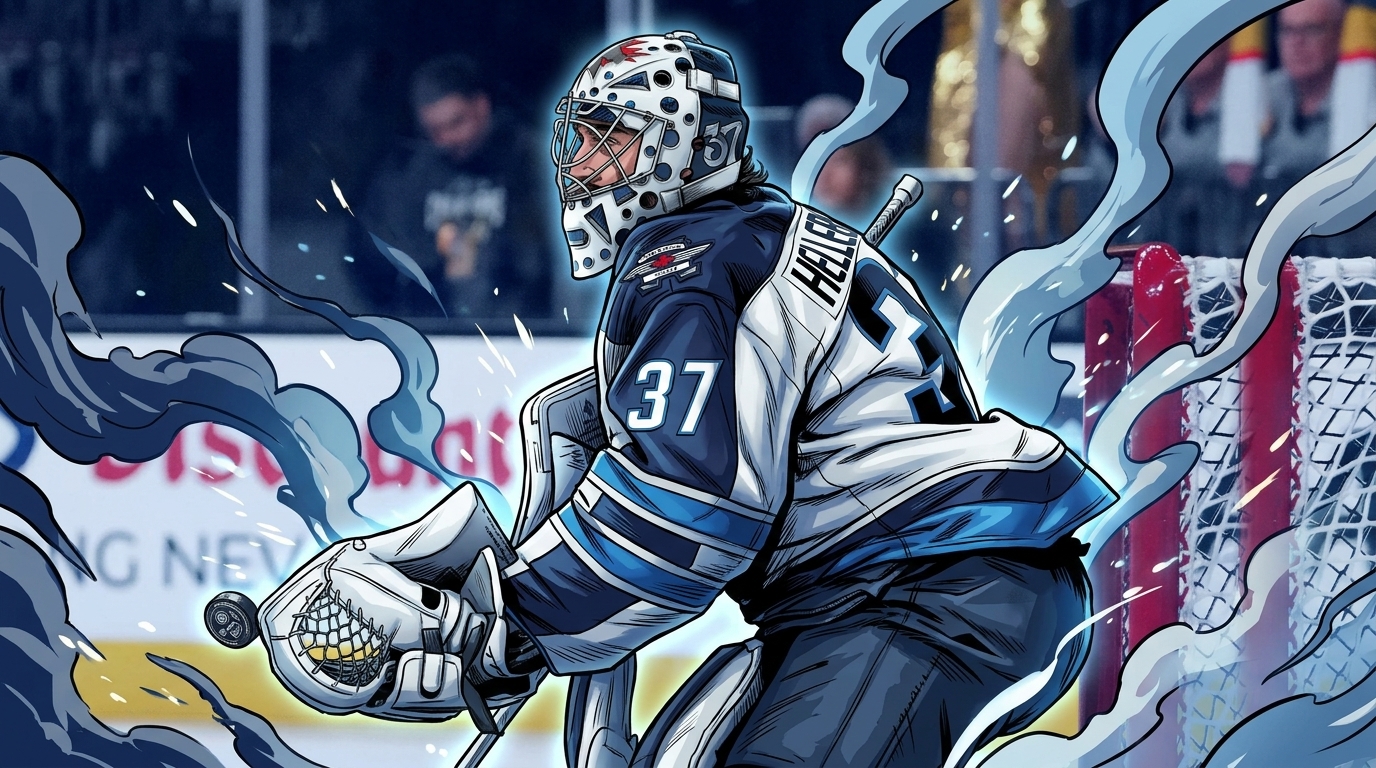

Here is a question worth sitting with before tonight’s Game 2 in Raleigh: if Mitch Marner was always a playoff choker, what do we call what he’s doing right now?
Not “performing well in a series.” Not “having a nice run.” Twenty-two points in sixteen playoff games, leading all NHL scorers, at a 1.38 points-per-game clip that is not just better than his Toronto playoff rate — it’s better than his Toronto regular-season rate. He set up the go-ahead goal in Game 1 of the Stanley Cup Final, then threw his body in front of a shot in the final seconds to preserve a 5-4 Vegas win. He is, by the numbers and by the eye, the best player in these playoffs.
So either Mitch Marner developed a previously undetected elite playoff gene at age 28 after signing with Vegas. Or the Toronto narrative was constructed on something flimsier than people wanted to examine.
I ran this three different ways. The answer keeps coming back the same.
How Many Points Does Mitch Marner Have in the 2026 Playoffs?
Mitch Marner has 22 points (7 goals, 15 assists) in 16 games in the 2026 playoffs, leading all NHL scorers. His 1.38 points-per-game pace exceeds his Toronto regular-season rate of 1.13 PPG. He’s posted a plus-12 rating, four shorthanded points, and five high-danger goals — more than he scored in his four previous Toronto postseasons combined.
That last number deserves to sit on its own for a second. Four postseasons. One high-danger goal. The explanation for that discrepancy does not live in Marner’s head. It lives in the data.
What the Toronto Numbers Actually Said
The canonical Marner-choker case rested on two pillars: his overall playoff PPG in Toronto (0.90 in 70 games) was lower than his regular-season rate, and his Games 5-7 rate was 0.41 PPG. Genuinely bad. About half his regular-season production.
What the surface stat omits is context. Toronto’s offensive zone time in their 2025 postseason was 40.2 percent. Vegas in 2026: 43.7 percent. That gap looks small until you consider what it means for a playmaker whose entire game is built on sustained possession and zone entries — Marner generates at a dramatically higher rate when his team doesn’t spend half the period chasing the puck in their own end. The Leafs were not creating the conditions under which his skill set could express itself. Vegas is.
There’s also a sample-size problem with the Games 5-7 framing. The goalpost kept moving. First he couldn’t produce in the playoffs. When he produced, he couldn’t produce in close games. When he produced in close games, the definition shifted to elimination games specifically. The claim was unfalsifiable. When a charge can’t be disproved, it was never really analysis to begin with.
What the Toronto structural record shows: the Leafs went 1-13 in series-clinching games during the Marner era. Thirteen losses in potential series-closing situations. One win. Framing that as a Marner problem requires selectively ignoring the goaltending variance, the second-unit forward depth, and the fact that the other franchise cornerstone was also going ice-cold at the wrong moments. Nobody wants to look at that part.
Why Vegas Unlocked a Different Marner
The sign-and-trade that sent Marner to Vegas for eight years at $12M AAV was widely framed as an overpay for a player who couldn’t handle the moment. Eight months later, Vegas’s run through the Western Conference included a sweep of the Presidents’ Trophy-winning Colorado Avalanche. It looks less like a coincidence and more like confirmation of what the underlying numbers suggested.
Vegas gave Marner things Toronto structurally couldn’t: a second offensive center (Jack Eichel) capable of drawing defensive attention away from Marner’s possession game; a goaltender in Adin Hill who has been reliable when it counts; and a coaching structure that deploys Marner in offensive-zone situations rather than leaning on him to generate offense from a standing start in the neutral zone.
The storylines entering this series weren’t just about Marner. Vegas assembled a genuinely deep roster. But Marner is the piece that changed the most from his previous organizational context, and his output reflects that most directly.
He also, for the first time in his NHL career, has a first-round series win in which he was visibly the best player. His Round 1 against Utah: set up the overtime winner in Game 5, then scored the series clincher in Game 6. One goal in one elimination situation: that’s more than he managed in nine years as a Maple Leaf in elimination contexts. The explanation that fits both data points is that the elimination game environment in Toronto had become psychologically contaminated in a way that Vegas reset.
He hired a mental performance coach in each of his last three Toronto seasons. He had full-time security at his house for two weeks after the 2025 playoff exit after his address was doxxed and he received death threats. If you are designing conditions that will suppress a player’s performance in high-leverage moments, that’s a reasonable prototype.
After the Western Conference Final clincher, you could see what leaving cost him, and what arriving in Vegas gave back.
https://twitter.com/yardbarker/status/2059739674290078160
The Matthews Double Standard Nobody Wants to Admit
Auston Matthews was held scoreless in Games 5, 6, and 7 of the 2024 Boston series. He was held without a goal through Game 5 of the 2025 Florida series. These are not cherry-picked data points. They are the defining playoff outcomes of the Toronto era, the ones that ended seasons.
Nobody called Matthews a choker. His playoff reputation survived intact. Marner’s did not.
I am not making a claim about Matthews’s character or ability. He is one of the best goal scorers in NHL history, and his regular-season production is generational. The point is narrower: the exact same playoff failure (the inability to convert in series-deciding games on the sport’s biggest stage) was applied to Marner as character evidence and applied to Matthews as bad luck. Call that what it is: a conclusion in search of a supporting framework, dressed up as analysis.
The Toronto media market needed someone to carry the blame for thirteen series-clinching losses. Marner, who is demonstrably less marketable and whose skill set (passing, puck retrieval, defensive responsibility) is harder to reduce to a highlight than a rocket slap shot, became the designated scapegoat.
Tortorella, renowned for brutal honesty with his own players and not a coach who distributes compliments to keep the room happy, put it plainly: the Toronto playoff narrative about Marner is “a bunch of bullsh*t.”
What a Conn Smythe Would Mean for the Choker Label
Marner is the Conn Smythe betting favorite at +165-+185, ahead of Frederik Andersen of Carolina at +220. Those odds reflect both his production (22 points leads the field by a meaningful margin) and the expectation that he’ll remain involved regardless of what Carolina’s defensive structure in Game 2 throws at him. Sebastian Aho is the likely primary check tonight in Raleigh, where Carolina gets last change on home ice. They had it in Game 1 too and Vegas won anyway, but Raleigh is still the more favorable environment for the Hurricanes.
Here’s what I think happens: the matchup adjustment slows Marner slightly, Carolina gets more zone time at home than they did in Game 1, and the series gets tighter. That’s the normal pattern. It doesn’t change the trajectory.
Marner’s 2026 playoff stats are not a hot streak. Six multipoint games in sixteen appearances, three three-point games, a plus-12 rating that reflects sustained two-way deployment, not just power-play cushion. This is a player operating at a level the Toronto postseason environment was actively suppressing. Vegas didn’t fix Marner. They removed the structural weight that was sitting on him.
When Marner was asked after the WCF what changed, he said: “I think things are just working. There’s nothing different.” Which is analytically frustrating and also probably true. The inputs changed. The outputs followed.
The evidence here is fairly unambiguous. Mitch Marner was not a choker. He was a generational playmaker in a franchise that couldn’t build around him correctly, playing in a market that needed a villain, absorbing blame for systemic failures that predated him and would outlast him. He left. He signed for $96 million with a team that knew how to use him. He is now, by the numbers, the best player left in the 2026 playoffs.
One win from the Conn Smythe. One win from a Stanley Cup that would have been unthinkable in any Leafs timeline.
He was never the problem. The data was always pointing here. It just took a change of address for everyone to see it.