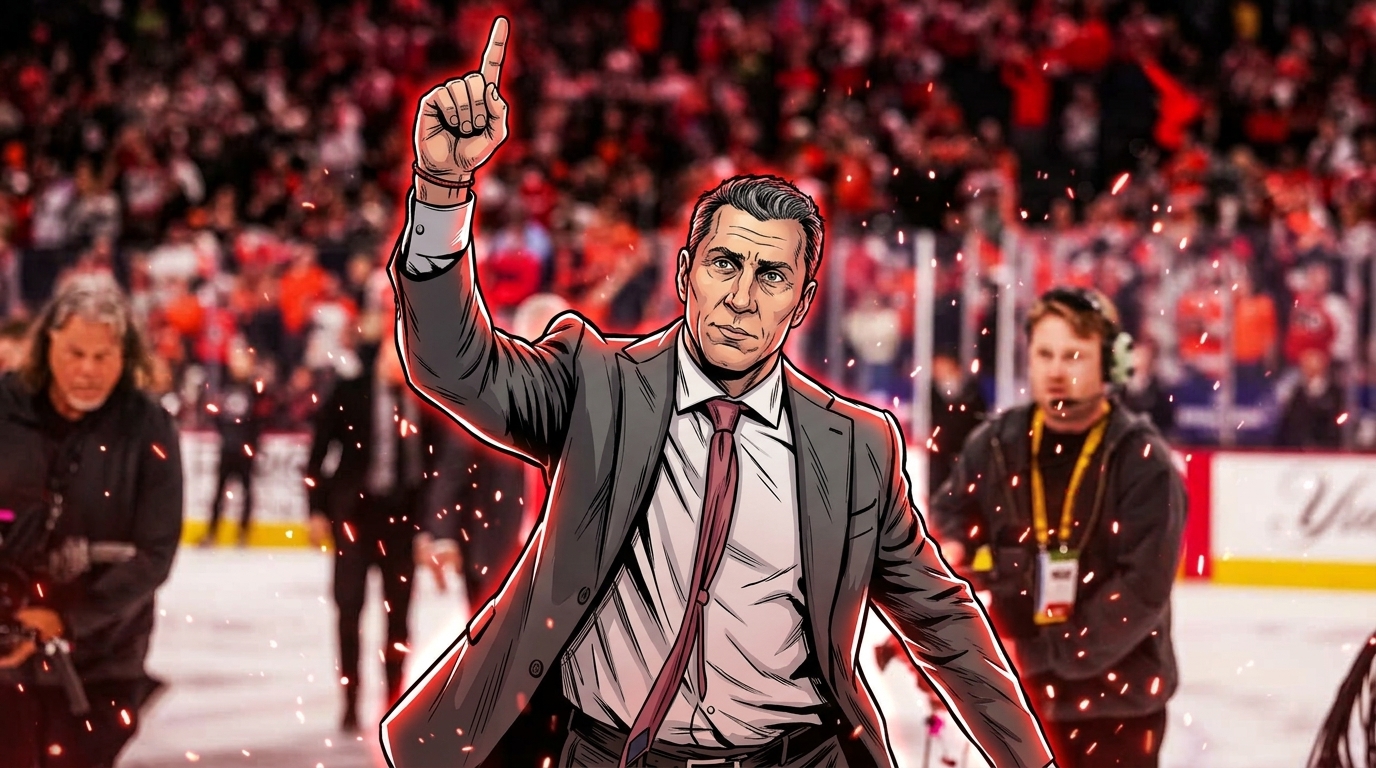
We have been watching the Stanley Cup Final through the usual lenses (the Golden Knights’ offensive volume, the Hurricanes’ suffocating defensive structure, the noise inside T-Mobile Arena), but there is a quieter story running underneath all of it, one that requires a bit of institutional memory to appreciate. Rod Brind’Amour is one win from completing something that has not happened in professional hockey in 70 years. Game 6 is Sunday in Las Vegas. The Carolina Hurricanes lead this series 3-2.
Has any NHL coach won the Stanley Cup with the same franchise they captained as a player? Six times, yes. Toe Blake with the Montreal Canadiens. Frank Boucher and Lester Patrick with the New York Rangers. Hap Day and Joe Primeau with the Toronto Maple Leafs. Cooney Weiland with the Boston Bruins. The last person to accomplish it was Blake, in 1956. That is a 70-year gap in the ledger, long enough that most current NHL players were not yet born when it happened. Rod Brind’Amour Stanley Cup captain coach 2026 is not a phrase anyone constructed before this spring. It is a phrase that now sits one regulation period away from becoming a historical category.
The Carolina Hurricanes won the 2006 Stanley Cup with Brind’Amour wearing the ‘C.’ He was the kind of captain who per NHL.com never quite operated the way the franchise wished its star players would, meaning, with personal branding in mind. He was loud about accountability and quiet about everything else, which made him exactly the wrong kind of player for an era that was becoming, slowly and then all at once, extremely online. He beat the Edmonton Oilers in seven games in 2006, raised the Cup, and continued playing through 2010. Then he stayed.
Brind’Amour joined the Hurricanes’ coaching staff immediately after retiring, as an assistant, and worked his way toward the head job through the worst stretch in franchise history. Carolina missed the playoffs for nine consecutive seasons (2009-10 through 2017-18), which, for anyone outside Raleigh, was easy to process as confirmation that the 2006 run had been an outlier, a team built for one postseason that couldn’t sustain itself. (This is the kind of quiet organizational collapse that gets filed under “market size” as though markets have anything to do with defensive zone coverage.) On May 8, 2018, the Hurricanes named Brind’Amour head coach.
His first season produced a return to the playoffs, and something more durable: a nickname. After an analyst from a losing opponent dismissed the team as a “bunch of jerks,” the Hurricanes sold thousands of shirts with the phrase. Brind’Amour had built a team that not only absorbed that framing but wore it as identity. The philosophy underneath it was less colorful: collective accountability, zero tolerance for individual branding over team results, defensive pressure so sustained that opposing coaches describe it the way people describe weather systems rather than hockey tactics.
The Brind’Amour coaching record now includes setting the mark for most wins by a head coach through his first 600 NHL games, a statistic that sounds like the kind of thing a franchise trots out at halftime of a blowout but is, when you consider the nine-year drought that preceded him, something more interesting. He took a program that had gone invisible in the conference and made it into one that opponents build game plans around.
https://twitter.com/Sportsnet/status/2061848111031435323
This Cup Final is, among other things, a study in what old-school coaching looks like in 2026. As NHL.com noted, Brind’Amour and Vegas head coach John Tortorella took divergent paths to the same stage. Both coaches operate from a philosophy of physical pressure and earned trust; they simply arrived there through different organizations and different personnel decisions, and their teams now reflect those divergences in opposing ways. Vegas scored 51 goals in 14 postseason games, the most of any team in the league during that span. Carolina has been the story of controlled chaos, a team that loses games and then wins the next three before anyone has figured out how to adjust.
The series has played out the way a close series with two defense-first coaches usually does: unevenly, with momentum swings that feel larger than the scoreboard suggests. Game 1 of this series went to Vegas, 5-4. Carolina won Game 2 in overtime, 4-3. Vegas took Game 3 in double overtime, 5-4. Carolina responded with a 5-3 win in Game 4. In Game 5, the Hurricanes won 4-2, and now hold a 3-2 lead heading back to Las Vegas. (Every game in this series has been within one goal in the final minutes, which is either compelling or exhausting depending on your proximity to a betting line.)
T-Mobile Arena is widely considered the loudest building in the NHL. Vegas won the Cup there in 2023, the franchise’s first championship in only its sixth season of existence. (This is the kind of organizational fact that sounds invented but is simply a function of the franchise being very young and very good, in roughly that order.) Brind’Amour will coach Game 6 in a building designed to make everything harder for visitors: the crowd noise, the lighting, the specific texture of playoff hockey played in a desert city that treats its team like civic infrastructure.
What he is chasing is not the championship alone. He already has that experience, from the other side of the ice, two decades ago. What he is chasing is their dominant run through these playoffs arriving at its full conclusion under his direction, the franchise completing a loop that started when he was a player and would finish when he is a coach. The six men who preceded him on that list (Blake, Boucher, Day, Patrick, Primeau, Weiland) did it in an era when the league had fewer teams, fewer playoff rounds, and considerably less analytical infrastructure devoted to preventing exactly this kind of continuity.
For what it’s worth, I spent years compiling notes for TV analysts who summarized careers in fifteen-second bites, and the shelf life of a “rarest arc in sports” framing is usually about three media cycles. But the Brind’Amour version holds up under pressure because the gap he is closing (70 years, six predecessors, a franchise that nearly ceased to matter) is not a framing construct. It is a fact about how hard this particular thing is to do. Brind’Amour’s complicated ECF record is part of that history too, and Sunday is a chance to rewrite the whole ledger at once.
Game 6 is Sunday, June 14. One win, in the loudest building in hockey, against a team that raised this same trophy in that same building three years ago, with 70 years of NHL history sitting in the balance. Watch what he does with his players during warm-ups — not the X’s and O’s, but the interactions. The thing he has always understood, better than most coaches who came to the job through the analyst pipeline, is that accountability is not a speech. It is a practice, built over nine years of missed playoffs and one championship already in the case. The question is whether the Hurricanes have enough of it left to close.