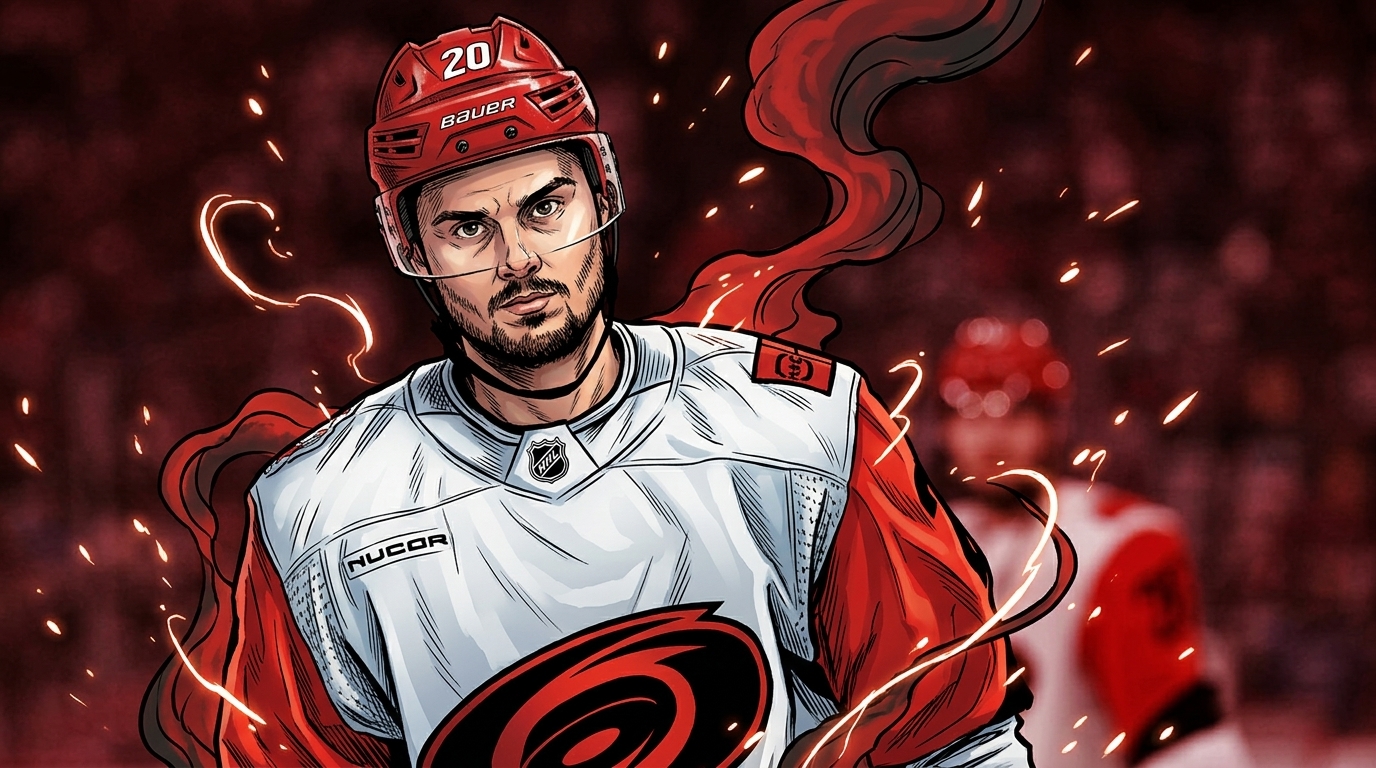
The Hurricanes top line of Jarvis, Aho, and Svechnikov finished Game 1 of the 2026 Stanley Cup Final with zero points, zero goals, a 47% expected goals share at 5-on-5, and a minus-1 on-ice differential. Three shots combined across three players in more than 17 minutes of play. Carolina led 2-0 in the second period and still lost 5-4. Those two facts are not separate problems. They are the same problem.
Rod Brind’Amour built this team on a specific architecture: a defensive system that suppresses opponent shot quality while the top line handles the offense. In Game 1, both halves broke down at the same time. Vegas controlled 73.3% of shot share in the second period alone, erasing the two-goal lead in under six minutes. The Jarvis-Aho-Svechnikov line was already invisible by the time the comeback started, which meant Carolina had no answer when it needed one most. The coaching adjustment window before Thursday in Raleigh is not just urgent — it may be the most consequential 48 hours of Carolina’s season.
The fact that Game 1 was the first time a road team had erased a multi-goal deficit in a Stanley Cup Final Game 1 is worth sitting with for a moment. Vegas came in, fell behind 2-0, and then systematically dismantled a Carolina structure that had held up through three rounds of the playoffs. Shea Theodore and Brayden McNabb each recorded three points — the first defensive pair to do that in a Stanley Cup Final Game 1 — which tells you something about which team was generating from everywhere and which team was generating from nowhere. Carolina’s four goals came from Nikolaj Ehlers (twice), Jordan Staal, and Shayne Gostisbehere. The top line contributed nothing. That omission is the story.
The featured snippet version, because it deserves plain language: The Hurricanes top line of Seth Jarvis, Sebastian Aho, and Andrei Svechnikov combined for zero points and a 47% expected goals share at 5-on-5 in Game 1 of the Stanley Cup Final. Jarvis had three shots, Aho had one, Svechnikov had one. Vegas outscored them 1-0 while they were on ice together. Carolina lost 5-4 after leading 2-0.
Brind’Amour’s press conference afterward was candid in the way that only coaches who are also former players tend to be — no deflection, no “we’ll watch the film” boilerplate. I spent two years in a previous life transcribing post-game sessions for analysts who’d reduce that kind of honesty to a pull quote and move on. What Brind’Amour said in full, to TSN and NHL.com, matters more than the headline: “They got to play in the other team’s end. They’re too much one and done and not even one [scoring chance], and it’s not a lot of time. So, they got to get a little more offensive zone time.” Then: “Your best guys gotta get on the scoresheet. That’s going to have to happen if we want to get where we want to be.” Then, referring to a single late shift that finally looked like what the line is supposed to do: “Kind of like that last shift they had. That was one of the shifts you could say: ‘OK, there you go. That’s how it needs to look.’ We need them to get going.”
That sequence — the problem, the standard, and the one glimmer — is essentially the entire Game 2 preview compressed into three quotes. Brind’Amour is not panicking. He is telling his best players, publicly, that they have to be better. The implication is that the system is fine and the execution was not. That might be the most concerning part of all, because if the system is fine and the top line still went pointless, it means Vegas found a way to make Jarvis, Aho, and Svechnikov irrelevant within the structure Carolina relies on. That is a harder adjustment to make than a line change or a power-play tweak.
Tomas Hertl’s game-winner came at 16:56 of the third period, a give-and-go with Colton Sissons that ended with a slot shot over Frederik Andersen’s blocker. What makes that sequence worth examining is what came 21 seconds earlier: Carter Hart denied Seth Jarvis’s one-timer. Carolina came within a save of tying the game in the final four minutes. One goal later, the series was effectively flipped. The margin between a Jarvis goal and a Hertl game-winner is the margin between a 1-0 Carolina series lead and a 0-1 Carolina series hole. Andersen is not the reason this series is in trouble. The top line is the reason, and the timing of its one real chance underscores exactly how thin that margin was.
https://twitter.com/TheAthletic/status/2062186228271780113
Vegas also got three points from Ivan Barbashev, who scored early in the second period and helped trigger the momentum shift that defined the middle frame. The Knights did not need their stars to carry them — William Karlsson scored, Brett Howden scored, Theodore scored. Seven different Golden Knights recorded at least one point. Vegas spread its offense across seven players; Carolina concentrated everything in a top line that produced nothing. That contrast is the one Brind’Amour has to solve before Thursday without changing the identity of a team that has played this way all year.
The series preview flagged the top line’s ability to generate sustained offensive zone time as the central variable for Carolina. That was the right framing — it just turned out the risk scenario was more acute than anyone anticipated in Game 1. Jarvis had three shots on a line that averaged north of a dozen attempts per game in the regular season. Aho had one. Svechnikov had one. Either Vegas has a specific defensive scheme dialed in for this line, or the Hurricanes’ best players had an off night in the worst possible game.
The answer to that question is what Game 2 will tell us. Carolina gets PNC Arena on Thursday at 8 PM ET and presumably a crowd that will be hostile enough to force a response. Brind’Amour said he needs his best players to get going. If they don’t — if the Jarvis-Aho-Svechnikov line goes quiet again in a home game with the series on the line at 0-2 — the conversation shifts from “adjustment” to “problem Vegas has already solved.” Thursday is about whether that last shift Brind’Amour mentioned, the one that finally looked right, was a preview or a fluke.