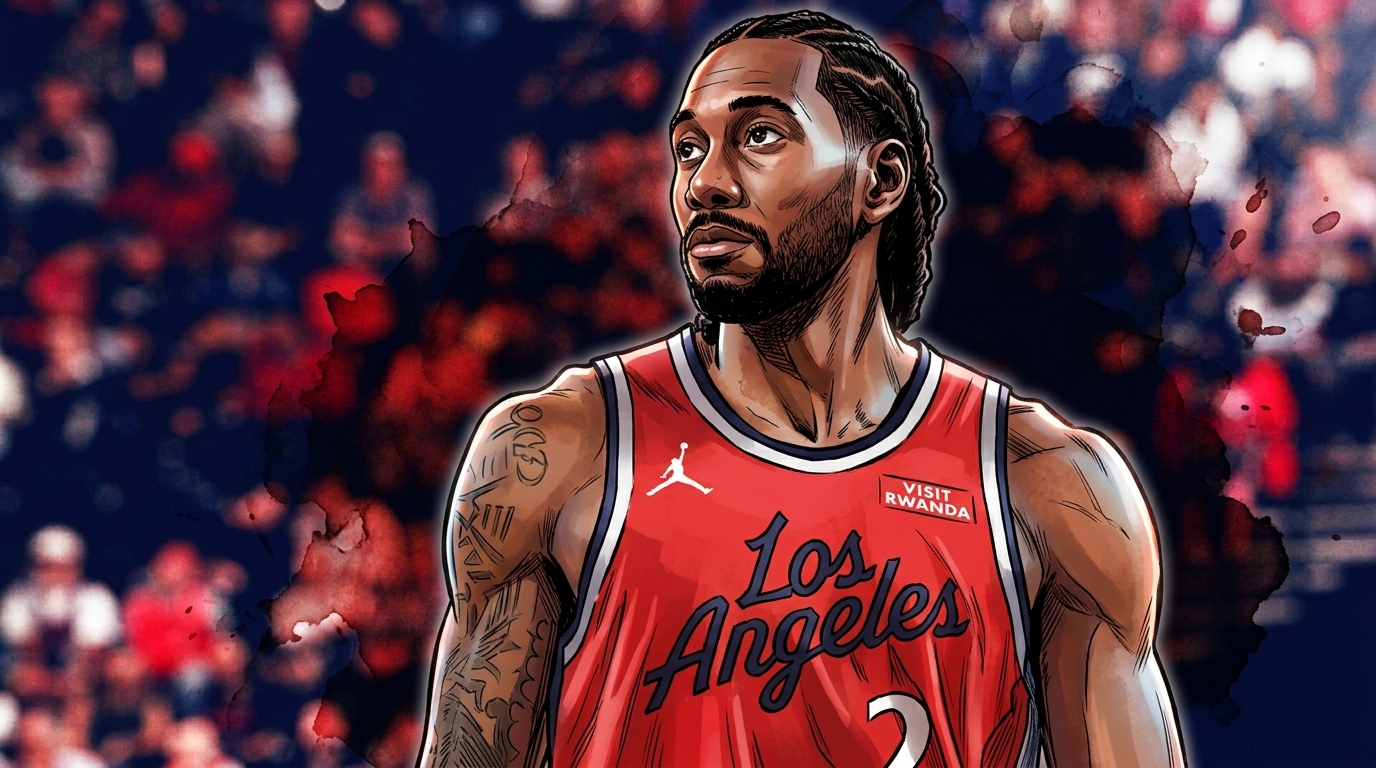
The cleanest summary of where the NBA’s salary cap enforcement actually stands is this: the league caught one of its most brazen alleged circumvention schemes not because it was watching, but because a startup went bankrupt.
We are living through the consequences of that distinction right now, and they are considerable. A trade everyone agreed to — Kawhi Leonard to the Toronto Raptors, in exchange for Brandon Ingram, Gradey Dick, and a haul of draft capital — is sitting frozen because the Los Angeles Clippers are under active NBA investigation for allegedly routing $28 million in hidden compensation to Kawhi through a now-defunct green fintech company called Aspiration. The trade was agreed June 30. It has not been finalized. It may not be finalized for weeks.
The Raptors, to their credit, said exactly what needed to be said: they “remain eager to bring Kawhi back to Toronto and look forward to a swift resolution.” The subtext being that they are not willing to assume liability for whatever penalties the NBA might ultimately impose — a reasonable position, since the league hasn’t told anyone what those penalties are yet, because outside counsel hasn’t finished the investigation yet.
Shams Charania broke the hold news on July 9, with the Clippers issuing a statement insisting they “did not funnel money to Kawhi Leonard through Aspiration” and positioning the organization as victims of the fraud.
https://twitter.com/ShamsCharania/status/2075293917118136739
The alleged mechanism, per CBS Sports, is not complicated: Kawhi had a $28 million, four-year endorsement deal with Aspiration signed in 2022 that allegedly required little or no actual work, with payments guaranteed as long as he remained on the Clippers. If accurate, that’s shadow salary — compensation that doesn’t count against the cap because it’s technically from a third party, except the third party was functionally a Clippers-adjacent entity. The Clippers also had a $300 million, 23-year naming partnership with Aspiration. (The league, noticing none of this in real time, became aware of it only after Aspiration collapsed and its books became a public matter.)
Aspiration’s co-founder, Joe Sanberg, pleaded guilty to two counts of wire fraud — defrauding investors and lenders of $248 million — and was sentenced to 14 years in federal prison. He did cooperate with the NBA investigation, sitting for two in-person interviews and providing documents; the league acknowledged his cooperation “substantially assisted” the process. Steve Ballmer, who personally invested $60 million in Aspiration, has told a federal judge he had no knowledge of Kawhi’s endorsement deal and considers himself a victim. That may be true — fraud victims are common in schemes run by convicted fraudsters — but it does not resolve the league’s core question, which is whether cap circumvention occurred regardless of who knew what.
Pablo Torre’s podcast won the 2026 Pulitzer Prize in Audio Reporting for its coverage of this scandal. That’s not a footnote. A Pulitzer for sports audio is the kind of recognition that confirms this story is genuinely aberrant, not just another dreary cap-compliance sidebar.
I think the Clippers’ “we were victims” framing is probably partially true and almost entirely irrelevant to the NBA’s problem. Whether Ballmer knew about the Kawhi deal matters for criminal exposure; it doesn’t necessarily matter for whether the Clippers received a competitive advantage they weren’t entitled to. The two questions are legally distinct, and the league has to answer both.
The more unsettling question — the one the investigation has forced into the open without being willing to answer — is how widespread this is. The NBA’s cap monitoring has always been reactive. Teams submit contracts; the league reviews them. What the Aspiration situation revealed is that the monitoring never really extended to third-party arrangements that were structured to look like endorsement deals. The league caught this one because the company went bankrupt and its records became accessible. It did not catch it because anyone was watching. That is a meaningful distinction.
I believe the freeze on this trade is ultimately going to resolve in a way that lets Kawhi get to Toronto — the trade makes too much sense for too many parties, and the Raptors are not going to walk away from it. But the resolution is going to come with a fine that the Clippers absorb, possibly some draft penalty, and a lot of league-wide language about “strengthening oversight of third-party compensation arrangements.” The oversight will be strengthened in ways that make it marginally harder to get away with this particular structure — not in ways that eliminate creative compensation entirely, because the league doesn’t actually have the infrastructure to monitor that, and everyone involved knows it.
Kawhi, for his part, has said nothing. He rarely does. The most taciturn star in the league, now frozen in the most legally absurd limbo the league has ever constructed, is waiting — the same way he has waited out injuries, franchise situations, and every other complication of a career that has always seemed to operate slightly outside normal league physics. The Raptors are waiting. The Clippers want the cap relief badly enough to keep cooperating with an investigation that implicates them. And the NBA is waiting on outside counsel.
Watch for two things: when the investigation timeline gets a hard deadline (right now “coming weeks” is doing a lot of work), and whether any other team’s compensation arrangements get mentioned in the eventual findings. The Kawhi freeze is singular. The lesson it teaches about league monitoring is not.