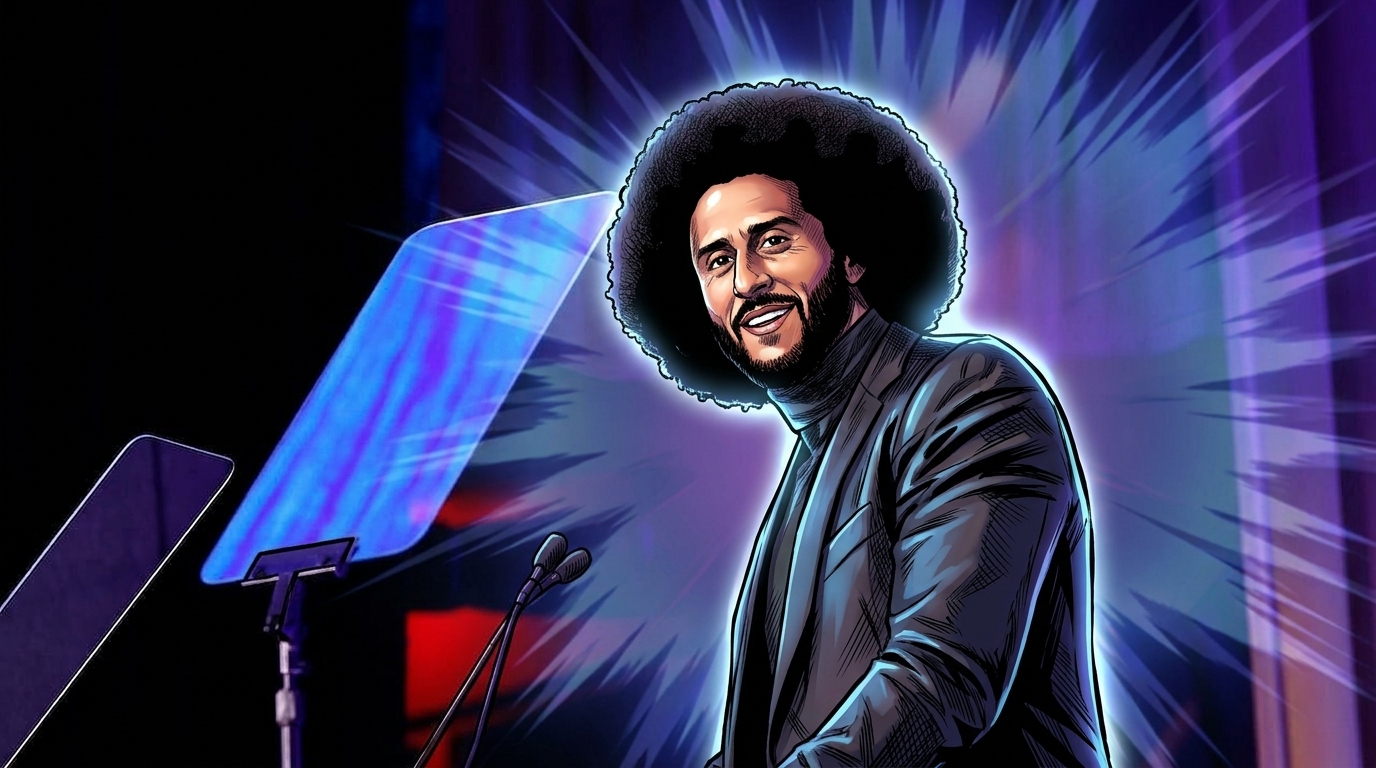

I spent enough time inside K-pop fandom Twitter during undergrad to recognize this pattern on sight: a comeback teaser drops, thirty seconds of nothing, and by morning two camps have already litigated a record that doesn’t exist yet. Nobody has heard a bar. Everybody has a verdict. The teaser was never the argument. It’s just the occasion for an argument that was already loaded, sitting there, waiting on something to fire it.
Colin Kaepernick’s publisher put out a two-paragraph description of a book that won’t exist for another six weeks, and by the time I’d read it twice, the reaction had sorted itself into the same two camps it’s occupied since 2016. What’s worth sitting with isn’t that people disagree about Kaepernick. That’s not news. It’s how little the argument needed to relaunch. A title, a release date, and a pull quote about sacrifice were enough to reopen a fight nobody agreed was settled. Nobody was actually waiting on information. They were waiting on an occasion, and this week the occasion showed up.
Colin Kaepernick, the former San Francisco 49ers quarterback, announced The Perilous Fight on April 7. “What would you sacrifice for what you believe in? I gave up everything. And I’d do it again,” he wrote. “The world has been telling my story for ten years. It’s my turn.”
https://twitter.com/Kaepernick7/status/2041522660086075656
Legacy Lit, the Hachette Book Group imprint under Grand Central Publishing, will release the book September 15, 2026, in hardcover and eBook, with an audiobook narrated by Kaepernick himself, exclusive to Audible.
The publisher’s description calls it “equal parts memoir and manifesto,” tracing Kaepernick’s path from Turlock, California, where he grew up a Black kid adopted into a white family, through what it describes as the off-the-field battles that turned a single act of protest into a movement that changed American sports and culture.
None of that is a plot. It’s flap copy, engineered the way all celebrity-memoir flap copy is engineered: promise depth, spoil nothing. And still, the discourse arrived before the book did, fully formed, arguing about pages that don’t exist yet.
The date isn’t random. September 15 lands two weeks after September 1, the ten-year anniversary of the first time Kaepernick knelt during the national anthem. That anniversary is the real subject here, more than anything he’s actually written down. Ten years after he first took a knee, the country still hasn’t agreed on what that Sunday was — a quarterback sacrificing his career for a principle, or the moment the NFL learned it could quietly make an inconvenient player disappear. The Perilous Fight isn’t out until September, and it won’t settle that argument. It just gives both sides a new place to keep having it.
You can watch the split happen in the replies to the announcement. One fan wrote that “only in the U.S. would a person with such disrespect for their government be worth millions of dollars off of that stunt,” and dismissed him as irrelevant. Another called him a hero outright: “Kaepernick gave up everything in the name of fighting for justice.” OutKick’s coverage split the difference into dismissiveness, questioning whether the book has anything new to say and joking that it’s headed for the clearance pile. Three readings, and not one of them has opened the book.
I studied enough sociology to recognize what’s actually being fought over, and it isn’t sales. It’s custody. Whoever gets to narrate 2016, as principled sacrifice or as opportunistic theater, gets something close to ownership over what the NFL is allowed to mean going forward. That’s a bigger prize than a first printing, and it explains why a two-paragraph announcement generated more heat than most finished books manage on release day.
This isn’t the first time a moment nobody actually witnessed together got reinterpreted into a referendum on something much bigger than itself. Sports and politics colliding in real time tends to produce the same shape of argument no matter the sport, the venue, or the decade. The specifics change. What people are actually fighting about rarely does.
What happens on September 15 is almost beside the point. Depending on who’s asked, the book will confirm a decade of martyrdom or expose ten years of grievance marketing, and both verdicts were written before anyone had a chance to read a page. The discourse cycle doesn’t need a finished book. It needs a date on a calendar and a country still arguing about what a Sunday in 2016 was supposed to mean.
I don’t know what The Perilous Fight will actually say. I’m not sure it matters as much as this week suggested it would.