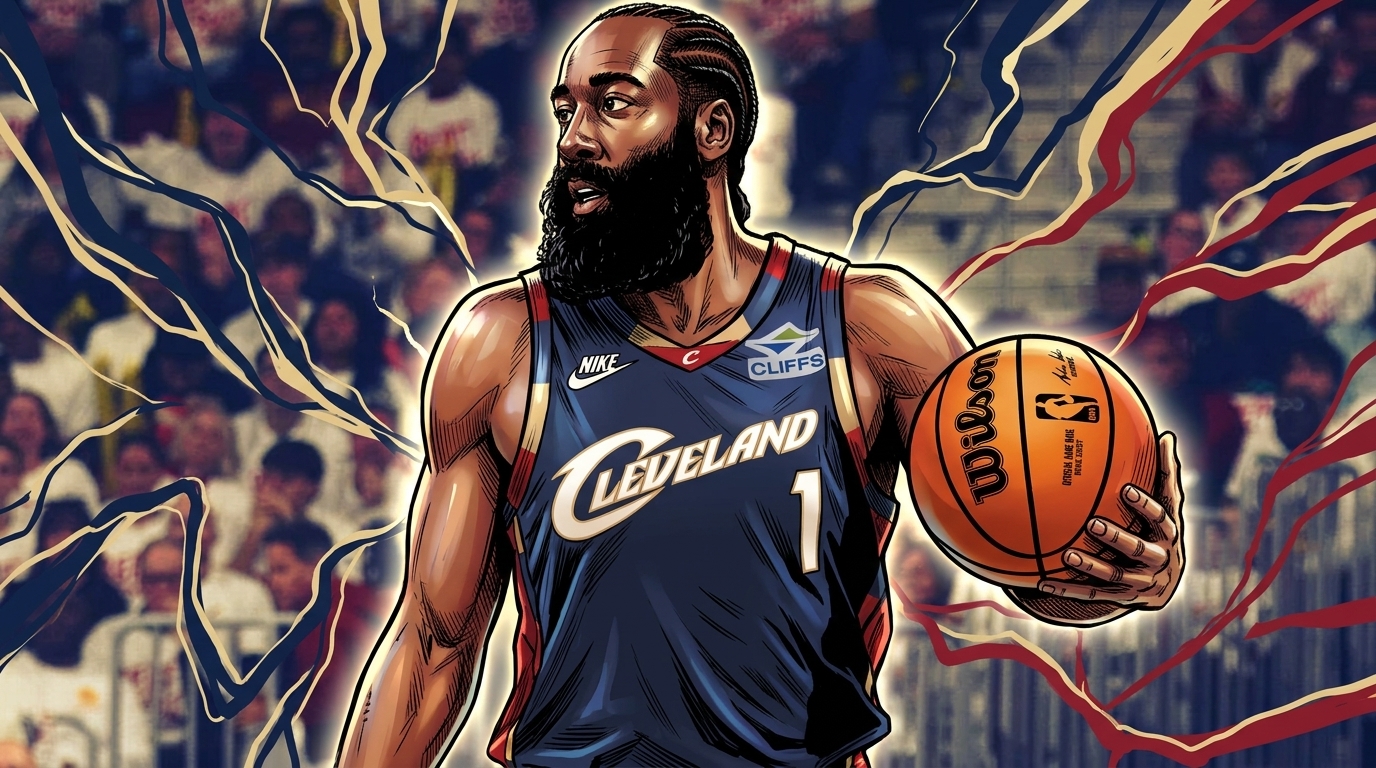

James Harden just turned down $42.3 million. Guaranteed. For one season. Nobody who has watched him walk through four franchises and every contract standoff along the way would have called this.
Harden is declining his 2026-27 player option with the Cleveland Cavaliers, and instead of cashing that number, he’s working with the front office on a new multiyear deal that lands somewhere around two years and $60 million combined. That’s less annual money for more years of commitment, and it’s happening for one specific reason: to keep Cleveland out of the NBA’s second luxury tax apron.
Shams Charania first reported the decision for ESPN, and the corroboration since has been immediate.
https://twitter.com/ShamsCharania/status/2071582018119389273
Harden has spent his career maximizing single-season money, or forcing his way out the door when a franchise wouldn’t pay it. This is neither. This is a discount, taken voluntarily, to fix a cap problem that isn’t technically his to fix.
Why Would Harden Take Less Money Across More Years?
Harden is walking back from $42.3 million in guaranteed 2026-27 money to sign a deal that pays him roughly $30 million a year over two seasons, a decision that only makes sense if you assume he cares more about Cleveland’s financial flexibility than his own single-year ceiling.
Except this isn’t actually the first time. Harden forced his way out of Houston in 2020, forced his way out of Philadelphia in 2023, and in between those two exits, he opted out of a $47.4 million player option with the Sixers specifically so the front office could afford P.J. Tucker and Danuel House Jr. in free agency. The pattern already existed. What’s different this time is the size of the number he’s leaving on the table and the fact that Cleveland, unlike that Philadelphia team, isn’t paying him back with a title window that’s already open.
HoopsRumors reports the new deal is built specifically to get Cleveland under the second apron, which means Harden isn’t taking a discount because his market dried up. He took less because the roster needed him to.
What Does the Second Apron Actually Cost a Team?
Crossing the second apron strips a team of the full midlevel exception, blocks salary aggregation in trades, and freezes a first-round pick seven years out if the team stays over the line. Those three penalties turn a championship-caliber roster into one that can barely fix itself in February.
Start with the exception money. A team above the second apron loses the full midlevel exception and gets bumped down to the taxpayer version, projected at roughly $6.1 million for 2026-27, or something like $12.5 million across two seasons. That’s the gap between signing a rotation guard who can defend in a playoff series and signing whoever’s left after every other contender has already picked through the buyout market.
Then there’s the trade rule, and this is the one that actually breaks a front office’s ability to operate. Second-apron teams can’t aggregate outgoing salaries. No packaging two $15 million players to match a $30 million incoming contract. Every trade has to clear close to one-for-one. That restriction would have made the deal that actually brought Harden to Cleveland — Darius Garland and a second-round pick going back to the Clippers — a much harder trade to build if Cleveland had needed to combine multiple smaller contracts to get there instead of moving one player straight up.
The pick freeze is the scariest part, and the mechanism is worth being precise about: it isn’t a penalty Cleveland has already triggered. It’s the rule the Cavaliers are trying to stay far enough from that it never gets the chance to apply. Spend enough seasons above the second apron and a future first-round pick locks in place, unable to move in a trade, and stay over the line long enough and that same pick can drop all the way to 30th regardless of record. Teams don’t get those assets back. They just stop having them.
How Much Does Cleveland Actually Save?
Cleveland trades $42.3 million in one-year guaranteed money for a deal that pays roughly $30 million annually over two seasons, freeing up room exactly where the roster was tightest. The Cavaliers carried the NBA’s highest payroll a season ago, and this offseason’s roster commitments already sat within single-digit millions of the second-apron line before the last two spots were even filled.
Public cap-tracking sites had Cleveland’s twelve returning contracts at roughly $224.7 million against a second-apron threshold near $221.7 million. Fill the final two roster spots with anything close to minimum-salary money and the team lands somewhere around $8 million over the wall it’s trying to duck under. Harden’s discount, on its own, is bigger than that entire gap.
What Does Cleveland Get Back for the Discount?
Cleveland gets back the tools an actual roster overhaul requires: the full midlevel exception instead of the taxpayer version, the ability to aggregate salaries in trades, and a future first-round pick that never gets frozen. None of that was available to a team stuck above the second apron.
This is where the real story lives. Harden’s discount buys optionality around a core still built with Donovan Mitchell at the front of it, for a front office that just watched this roster reach its first Eastern Conference finals since 2018, where the Knicks swept them. A team that just tasted that far into the playoffs and got cap-frozen the next morning would have nothing to show for it but the memory. Cleveland now has the tools to build past it instead.
Nine months ago, watching Harden shoot 43.5 percent from three in the regular season and then 29.9 percent in the playoffs, the read on him was simple: an aging guard chasing one more ring on reputation, with a shooting number that fell off a cliff exactly when it mattered most. That read isn’t wrong so much as incomplete. The player who forced his way out of three prior franchises just handed his fourth one the exact contract the front office needed to keep building around him. Give me the version of Harden who understood the math better than anyone expected him to.