
Sometime before September, approximately 160 ESPN employees will pack up their things at LA Live, drive southwest and move into the building that used to belong to NFL Network — the network ESPN bought from the NFL, which also accepted a 10% equity stake in ESPN as part of the deal. They will share a facility adjacent to SoFi Stadium, which is the NFL’s stadium. They will probably share a cafeteria.
This is not a metaphor. It is a lease arrangement. That’s what makes it interesting.
ESPN’s official announcement described “a consolidated West Coast production center at Hollywood Park in Inglewood,” noting that the facility “will continue to serve as the home of NFL Network and NFL RedZone while also adding NBA Today and WNBA Countdown.” The statement is technically accurate the way a real estate listing is technically accurate — all the facts are present, the arrangement itself remains unexamined. What the statement does not address is the ancient journalistic question of who covers the people who pay the bills. The people who cover NFL officiating controversies will now be doing it inside a building that the NFL built, adjacent to a stadium the NFL filled, for a company the NFL partially owns. The cafeteria metaphor does actual analytical work here: you cannot have a theoretical newsroom wall when you are eating lunch down the hall from the subject of your coverage.
When the original acquisition closed in January, the official framing was consolidation, efficiency, synergy — the usual vocabulary of corporate mergers that don’t want to be examined too closely. What nobody spent much time on was the history of what NFL Network actually was. The league created it in 2003 for one specific reason: to control its own narrative. To have a network that would cover the NFL the way the NFL wanted to be covered; that would not have an institutional interest in asking hard questions about concussions, or officiating, or labor negotiations, because the institution asking those questions was the same one that signed the checks. That was the original NFL Network. ESPN just bought it, and now they’re moving in.
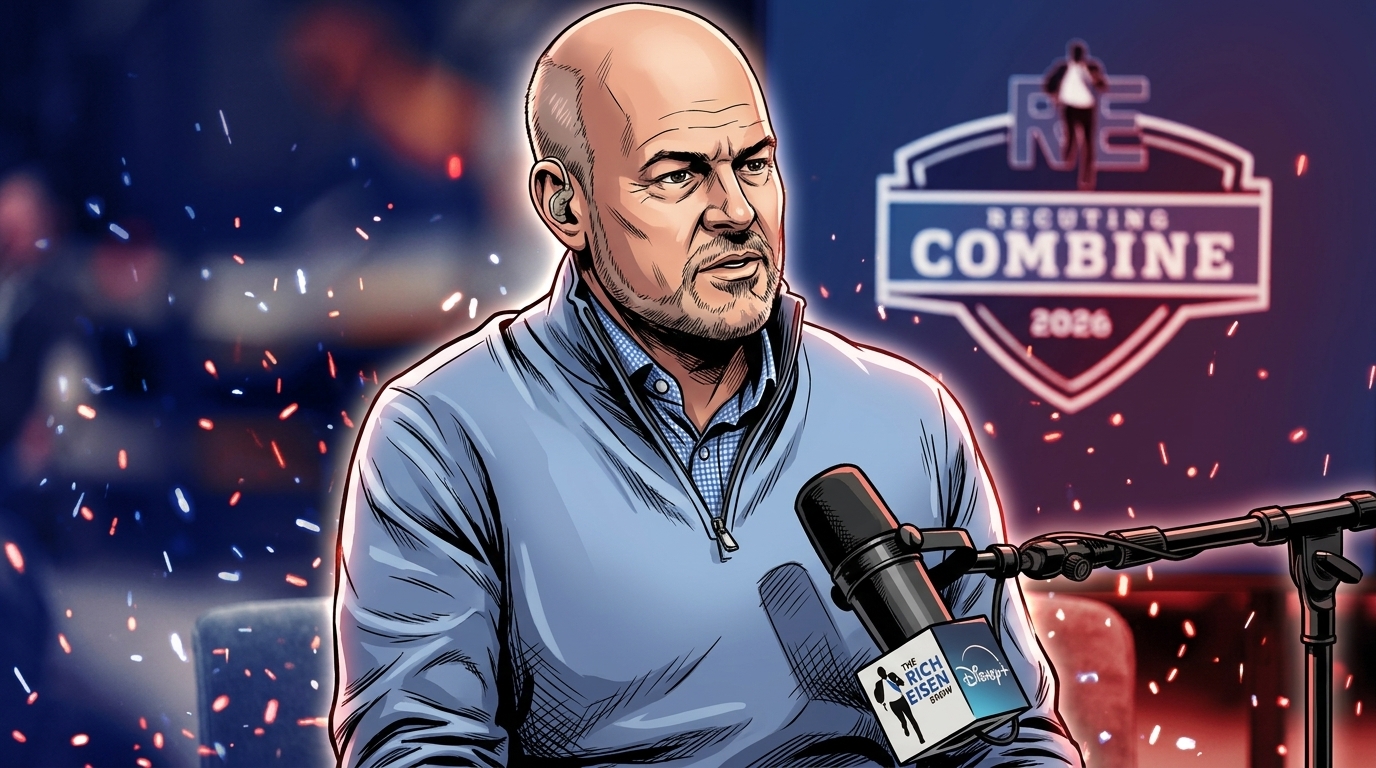
Rich Eisen, who spent 23 years building that network, gave an emotional farewell in the spring. “I feel like we’re being dropped off at college,” he said. “We are grown, we are mature, and we’re still growing.” It is a generous way to frame a situation that is more specifically: the entity that employed you to cover a league has been absorbed by the entity that has the most to lose from aggressive coverage of that league. Eisen has since returned to Bristol to host SportsCenter, which is its own kind of full circle.
https://twitter.com/awfulannouncing/status/2043544800809595258
The detail worth keeping in mind: the NFL retained full editorial control of RedZone. Disney got the linear distribution rights; Scott Hanson stayed an NFL employee. So the separation of content-creation-from-distribution still technically exists, in the most technical sense possible, in one corner of this arrangement. ESPN covers the NFL; the NFL controls what gets shown on RedZone; everyone shares the Hollywood Park zip code. The wall is not gone. It’s just that nobody is quite sure which side of it anything is on anymore.
This is what ESPN’s ongoing expansion in sports media actually looks like at the endpoint: not a scandal, not a dramatic moment of capture, but a lease renewal. The LA Live studios opened in 2009. They ran for seventeen years. Now they’re closing, and the people who worked there are moving into a building the league built to cover itself. There will be no hearing. There will be no reckoning. There will be, presumably, parking validation.
The most clarifying thing about this whole arrangement is that nobody involved seems to find it particularly clarifying. The deal was announced, the building move was announced, the employees were told they were not being laid off; the machinery of sports media absorbed itself and kept moving. Which is, in its way, the story. Not a scandal but a reclassification. Not the end of independent sports media but a memo confirming that it had already ended, and here are the new office directions.