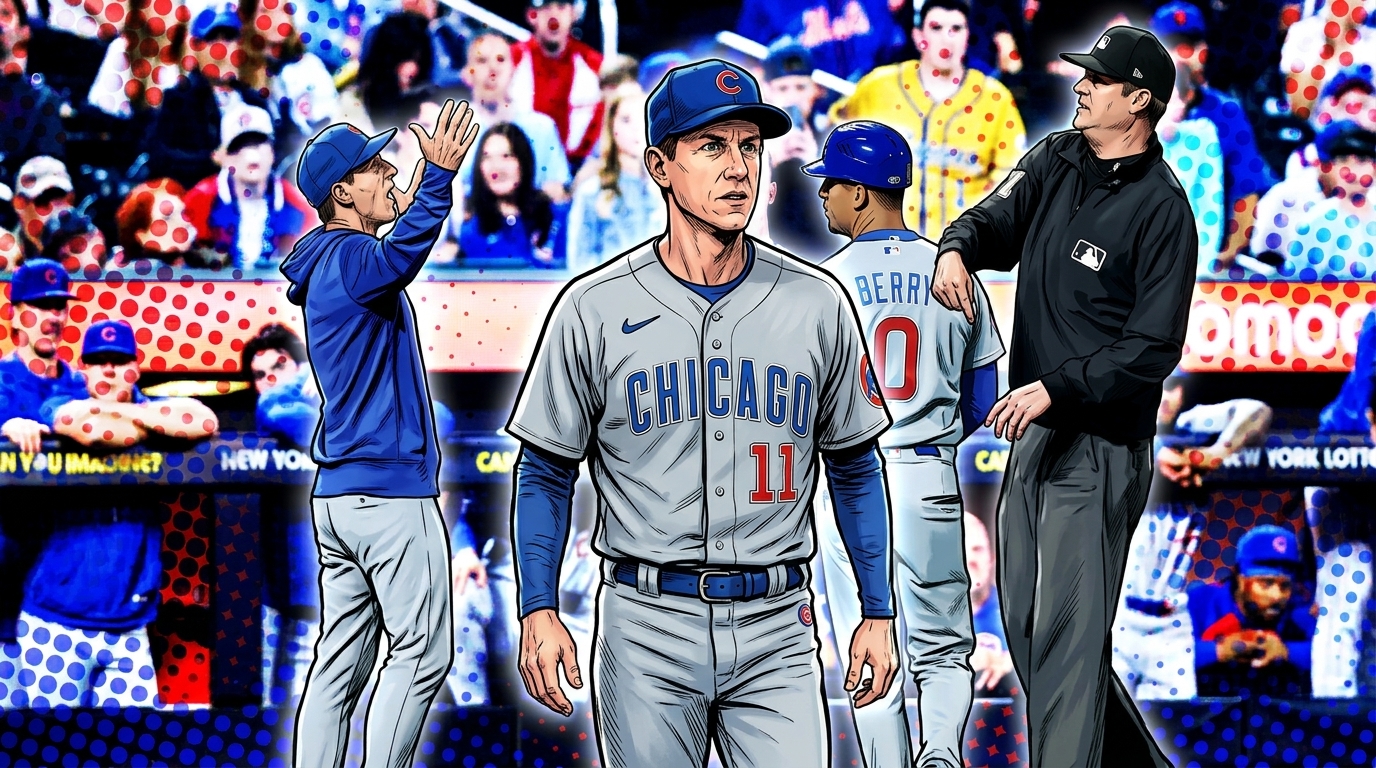

As of late June 2026, the Chicago Cubs have lost four of five Opening Day starters to injury: Cade Horton (season-ending Tommy John), Justin Steele (left elbow, likely done for 2026), Edward Cabrera (hamstring), and Jameson Taillon (hamstring), with Matthew Boyd also sidelined. That is 80 percent of a rotation that, in March, looked like a genuine asset. What remains is a depth chart Jed Hoyer is describing as a plan.
It isn’t one. It’s The Depth Ledger — the gap between what an organization says it has available and what those arms can actually deliver in starts, innings, and run prevention. When you run the Ledger on the 2026 Cubs, the math is unambiguous.
The Depth Ledger: Five Starters, Five Outcomes
The Opening Day rotation Hoyer assembled was legitimate. Matthew Boyd had been an All-Star in 2025 (14 wins, 3.21 ERA) before a hamstring sent him to the IL before the season fully found its rhythm. Cade Horton was the real prize: the NL ROY runner-up in 2025, electric stuff, a future ace trajectory. He went in for his second Tommy John surgery, a full UCL reconstruction — not the internal brace procedure that sometimes allows faster timelines. He won’t pitch in meaningful games until mid-2027, at the earliest.
Justin Steele never threw a pitch this season. Hoyer said on The Score it would be “unrealistic to expect Justin Steele to start for the Cubs in 2026.” That is a soft IL in everything but bureaucratic categorization. Edward Cabrera was carted off the field June 23 with a hamstring injury, out for weeks at minimum. Jameson Taillon went down with his own hamstring strain, two soft-tissue injuries running concurrently.
Ben Brown, a depth arm the Cubs needed more than they expected, is out with a neck stress reaction.
Five rotation members. Five IL trips.
Woof.
Dansby Swanson, who has been around professional baseball long enough to have perspective, put it plainly: “I’ve truly never really been a part of something like this, this extreme and drastic.” Craig Counsell, to his credit, wasn’t spinning: “We’re in a rough spot. I think we can get through it.”
Is the Cubs’ Rotation Collapse a Jed Hoyer Failure?
Yes — not because injuries are preventable, but because organizational depth is a choice. The Cubs entered 2026 with their entire rotation depth anchored in the major-league roster. There was no surplus. When four starters fell, the depth chart collapsed because there was nothing underneath it deep enough to hold. That is a front-office construction failure, and it was hiding in plain sight.
The “Mostly Internal” Inventory
Hoyer acknowledged the scope of the crisis to the Sun-Times: “We kind of have a rotation on the IL right now.” He also said the Cubs would be “going to be mostly focused internally” for rotation help leading to the deadline. I run three different projection models for my fantasy leagues. I ran the Cubs’ internal options through all of them. Here is what “mostly internal” actually looks like:
Shota Imanaga is the anchor: a genuine ace, posting roughly a 4.04 ERA across 64.2 innings in 2026. He is reliable. He is also the only anchor. The innings ceiling on an ace is around 200 per season; he cannot absorb the workload of a collapsed rotation around him.
Javier Assad posted a 3.65 ERA when healthy, which sounds encouraging until you learn he threw only 37 innings in all of 2025 due to injury. He is serviceable. Whether he can handle a starter’s workload over the back half of a full season is an open question, one the Cubs cannot afford to answer optimistically.
Colin Rea is a depth arm, full stop. Re-signed with a 2027 option, 4.99 ERA in 12 starts this season. His ceiling is a spot start and a bullpen game. He is not a rotation solution.
Triple-A options include Vince Velasquez and Gavin Hollowell, who have inspired limited confidence among the Cubs’ realistic replacement options per Bleacher Nation’s coverage.
https://twitter.com/BleacherNation/status/2040430230297301003
The Cubs did acquire David Peterson from the Mets on June 25, a 2025 All-Star and a real arm. That is one external addition to a void that needs three. “Mostly internal” is not a rotation. It is a math problem with no good solution.
What History Says About Teams That Lose Their Rotation
Two useful comps from recent memory.
The 2024 Tampa Bay Rays lost Shane McClanahan, Shane Baz, Jeffrey Springs, Drew Rasmussen, and Taj Bradley, all of them gone for significant stretches, several with Tommy John. The Rays were widely praised for organizational depth and pitching development. They finished 80-82. Even elite depth systems cannot absorb five simultaneous starter losses and remain competitive. The Rays won 80 games in a year they were expected to contend.
The 2024 Los Angeles Dodgers used 17 different starting pitchers due to injuries and won the World Series. Hoyer’s front office would love that comparison. There is one problem: the Dodgers carried a $300-plus million payroll and had 17 viable major-league arms in their organization. The Cubs are not the Dodgers. When you lose five starters and your replacement-level options are Colin Rea and Triple-A arms inspiring limited confidence, the Rays model is what history actually offers.
Rotation depth isn’t just a developmental philosophy. Under the incoming MLB salary cap, it will become a structural constraint: teams that fail to develop pitching depth internally will have fewer dollars to patch it externally. The Cubs are getting a preview of what that pressure looks like right now, before the rules even formally change.
The data here is unambiguous: teams that lose 80 percent of their rotation in a single season contend at a dramatically reduced rate. The comps that survived were the outliers with extraordinary depth reserves. The Cubs do not have them.
The One Variable That Makes This Different
Shota Imanaga is the only true ace on this staff. That sentence does more analytical work than it might appear to.
Most rotations absorb injury better because they have two or three legitimate starters who can carry adjacent innings. When one goes down, the second absorbs more, the third holds the floor. The Cubs’ floor, right now, is Imanaga at the top and then a significant drop to Assad and Rea. There is no second ace to split the load.
This matters for run prevention across the full season, but it matters even more for playoff positioning. The Cubs are competing in an NL Central that, even in a down year, punishes inconsistency. Every start Rea makes instead of Horton, every game Assad is stretched beyond his 2025 workload, is a coin flip on what kind of outing the lineup gets.
Consider the baseline of historically rare pitching durability: even when individual pitchers sustain extraordinary run prevention, team-level rotation failures are almost impossible to overcome without depth. Imanaga can be everything this rotation needs from him. He cannot be two of the five spots.
Where This Leaves the 2026 Cubs
Hoyer will be active at the deadline: Peterson is the first move, not the last. But a deadline rotation acquisition at market price, added to Imanaga and Assad and the triage that fills out the back end, projects to a team that wins somewhere between 78 and 84 games. That is not a contender. That is a team trying to stay relevant enough to justify the spending.
The core position players (Swanson, Ian Happ, Nico Hoerner) are not the problem. The offense has kept this team alive. What the rotation failure exposes is that Hoyer built this year’s window around starters who all needed to stay healthy, with nothing behind them deep enough to matter when they didn’t.
This isn’t bad luck dressed up as a disaster. It’s an organizational depth failure that bad luck finally revealed. The Depth Ledger doesn’t lie: what Hoyer has available and what he needs are not the same list, and they won’t be by the trade deadline either.