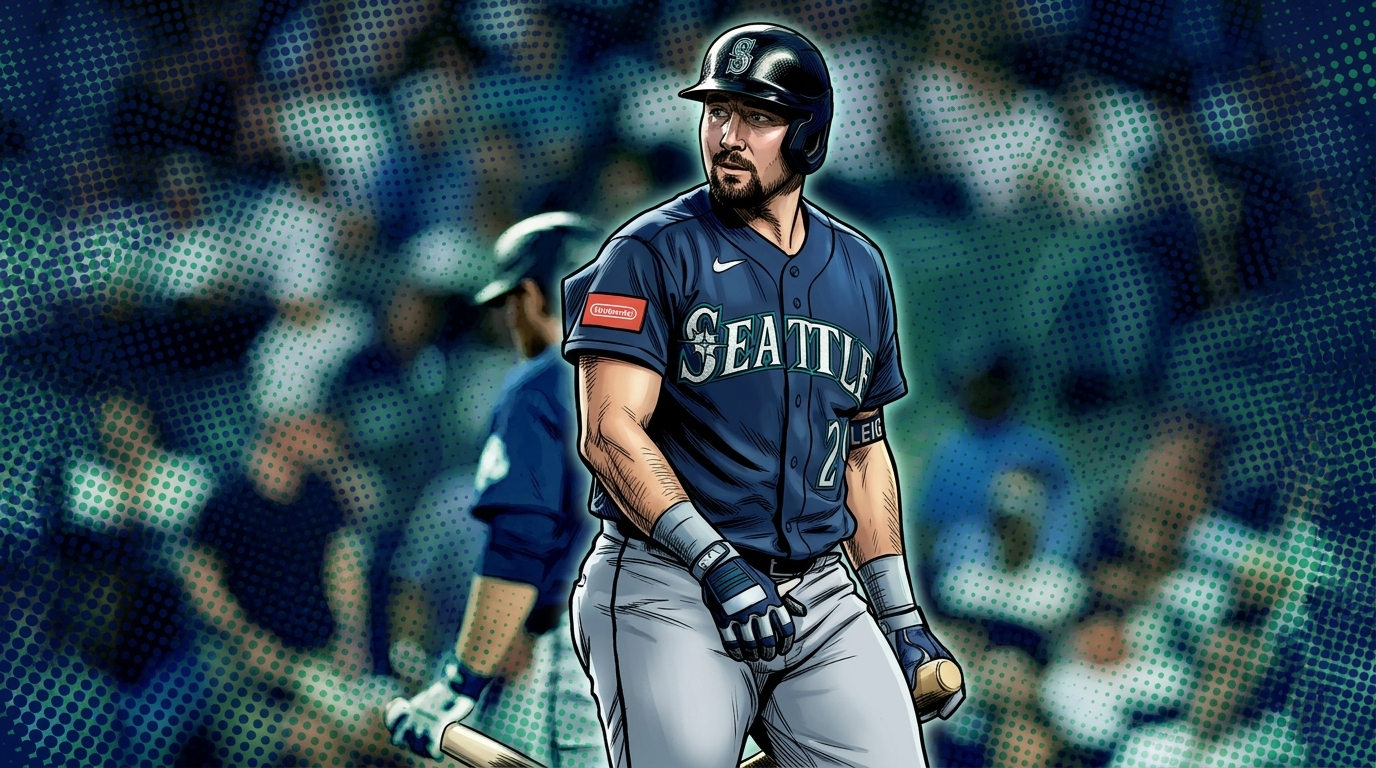

The most clarifying thing about Aroldis Chapman breaking the all-time relief pitcher strikeout record on the Fourth of July is that Boston is almost certainly going to trade him before August.
That’s not an indictment of Chapman, or of the Red Sox, or even of the trade deadline as an institution. It’s just the correct summary of what his career has always been: a man who arrives somewhere, dominates for a stretch, and departs before anyone has to formally decide what he means. On July 4, 2026, in Anaheim, Chapman threw a 98.6 mph fastball past Denzer Guzman for his 1,364th career strikeout, surpassing Hoyt Wilhelm’s record that had stood since 1972. He got his 17th save of the season. The Red Sox won 5-2. And his 0.46 ERA this year is the kind of number that makes every contender’s front office immediately start doing math.
Think of it this way: MLB teams have treated Chapman like a rental car for going on fifteen years. They acquire him — usually cheap, usually after something bad happened somewhere else — they drive it extremely hard for four to six months, they return it, and they let the next renter discover that the engine still works fine. The Reds ran him hard. The Yankees traded him mid-season to the Cubs, who used him to win a World Series, then watched him walk back to New York. The Royals had him for two years and released him. Texas picked him up, won a World Series, and moved on. Pittsburgh took a flier. Now Boston has him, and the speedometer reads 1,364 strikeouts, and the rental company is already fielding calls.
The rental car metaphor breaks down in one specific way: Chapman keeps appreciating. Most things you run hard depreciate. He’s 38 years old and posting the best ratios of his career in the back half of his career’s final act — which is, depending on how you count, his fourth different final act. That’s the part of the story nobody quite knows how to process; the career arc doesn’t follow the expected shape, so the system just keeps recycling him through new cities and new “redemption” frameworks and new sets of teammates who are briefly astonished that 98 mph is a real thing a human arm produces.
https://twitter.com/MLB/status/2073258697724248501
Wilhelm’s record, for context, took 1,872.1 innings over 21 seasons to accumulate; Chapman reached 1,364 in roughly 847 innings. The efficiency gap is startling even if you account for eras — Wilhelm was a knuckleballer who worked deep into games because relievers did that in 1952, and Chapman is a ninth-inning specialist who throws 15 pitches and sits down. The comparison is almost comically unfair, which is part of why the record held so long; there just weren’t many Chapman-shaped careers to threaten it. You need someone who can miss bats at a historic rate for a very long time across a lot of different uniforms.
What the uniform column reveals is the system’s logic. Every team that discarded Chapman gave some version of the same reasoning: diminishing velocity, high walk rate, volatility, contract situation, age concerns. And every team that picked him up got three-to-eighteen months of a pitcher who could still end a game faster than anyone else in the sport. The CBA’s structure around one-year deals and trade deadline rentals created exactly the incentive to cycle through him rather than build around him; nobody commits, everybody profits briefly, and the guy accumulates a record in somebody else’s jersey.
The counterargument is that this was always how relief pitching worked — that the fungibility is feature, not bug, and Chapman’s longevity is proof the market priced him correctly each time. Maybe. But the Red Sox sweeping the Yankees earlier this season with Chapman as closer, and now holding the most historically valuable relief arm available at the deadline, suggests the market keeps underpricing what he actually is: a finisher who still finishes.
He said after the game that he felt “very happy, very proud” and “very satisfied.” That’s it. That’s the quote. Fifty-four years of one man’s record; a career built across eight stops and two World Series rings and a domestic violence suspension and four different final acts; a 98.6 mph fastball on a national holiday — and the man who just etched his name into the permanent ledger of the sport told a reporter he felt satisfied.
The Boston franchise will get credit for the historical peak. Chapman will get his save. The next team that acquires him will get four months of the same thing everyone else got, and they will eventually return the car.
The record, at least, stays.