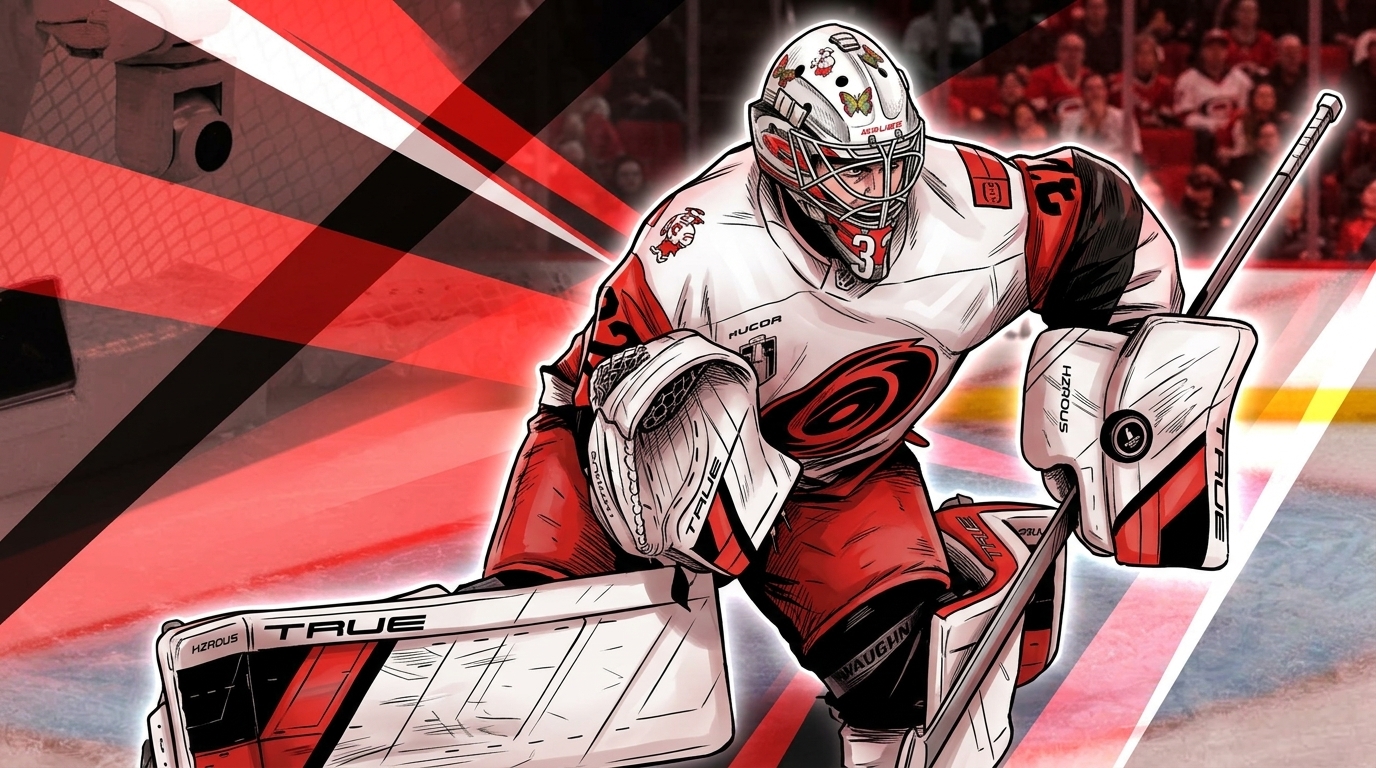

On October 5, 2025, every NHL team had twenty-four hours to decide whether Brandon Bussi was worth a roster spot; twenty-nine of them decided he was not, and the one that disagreed just won the Stanley Cup.
That is the whole story, more or less. The rest is detail work — how he wound up in that waiver window in the first place, what the organizations that passed were actually evaluating, what it means that Carolina’s evaluation was correct and every other team’s was wrong. But the shape of the thing is simple: a 24-hour window, thirty chances, twenty-nine misses, one Stanley Cup.
The procedural backdrop is not complicated. Florida put Bussi on waivers on October 5 because they’d signed him as an unrestricted free agent over the summer, he couldn’t win a camp roster spot, and they needed him in Charlotte — but first he had to clear. He was in his car, driving to Charlotte for AHL duty, when Carolina claimed him. The Panthers, for context, are the defending Stanley Cup champions. They evaluated Bussi in a live NHL training camp setting and concluded he was an AHL depth option. That evaluation is now on the record.
Boston had a longer look. Four years in Providence, 111 AHL games, 63 wins, a 2.61 GAA, a .915 save percentage, an AHL All-Rookie Team selection. The Bruins’ conclusion, after four years of primary-source evidence: Jeremy Swayman and Linus Ullmark were better, Bussi had no path, let him walk as a UFA. That is a defensible position — Swayman and Ullmark are both NHL-caliber starters; AHL goaltenders blocked by Vezina winners are not always Stanley Cup material. But Boston is also working with four years of data that Carolina used to decide Bussi was worth a three-year, $5.7 million contract extension before the playoffs even started. The same evidence. Different conclusions.
That extension, signed at the Olympic break in February, is the part that does not get discussed enough; it means Carolina’s belief in Bussi was not a panicked crisis response when Andersen went down in Game 3 of the Final — it was a considered organizational position. GM Eric Tulsky looked at the same player the rest of the league had either released, ignored, or not bothered to scout, and decided to lock him up for three years at real money. The claim in October was opportunistic; the extension in February was conviction.
Andersen started every playoff game through the first three rounds and the first two games of the Final. Bussi was the backup, then the backup in a Cup Final, then — after Andersen’s knee in Game 3 — the starter. Brind’Amour was straightforward about the Game 4 decision: “We went with the other guy. And if you’re gonna give [Andersen] a break, you need to give him a break. Him dressing and going through all that isn’t really giving him a night off.” The other guy went out and made 18 saves. In Game 6, at T-Mobile Arena in Las Vegas, he stopped 22 of 22 and Carolina won the Cup 3-0.
https://twitter.com/espn/status/2066360018098688485
The numbers from the playoff run are the kind that make evaluation frameworks uncomfortable: 3-1 record, 1.60 GAA, .931 save percentage. He became the third first-year goalie in NHL history to post a shutout in a Cup-clinching game — the second undrafted goalie to do it in the draft era, after Bernie Parent. These are not small numbers buried in context. They are visible, large, and now attached to a championship.
https://twitter.com/h_kirk6/status/2064553276352373200
The charitable read on the twenty-nine teams is that goaltending evaluation is genuinely hard; that AHL data translates imperfectly; that every roster decision involves tradeoffs and Bussi specifically involved blocked pathways that look different in retrospect than they did in real time. All of that is true. The uncharitable read is that a 27-year-old from Sound Beach, New York, with four years of clean AHL data and no obvious mechanical red flags, went unclaimed because the teams reviewing the wire already knew the answer before they looked at the file. The more interesting question — the one worth sitting with now that the Cup is decided — is how many waivers wires this week contain a name worth a second look that everyone has already decided about.
Bussi, afterward: “Probably no one, including myself, would have believed this was possible.” He’s being generous. The organizational record on this one is pretty clear about who believed what.