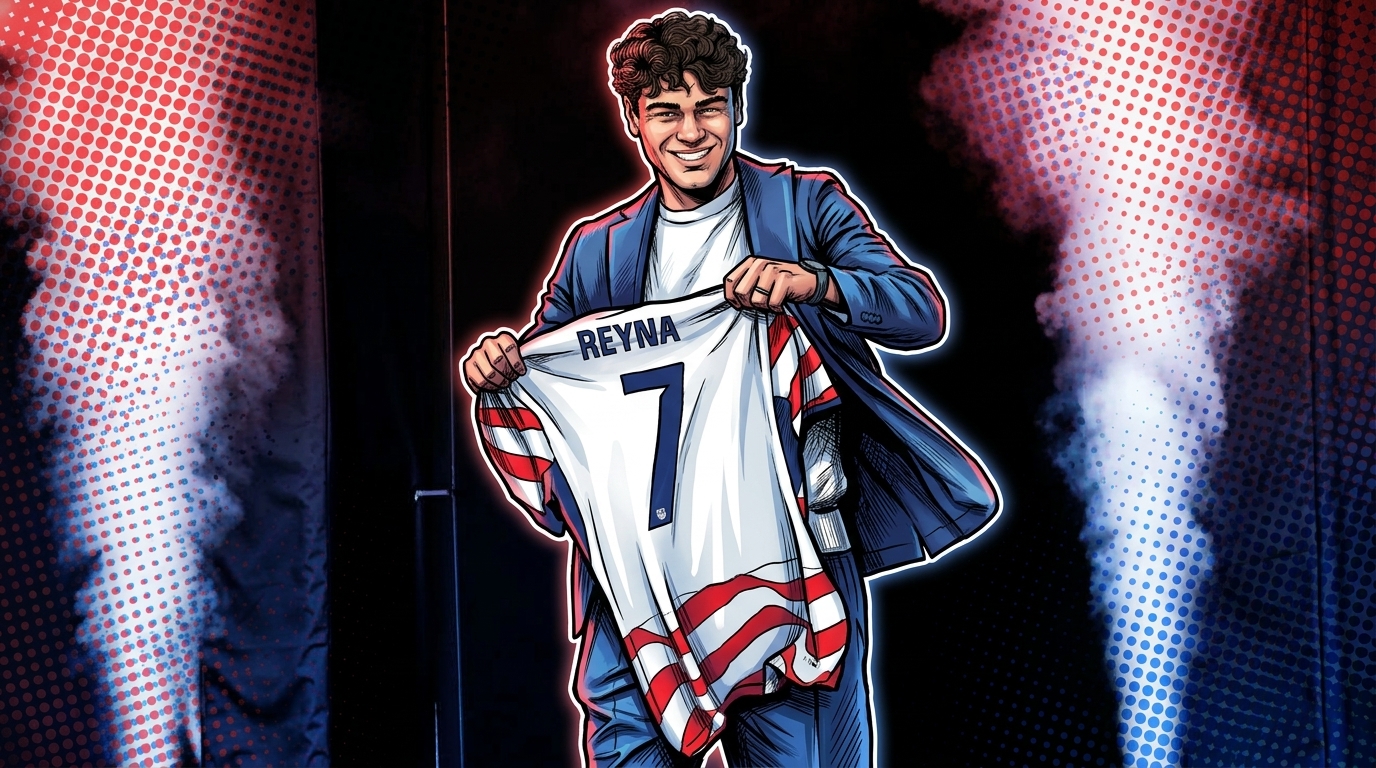

Gio Reyna is on the USMNT World Cup roster. He has played 137 minutes for Borussia Mönchengladbach since January 2026. He has not started a club match since December. Per ESPN, that is the entire foundation of club form Mauricio Pochettino is bringing to a home World Cup.
Diego Luna is not on the roster. Luna, who appeared in 17 of 18 USMNT matches throughout 2025, who scored four goals and added an assist for Real Salt Lake this MLS season, who carried a 7.45 FotMob rating and was named to the MLS Team of the Matchday Best XI — that player got cut via email after Friday practice and went home.
That is not a close call dressed up as a hard decision. It is a hard decision dressed up as a soccer one.
Pochettino’s public defense of Reyna at the May 26 press conference in New York City was exactly what you’d expect. “I think we all know Gio have an amazing talent and experience, too,” he told reporters per ESPN. He acknowledged, in the same breath, that Reyna would not start every game. A player who cannot crack the lineup at Mönchengladbach will not crack the lineup for the United States at a World Cup — and Pochettino essentially said so. What he is betting on is that the idea of Reyna is worth a roster spot.
That bet has a long history in USMNT circles. Coaches reach for the player they believe in over the player who is performing. It has not aged well. The 137 minutes figure is not a small sample size problem. It is a structural one. A player accumulating that kind of club time since January is not in form — he is in recovery, maintenance, or both. Bringing him to a tournament on reputation rather than readiness is a choice with a real cost.
That cost has a name.
https://twitter.com/_Zeets/status/2057967294760763642
Luna was not a fringe call-up or a nice story. He was a regular. He scored three goals at the 2025 CONCACAF Gold Cup including decisive contributions against Costa Rica and Guatemala. Per Yahoo Sports, he featured in 17 of 18 USMNT matches last year. He turned 22 in the middle of a productive MLS season and scored his 25th career RSL goal on May 4. Nike put him on World Cup promotional billboards. USSF used his face to market the roster cycle.
Then they sent him an email.
https://twitter.com/USMNTTAKES/status/2057969133581733900
The comparison that makes this most concrete is not Reyna versus Luna in a vacuum — it is the logic Pochettino used to justify each decision. Luna’s consistency, availability, and current-season production were not enough. Reyna’s November 2025 international window — a goal against Paraguay, an assist in a 5-1 rout of Uruguay — apparently was. That is a two-game sample from six months ago against a roster construction built on six months of evidence. The math does not hold.
What does hold is a pattern. Pochettino has consistently favored European-based pedigree over MLS form. Per Yahoo Sports, that philosophy shaped this roster toward players like Reyna (Bundesliga) over players like Luna (MLS), even when the production numbers run the other direction. That is a coherent philosophy, but coherence is not the same as correctness. If you want to read more on how European club context shapes USMNT selection thinking, the soccer coverage on this site has been tracking the cycle all spring.
Alejandro Zendejas, who scored four goals and added two assists in five Liga MX playoff matches for Club América, also made the roster. His inclusion is defensible on form alone. That is exactly the kind of selection logic that makes the Luna decision harder to accept — because it shows Pochettino can reward current production when it suits him. It just has to come from the right league, or the right player.
The US opens against Paraguay on June 12 at SoFi Stadium. If Reyna plays meaningful minutes in Group D, this conversation gets complicated. If he doesn’t — if the 137 minutes of club action since January turns out to be exactly what it looks like — then Diego Luna watched the home World Cup from his couch because his coach believed in a name more than a number.
That outcome has happened before in this program. It is how reputations become cautionary tales.