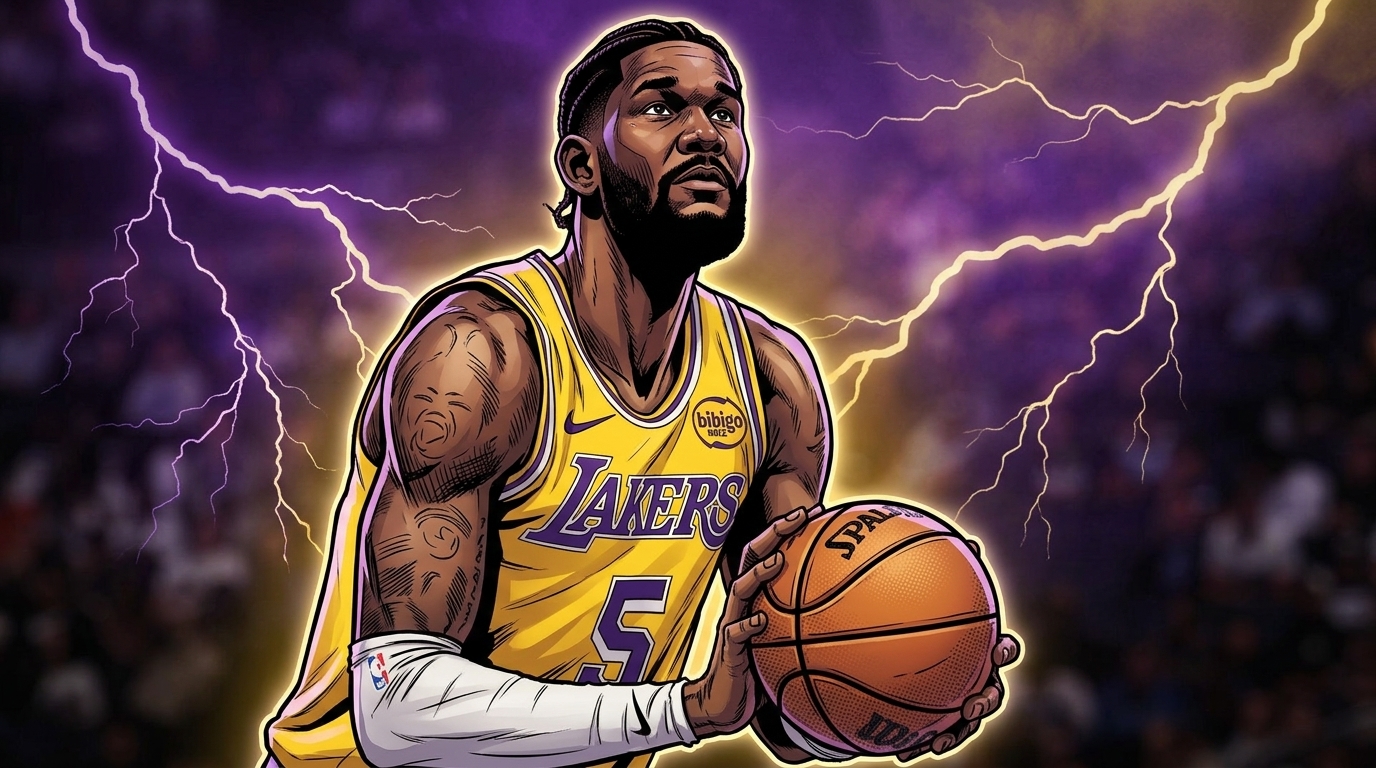

Deandre Ayton started every game he played last season. All 72 of them. He shot 67.1 percent from the floor while averaging 12.5 points and 8.0 rebounds a night, production from a starting center that most rosters would kill for. The Lakers just traded that player to the Washington Wizards for Jaden Hardy and two second-round picks. Judged purely on box scores, this is one of the more lopsided trade returns of the offseason, and the front office logic behind dumping Ayton only makes sense once you follow the money elsewhere.
That money went to Walker Kessler. The same week the Ayton trade got announced, the Lakers signed Walker Kessler to a four-year, $130 million sign-and-trade, sending Utah an unprotected 2031 first, an unprotected 2033 first, and first-round swaps in 2028 and 2030. Kessler is a center who missed nearly all of last season. Once Los Angeles committed nine figures to replace Ayton at the position he’d just anchored for 72 straight starts, Ayton became a name on an expiring $8 million deal with no path back into the rotation. But the real story of this trade isn’t what the Lakers gave up. It’s what Washington just built: three centers who, combined, have barely produced one fully healthy NBA season across the last three years, and a frontcourt that could turn Ayton’s on-paper value into something the box score won’t explain until games start getting decided by who isn’t available.
What the Lakers Actually Gave Up
Set aside the value question for a second and look at what walked out the door. Ayton wasn’t a reclamation project or a guy fighting for minutes. He started all 72 games he appeared in, put up 12.5 and 8.0 on 67.1 percent shooting, and stayed off the injury report doing it. In return, the Wizards sent back Jaden Hardy, a bench guard who averaged 12.6 points on 44.3 percent shooting, including 42 percent from three, in just 23 games last season, plus second-round picks in 2031 and 2032. Hardy has two years and $12 million left on his contract and real shooting upside; he’s a fine player. He is not, on paper, equivalent value for a starting center who just played a full season at a 67 percent clip.
Shams Charania broke the trade before either team confirmed it:
https://twitter.com/ShamsCharania/status/2073092477070823605
Roster fit aside, the timing tells the actual story. What Washington paid barely registered as a cost because Los Angeles had already decided, by handing Kessler $130 million, that Ayton wasn’t part of the plan regardless of what he’d just done on the floor.
Why Did Ayton’s Value Crater So Fast?
Ayton’s trade value collapsed the moment the Lakers committed four years and $130 million to Walker Kessler at the same position, a signal the front office no longer viewed Ayton, who started all 72 games he played last season, as part of the long-term plan. That left him worth only a bench guard and two second-round picks in return.
Walker Kessler’s contract explains the whole trade. Teams don’t pay $130 million for a backup plan. The Lakers wanted Kessler as the starter, even though Ayton was coming off a full, productive, injury-free season with no remaining role to hand him. I ran the shooting splits three different ways looking for some hidden decline that would justify moving on, and there isn’t one. Ayton’s efficiency last year was the best of his career. The decision wasn’t about what Ayton did. It was about what Kessler represented: younger, cheaper on a rookie-scale trajectory relative to a second max deal, and, in the Lakers’ evaluation, a better defensive fit next to their current core. Once that call got made, Ayton’s market shrank to whichever team wanted a prove-it center on an expiring deal. Washington was that team.
Washington’s Frontcourt, By the Health Data
Here’s the part that doesn’t make the highlight package. Washington’s frontcourt was already crowded before Ayton arrived. Alex Sarr, the No. 2 pick in the 2024 draft, underwent surgery for a fractured right foot after suffering the injury during an offseason workout, and he’s expected back for the start of next season. That’s an expectation, not a guarantee. He played just 48 games in 2025-26 around hamstring and toe injuries, though his per-game numbers when healthy were legitimate: 16.3 points, 7.4 rebounds, 2.0 blocks, and 33 percent from three on 150 attempts, real stretch-big volume for a 20-year-old.
Then there’s Anthony Davis. Davis played 51 of 82 games with the Lakers in 2024-25, including a Christmas Day ankle sprain and an abdominal strain, before Dallas traded him to Washington at the deadline. He played 20 total games across the whole 2025-26 season, 29 with the Mavericks before a Jan. 8 hand-ligament injury against Utah on top of prior calf and groin issues, and Washington shut him down for the rest of the year. Twenty games. That’s the number that should stop you. A 10-time All-Star, and the team that just traded for him got a quarter of a season out of him before it was over.
Add Ayton to that group and Washington now has three centers who, added together, haven’t given a team a full healthy year among them since 2023. And that’s before accounting for AJ Dybantsa, the No. 1 pick in the 2026 draft, a forward who also needs frontcourt minutes as a rookie. Four bodies, one set of available minutes, and a recent track record where at least one of the three centers is out of the lineup at any given time.
Does Ayton at Center Fix Washington’s Logjam?
There’s a real basketball argument for why this works. Ayton at center lets Davis slide to power forward full time, a positional shift AD has reportedly wanted for years, and gives Washington a durable insurance option while Sarr rehabs his foot. At $8 million on an expiring, prove-it contract, Ayton isn’t cannibalizing the roster’s financial flexibility either. Depth at a position where two of your three bigs have missed significant time is depth a smart front office should want. That argument is coherent, and it isn’t built on ignoring the injury history. It’s built on managing it.
The problem is durability doesn’t respond to lineup theory. Sarr is coming off foot surgery and won’t have played a live NBA game in months by opening night. Davis has missed extended stretches in each of the last two seasons and topped out at 20 total games this past year. Ayton is the outlier who actually stayed healthy, and Washington now needs him to stay that way while also hoping Sarr’s foot holds up on a reconstructed timeline and Davis’s body cooperates for a full campaign for the first time since 2023. Positional fit on a whiteboard doesn’t fix a roster where the binding constraint isn’t who plays where. It’s who’s actually able to play at all.
What This Actually Means for the Wizards
Washington Wizards fans should be encouraged by the individual talent stacked in that frontcourt and clear-eyed about what it will actually look like on a given night. Some nights, Ayton, Sarr, and Davis will all be healthy and Washington will run out one of the more talented big-man rotations in the conference on paper. Most nights, expect one of the three watching from the bench in street clothes, and Ayton — the guy who started 72 straight games last year — becomes the answer to whichever health question the roster is asking that week. The Lakers didn’t just lose a productive center in this trade. They handed Washington a durability problem dressed up as a talent upgrade, and the difference between those two things will decide how this frontcourt actually performs once the games count.