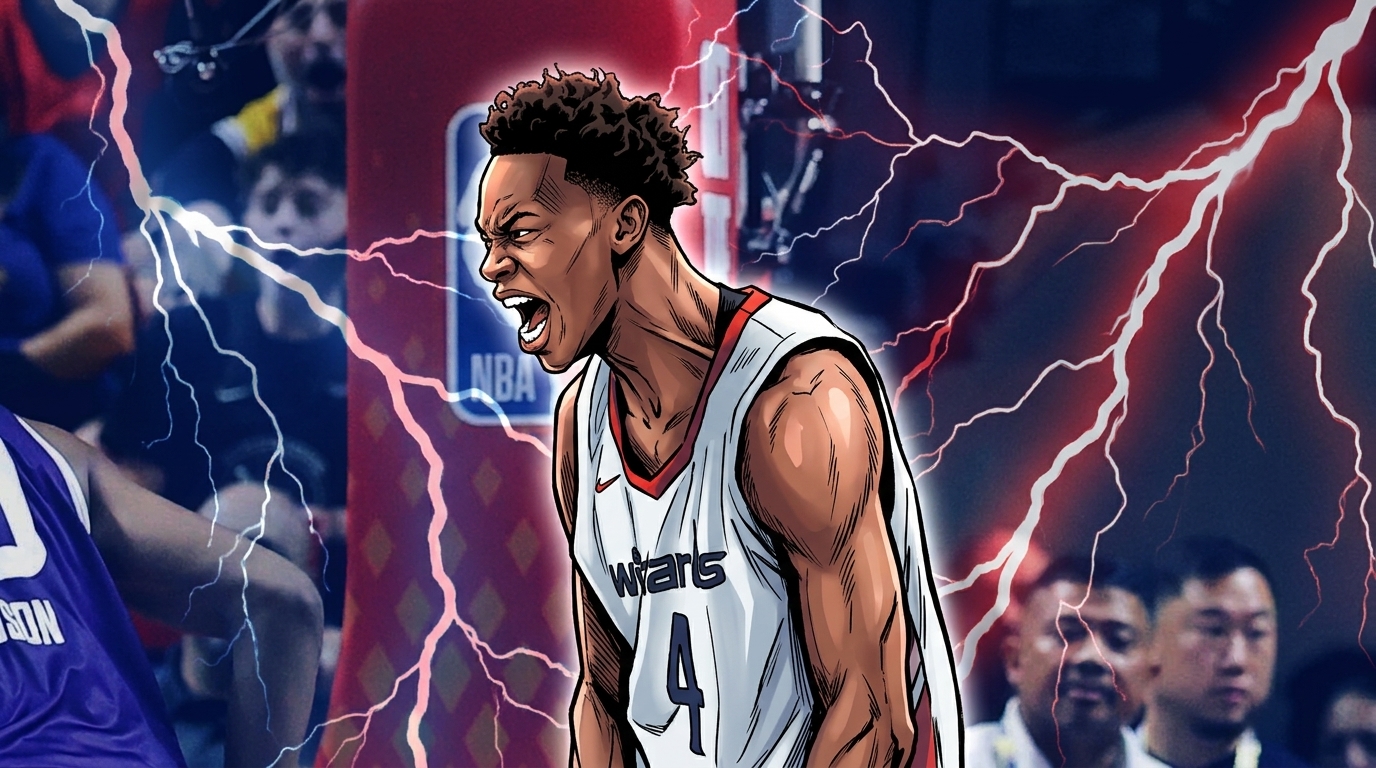

Twenty-seven points is a number that demands attention. But in AJ Dybantsa’s NBA summer league debut, the number itself is almost the least interesting thing that happened.
Summer league statistics are famously unreliable as NBA predictors — the competition is uneven, the sample sizes are microscopic, and the environment inflates performances in ways that have almost no relationship to what prospects will do against NBA rotations in February. The history here is unambiguous: summer league scoring leaders have washed out of the league while summer league role players became All-Stars. Treating a single summer league game as diagnostic is, in most cases, an error. But there is one exception. Summer league can reveal creation type — and a prospect who scores 27 by catching kick-out threes tells you almost nothing, while a prospect who scores 27 by creating off the dribble in isolation and transition tells you something real. Dybantsa’s 27 came almost entirely the second way. That distinction is everything.
Why Summer League Numbers Are Almost Useless
The Thomas and Mack Center in July is a strange environment. Defenses are porous, rotations are disorganized, and role players who will spend the next two years in the G League are guarding the same prospects who will anchor franchises. The competition gap between the best player on the court and the worst is often wider than anything that exists in the regular season. That gap inflates counting stats in ways that make nearly all box score comparisons misleading.
Washington’s 92-88 win over the Utah Jazz is a case in point. Darryn Peterson, the second overall pick, put up 24 points on his end. Two top picks, two big performances. Contextualized against the field, neither result says much. The number 27 tells you Dybantsa can score in summer league. It does not tell you he can score in the NBA. What tells you that is something the box score barely captures.
The One Thing Summer League Actually Reveals
Creation type is durable. If a prospect’s points come from systems — off screens, from the corner on relocations, catching-and-shooting on kick-outs — summer league success is predictive of almost nothing, because those same creations work against scrambling, inexperienced defenses and then evaporate when NBA closeouts arrive. But if a prospect’s points come from one-on-one creation, from the ability to generate separation with the dribble and finish at the rim under physical contact, that skill transfers. Contact absorption, footwork, and the ability to draw fouls are not products of weak summer league competition. They are physical and technical tools that exist before the game begins.
Dybantsa went 7-of-18 from the field, 0-of-5 from three, and drew fouls at a rate that would be notable against far better competition. Those lines, read together, describe a player who got to his spots against live resistance and made contact an asset rather than a problem. Per the NBA’s official summer league coverage, the sequence that defined his night came in the first half: a snatch back, a lefty dribble, a jump-stop, and then he powered through contact rather than absorbing it passively. That is not a summer league skill. That is a skill that exists at every level.
He finished with 19 of his 27 points in the first half. Trae Young and Anthony Davis were in the building watching. The audience was notable. The basketball was more notable.
https://twitter.com/NBA/status/2075414703895990519
What Dybantsa’s Shot Chart Tells Us
The shot chart from the Thomas and Mack is revealing in both directions. Seven-of-eighteen from the field, zero-of-five from three, and a trip to the free-throw line on almost half his total shot attempts. The arc attempts were not catch-and-shoot threes that barely rimmed out — they were genuine isolation looks, pull-up attempts, and one first-quarter poster dunk where he beat two Jazz defenders and fended off a contest before finishing two-handed. According to ESPN’s summer league analysis, an analyst put it simply: “You couldn’t keep AJ from the rim.”
The 27 points reportedly tied Blake Griffin for the most points by a number-one overall pick in a Las Vegas Summer League debut since 2004. That company is worth noting not because the record matters, but because of what Griffin’s draft profile looked like: an athletic freak whose rim pressure and foul-drawing made him immediately effective. Dybantsa’s path to 27 had more guard-skill layered on top, but the underlying mechanism — contact creation, free-throw drawing, interior dominance — maps onto a comparable template.
Growing up watching the Warriors dynasty trained me to evaluate prospects through a specific lens: does this player make the right read, or does he make his read? Dybantsa, at 18, made his read almost every possession. That level of dribble conviction is genuinely uncommon for a player at this stage.
The Part That Should Give You Pause
Zero-for-five from three. That is the only number in the box score that should produce actual concern — and it should produce some.
His BYU season split was 33.1% from three on what were presumably open looks created by the offense he was anchoring. That is a below-average NBA shooting percentage at the college level, and college three-point percentage is one of the more predictive individual statistics for projecting NBA shooting efficiency. A 33% college shooter hitting zero-for-five in a summer league debut is not a sample-size fluke to be dismissed; it is consistent information arriving in a consistent pattern. The comps cited for Dybantsa — Tracy McGrady, DeMar DeRozan, Jaylen Brown — include players who were limited or inconsistent three-point shooters at various points in their careers. That is not a coincidence in how those comps were constructed.
The concern is specific and narrow. It is not that Dybantsa cannot score; the evidence for his scoring ability is overwhelming. It is that his ceiling as a playmaker depends partly on whether defenses have to respect his pull-up range, and right now they have reason to sag. A 33% shooter gives help defenders a license to shade toward the paint, which clogs exactly the lanes he wants to attack. “All that waiting taught me how to stay ready,” he told Yahoo Sports after the draft. The waiting is over. The shooting, though, has more developing to do.
His debut told you something real: Dybantsa is a genuine off-the-dribble creator at 18, with the contact absorption and free-throw drawing that indicates NBA-level separation ability. That is the signal in the noise of July basketball. The question mark on his three-point shot is equally real, and it will define the ceiling. If it develops to league average, the T-Mac ceiling becomes a conversation. If it stagnates at 33%, the floor is still solid — but the comparison shifts from McGrady to a more earthbound version of DeRozan, which is still a good player and a long way from a generational one.
Expect that question to follow him through training camp and into November. The rim pressure will still be there. The shooters across from him will be better. That is when the answer arrives.