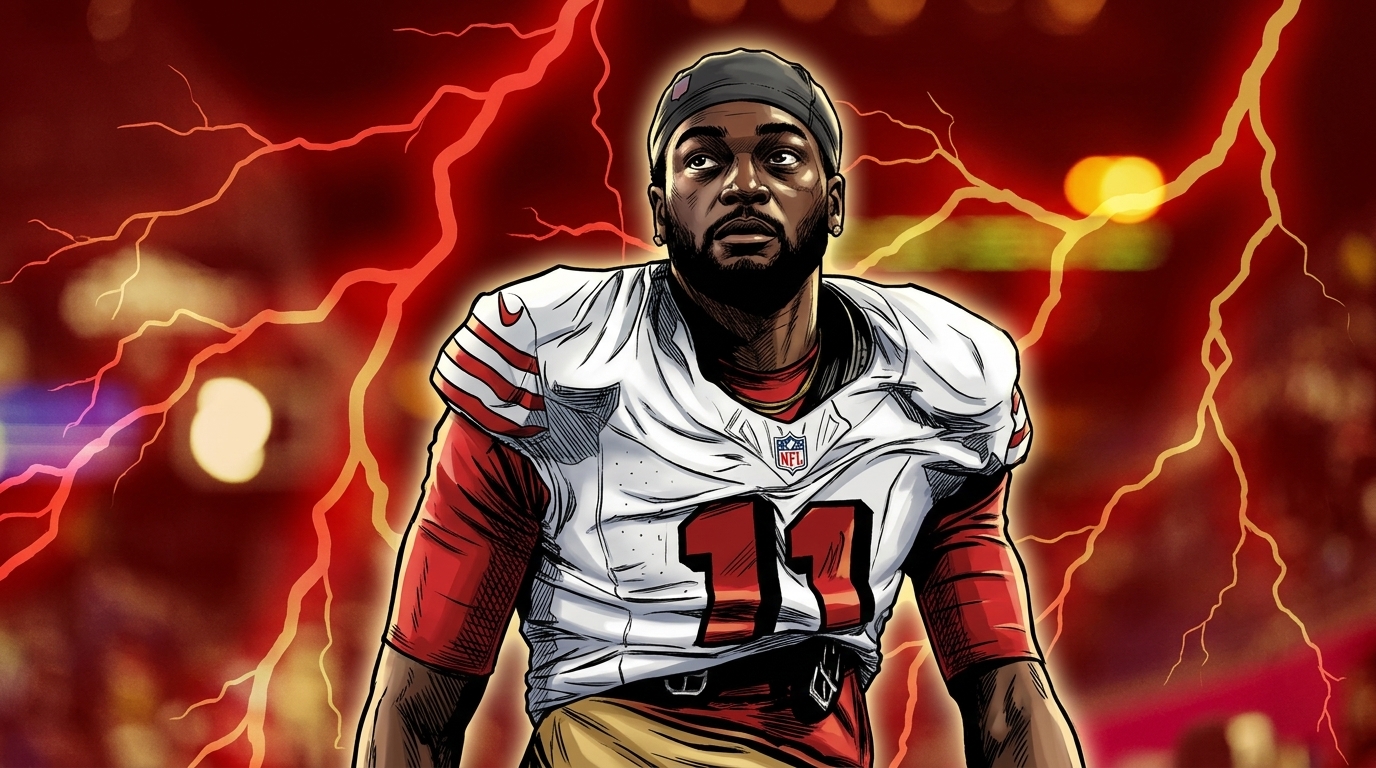
Brandon Aiyuk has a misdemeanor arrest warrant not because he was reckless, but because he was reckless with a camera rolling, an edit bay standing by, and a YouTube upload button at the end of it — and at no point in that entire production process did a single synapse in his brain register that this was a problem.
That is the sentence you need to hold onto. Not the 111 MPH. Not the 40 MPH speed limit on Tasman Drive, the road that runs directly past Levi’s Stadium, the stadium where the San Francisco 49ers pay him to play football. Not even the Brandon Aiyuk arrest warrant issued June 3 by the Santa Clara County DA for misdemeanor “exhibition of speed.” The sentence is: he posted the video himself. Voluntarily. To his own YouTube channel, on December 20, 2025.
I read that detail twice because I assumed I was missing the part where it was a mistake. Like maybe he thought it was unlisted. Maybe a kid got his phone. But no. Brandon Aiyuk produced a piece of content in which he drives a Cadillac CT5-V Blackwing (a near-700-horsepower car, in case you want to appreciate the physics) at 111 miles per hour on a public road, and then he published it.
https://x.com/UnderdogNFL/status/2062230041556373549
The warrant came six months later, which is its own commentary on the pace of accountability, but let’s not get distracted. Investigators matched Aiyuk to the video by his red sweatpants, which were visible earlier in the same clip. He wasn’t pulled over. Nobody stopped him. He just drove 111 miles per hour on a street with a 40 MPH limit and then handed the prosecution everything they needed in 1080p.
After the warrant dropped, Aiyuk posted an Instagram video of himself driving on a racetrack, per ESPN. The lesson has been received and filed accordingly.
Here is the thing about consequence immunity: it doesn’t make people reckless. They were already reckless. What it does is remove the internal governor that makes most humans pause before doing something catastrophically stupid in public. When nothing has ever really cost you anything, “this could be a problem” stops occurring as a thought at all. Brandon Aiyuk did not look at his YouTube upload screen and think, well, maybe. He thought: content. He thought: they’ll love this.
The 49ers are not blameless here, either. They gave this man a $120 million contract, watched him skip mandatory knee rehab sessions in 2025, and spent the offseason voiding approximately $26 million in guarantees. GM John Lynch said it was “safe to say” Aiyuk had played his last snap for San Francisco. Two NFL executives reportedly called him untradeable. Kyle Shanahan, as of December 2025, said he hadn’t seen Aiyuk in a month. That’s a head coach. Hadn’t seen his wide receiver. In a month.
This is what the NFL builds. It builds a system where stardom functions as a force field, where the money and the access and the insulation stack so deep that a man films himself committing a crime on a public road and genuinely does not register that this is a crime. The sport treats its players as assets right up until the moment the asset becomes a liability, at which point the machinery turns very cold very fast. Aiyuk is finding that out now, in the worst possible sequence: warrant first, unemployable second, forgotten third.
What’s the penalty for the Brandon Aiyuk arrest warrant, if it ever gets to that? Up to 90 days in jail and a $500 fine. The fine being $500 is its own kind of comedy. You can’t fine your way to consequences for someone who signed a nine-figure contract. You cannot build a system where the floor of accountability is $500 and then act surprised when people treat the floor as decorative.
His apology, for the record: “Sorry ya’ll, my car content won’t come with speeding anymore!” He added something about praying with his son and not wanting anyone to miss out on that opportunity. Sincerely.
Rashee Rice is sitting under a probation agreement that could send him back to jail for a joint. Brandon Aiyuk filmed a 111 MPH joyride on a public road, uploaded it himself, and is still making content. Tell me again about the league’s standards. The system doesn’t enforce accountability. It just occasionally gets embarrassed into pretending it does.
This is what zero consequences looks like before they finally show up. And they always show up. Every time. The NFL has a long track record of organizations that thought they were immune to the wreckage until they weren’t. Aiyuk built his own case file. He uploaded it. He hit publish.