
The NFL’s narrative apparatus runs on pre-packaged authenticity, and the A.J. Brown trade to the Patriots is the machine running so smoothly you can’t tell where the real parts end and the fabricated ones begin.
Brown traded to New England on June 1, and the timeline from the original trade breakdown was exact down to the dead-cap split that made it work financially. Within 48 hours the internet had constructed a complete destiny arc: childhood Patriots fan, Mike Vrabel reunion, Drake Maye unlocked, universe in alignment. The story practically wrote itself. That’s the part that should give you pause.
https://twitter.com/AdamSchefter/status/2046174911408881688
The evidence of Brown’s childhood fandom is genuine, and it’s a little heartbreaking in the way real things sometimes are. He grew up in Starkville, Mississippi, inspired by an older cousin, and kept a Patriots Man Cave rug for years, the kind of detail that doesn’t make sense to fabricate. At the 2019 NFL Draft, he was at a party hoping New England would take him in the late first round; instead the Patriots took N’Keal Harry, and Brown went to a closet to collect himself. That’s a real story. It has the texture of something that actually happened to a person.
Then there were the Instagram photos.
After the trade, Brown posted what he framed as childhood images of himself in Patriots gear: proof, aesthetically presented, of the lifelong fandom. Instagram attached a notice: the photos “may have been created by AI.” The tell-tale details weren’t subtle: Nike logos visible on jerseys, when Nike didn’t become the NFL’s uniform partner until 2012; the Patriots chest wordmark, which didn’t appear on actual jerseys until 2015, by which point Brown was a teenager, not a child. Tom Brady posted heart emojis in response. The Patriots’ official account did the same. AJ Brown’s childhood Patriots fandom was real — mostly; the photos were something else.
Nobody in the apparatus cared. The hearts kept coming. The narrative machine cannot distinguish between authentic childhood attachment and a well-produced facsimile, and in the current media environment, it doesn’t particularly need to. The rug exists. The closet moment happened. Those things are true, and they are now indistinguishable from the AI photos because all of it feeds the same machine and the machine produces the same output: a player arriving at his destiny. Whether the supporting evidence is real is a rounding error.
The Vrabel thread is the actual interesting part, and it works as a structural pattern rather than a sentimental one. Vrabel drafted Brown 51st overall in 2019; that’s the Vrabel relationship that made this trade make sense before it ever made the news. He watched Brown become an Eagles star: four consecutive 1,000-yard seasons, a 1,496-yard debut year in Philadelphia in 2022 that remains Brown’s career best. Brown initially clashed with Vrabel’s accountability-first coaching style at Tennessee; he grew to respect it deeply. Then the NFL reshuffled its pieces and put Vrabel in New England, and the pipeline that originally connected them in 2019 routed them back to each other in 2026.
This is the actual pattern: not destiny, but the way NFL talent pipelines keep recycling the same connections regardless of anyone’s intentions. Vrabel didn’t engineer the reunion; the Eagles needed the cap mechanics that made this possible, splitting a $43.45 million dead-cap hit across two seasons by timing the trade after June 1, and the Patriots happened to be the team on the other end of that phone call. Vrabel commented afterward that “having experience with the person” added value. That’s a careful institutional statement that is technically true and emotionally resonant and means roughly what it sounds like while also meaning much less. The machine ran that quote through several cycles and turned it into fate.
Brown cleared his physical June 2 and showed up at OTAs the same day. At practice, Drake Maye told him: “Welcome to New England. Should be some fun. Let me know what you want. I’m here to give you the rock.” Brown on Maye: “He can make any throw. He’s very poised.” Drake Maye’s No. 1 target finally arriving looks like this: two professional athletes at a practice facility, being professionally cordial in a way that sounds like warmth, which it may also be. Maye hit 12 straight completions in 11-on-11 at those OTAs; Brown caught a quick hitch and didn’t cut to the front of the position drills because he said he wanted to earn the spot. He’s 28, with four consecutive 1,000-yard seasons; he has already earned the spot. The gesture was still correct.
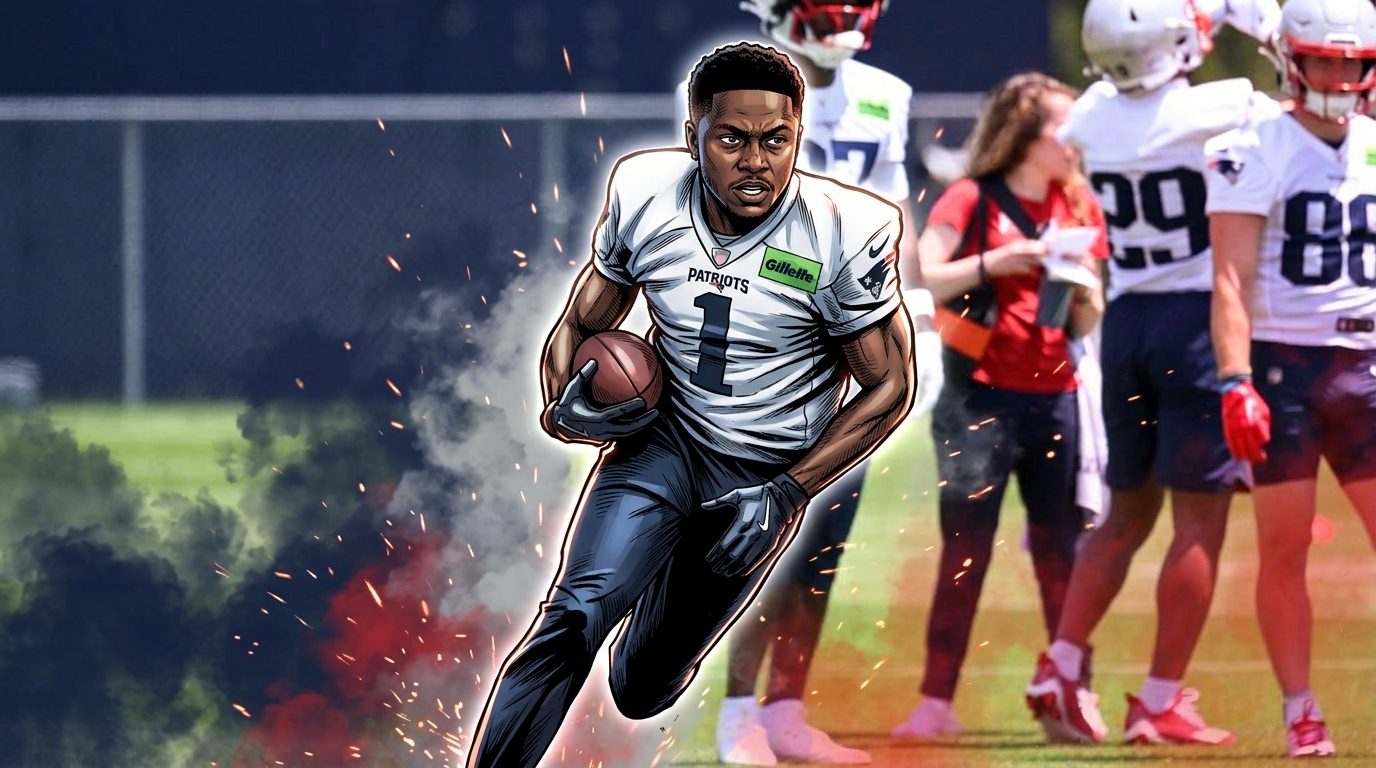
Brown will wear No. 1 in New England, his college number at Ole Miss and Julian Edelman’s old number; another thread the machine has already woven into the tapestry. The Patriots gave up a 2028 first-round pick and a 2027 fifth to get him. That’s a real price for a real player who will genuinely help a real young quarterback.
The Man Cave rug exists. The 2019 closet breakdown was real. The AI photos were not. Tom Brady posted heart emojis about all of it equally, which is perhaps the only honest summary of how any of this works.
Better late than never.