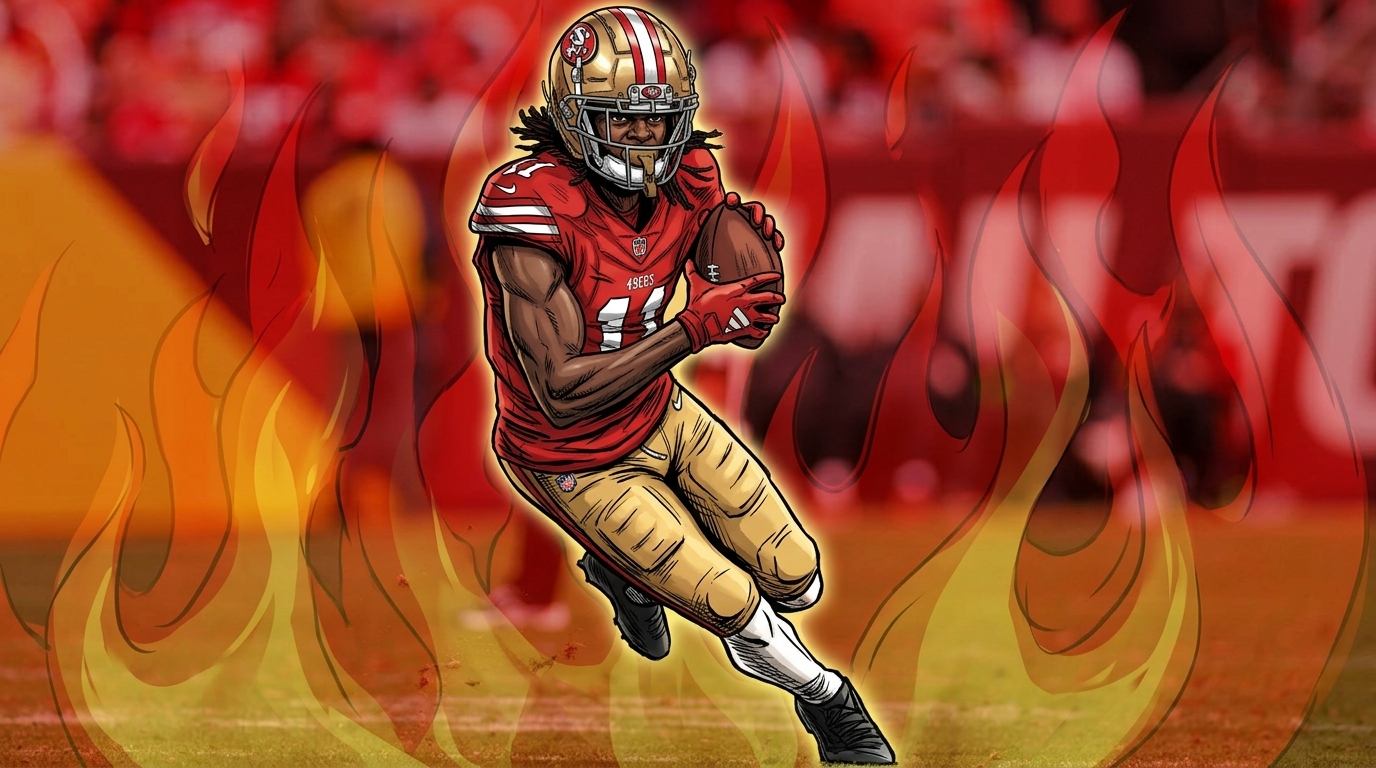

Brandon Aiyuk, the San Francisco 49ers wide receiver, faces an arrest warrant from Santa Clara County for exhibition of speed (a misdemeanor) stemming from a December video he posted to YouTube and then deleted, as though deletion were a legal category. It is not.
The facts of the initial report are almost admirably simple. On December 20, 2025, Aiyuk drove a Cadillac CT5-V Blackwing down Tasman Drive near Levi’s Stadium in Santa Clara, where the posted speed limit is 40 miles per hour. He filmed it. He posted it. Most outlets reported the speedometer reached 111 mph; 49ers beat writer Noah Furtado later raised the possibility that the readout was in kilometers per hour, not miles — 104 kph works out to roughly 64 mph.
https://twitter.com/_noahfurtado/status/2062241000882614417
The DA charged exhibition of speed regardless of which unit was showing on the display. Santa Clara Police forwarded the case to the district attorney on January 15, 2026. A complaint was executed February 11 and filed February 24. The case remains open with no scheduled hearings as of June 2026. Potential penalties are modest by the standards of professional athlete legal troubles: up to a $500 fine, 90 days in county jail, possible probation. The Brandon Aiyuk arrest warrant is, on its face, a minor legal matter. The context is what makes it worth examining.
Aiyuk deleted the video. This is the part that deserves the most careful attention, because it reveals something about how a person in the age of permanent digital records thinks about evidence. The deletion was not slow or considered; it happened fast enough to suggest Aiyuk understood, in real time, that he had posted something problematic. His face wasn’t directly visible in the footage, but the driver wore red sweatpants matching his earlier appearance in the same video. The apology he posted afterward had the rhythm of a man who had been advised to say something quickly: “Sorry ya’ll, my car content won’t come with speeding anymore. Was praying with my son tonight and wouldn’t want anybody else to miss out on an opportunity to do the same with their loved ones!” That is what remorse sounds like when it has been given a twenty-minute deadline. It is also, incidentally, what a preserved public statement looks like; it was screenshotted before he could reconsider it, too.
The deletion metaphor only works if deletion actually does something. In 2025, it doesn’t. Every major platform’s content is archived, screen-captured, and mirrored within seconds of posting. The journalist who finds a video before the poster removes it is not performing a remarkable act of digital forensics; they are refreshing a feed. Aiyuk posted what he thought was a flex and then tried to unpublish the evidence, and the mechanism for unpublishing evidence no longer operates at human speed. He thought he was making a choice. What he actually made was a record — a self-documenting legal violation, posted to his own channel, under his own account.
The position this creates is worth mapping. Aiyuk tore his ACL, MCL, and meniscus on October 20, 2024, in a Week 7 game against Kansas City. He described the injury himself as “torn ACL, MCL [and a] messed up meniscus.” He had signed a four-year, $120 million extension in August 2024 and played seven games before that contract became a document about what might have been. The 49ers voided $24.9 million in guaranteed 2026 money after he missed rehab sessions. GM John Lynch said in January that “it’s safe to say he’s played his last snap as a Niner.” Lynch told ESPN in June that Aiyuk is available for trade: “We’re available. Give us a call… He’s an extremely talented player.” The Washington Commanders are reportedly the primary interested party, though a standoff over compensation versus waiting for a release has stalled any deal.
This is the inventory of Aiyuk’s situation before the legal dimension enters: major knee injury, missed rehab sessions, voided guarantees, a public declaration from his own GM that his tenure is finished, a trade stalemate with his most likely destination. His NFL future is not foreclosed, but it requires nearly everything to go right from here. What he chose to do, in this context, in December 2025, was take his Cadillac (“the Cadillac’s answer to Dodge’s Hellcat model,” per his own description) out near the stadium where he tore his knee and record himself driving it.
The exhibition of speed arrest warrant is not the existential threat to his career that the injury is. A misdemeanor with a potential $500 ceiling is not, under ordinary circumstances, the thing that terminates an NFL wide receiver’s trajectory. But it doesn’t operate in isolation. It operates inside a narrative that was already running; it adds a chapter to the story any team acquiring Aiyuk will include in their due diligence. This is how off-field accountability functions in the modern NFL: not as a single disqualifying event, but as accumulation. Rashee Rice’s probation violation added a chapter to a story that already existed; each entry made the next one land with more weight.
What Aiyuk made is a document. The Santa Clara DA has it; the NFL has it; every team with a GM who reads a file before making a call has it. He deleted a YouTube video and in doing so confirmed, inadvertently, that he understood it was worth deleting. The deletion-and-warrant sequence is now the defining story of his offseason: not the injury recovery, not the trade speculation, but the question of whether a man who filmed himself speeding and then deleted the evidence is the kind of player you want to absorb into your locker room. That is the math teams are actually running right now, because the warrant stays open and the process runs parallel to everything else.
The video is gone. The case file isn’t. The warrant exists in county records with exactly the same permanence it would have had if Aiyuk had left the original video up, and in some ways more — because the deletion tells you something about the judgment that produced the video in the first place. The thing about permanent digital records is that they don’t require the original document to be permanent. The act of removing something is itself a record; courts understand this well, even if YouTube’s interface makes it feel otherwise.
Aiyuk’s apology mentioned his son, and the sincerity of that is not really in question. The warrant is still there regardless. And the thing about building an NFL comeback on ACL recovery and organizational goodwill is that it leaves little room for the county DA to be running a parallel process on a misdemeanor file. The video is gone. Everything else remains exactly where he left it.