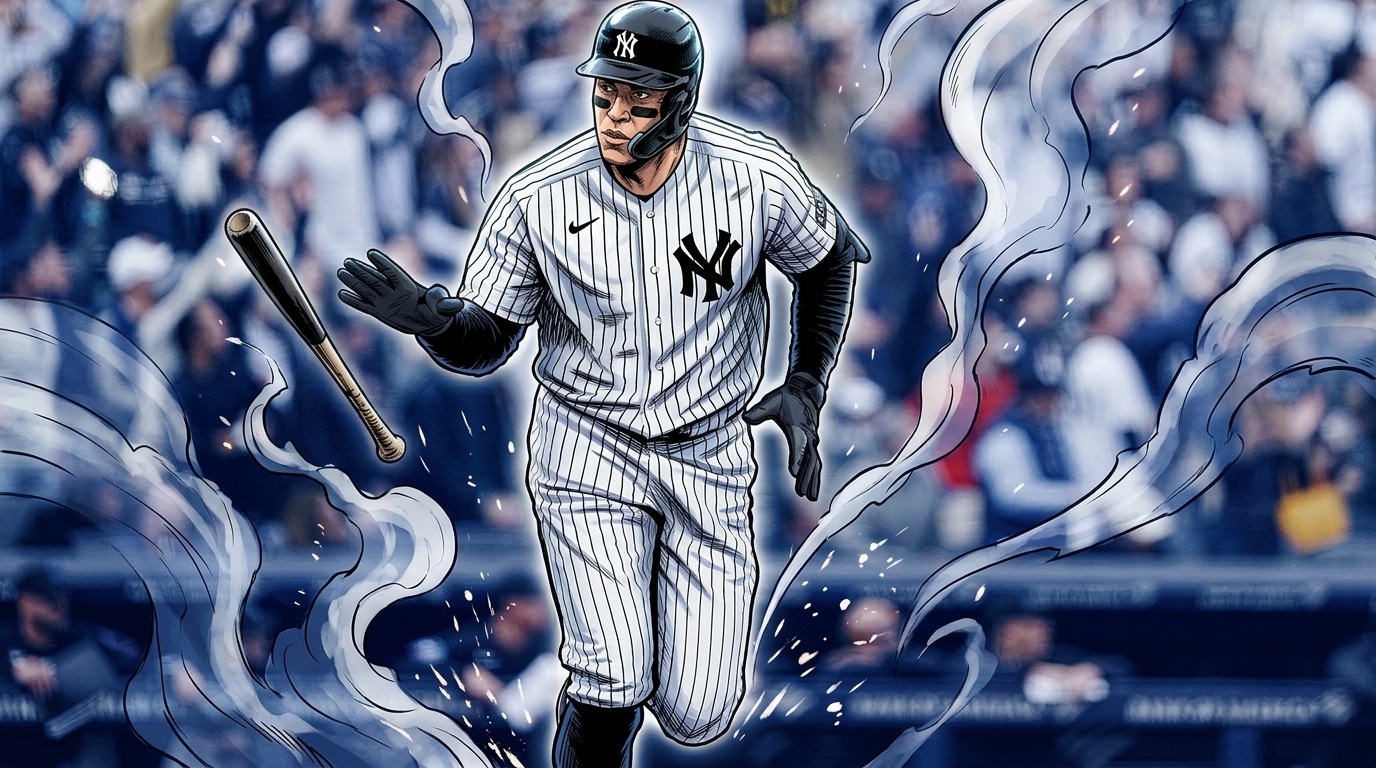

The New York Yankees have been unusually quiet about Aaron Judge this summer. No detailed injury updates. No timeline commitments. No acknowledgment that their franchise anchor has been playing — and then not playing — hurt. The front office has treated the situation like a classified document, and the baseball media has largely filled the void with the easiest available narrative: decline.
The numbers don’t support that narrative. Not even close.
What the Traditional Numbers Show
Judge’s 2026 line through 59 games — .248 batting average, .907 OPS, 17 home runs, 38 RBI — reads as a step backward from the man who hit .331 with 53 home runs in 2025. Against a three-time MVP coming off consecutive historic seasons, .248 looks like regression. It looks like age catching up to a 34-year-old body.
That interpretation is understandable. It is also missing the most important layer of the data.
At a 47-home-run pace over 162 games and his eighth All-Star selection, this is still an elite player. But the batting average and the OPS both fell noticeably from where Judge has set the modern standard for himself. Surface-level, the concern is legitimate. Surface-level is where the Yankees want you to stay.
What the Statcast Numbers Show
Dig into the Baseball Savant profile and the picture inverts entirely.
Judge’s exit velocity average sits at 94.1 mph. His hard-hit rate is 57.3%. His barrel percentage — the share of batted balls hit at the ideal combination of speed and launch angle — is 21.7%. That barrel figure is not a good number. That is a historically good number. It belongs in the same neighborhood as the best contact profiles in baseball.
His expected weighted on-base average, xwOBA, is .415. To translate that into plain language: an xwOBA of .415 is the contact fingerprint of a top-15 hitter in baseball. It reflects the quality of what Judge is hitting, stripped of where those balls happened to land, stripped of sequencing, stripped of luck.
His actual wOBA — what he actually produced — is .385.
The gap between those two numbers, 30 points, is not noise. It is signal.
The Gap That Explains Everything
Call this the Contact-Result Divergence: when a hitter’s xwOBA significantly exceeds his wOBA, his contact quality is outrunning his production. The ball-strike outcomes are not keeping pace with how hard and how well he is hitting the ball.
This is the opposite of a decline pattern. A declining hitter’s xwOBA drops to or below his wOBA — the quality of contact softens first, and results follow. What Judge’s profile shows instead is elite contact that is converting at a lower rate than expected. That combination has a name: injury.
On April 26, Judge fractured his right first rib diving for a fly ball at Minute Maid Park, avoiding a collision with Jazz Chisholm on a Dustin Harris drive. He played every game in May — all 30 of them — on a fractured rib. On May 3, he crashed into the right field wall in Baltimore. “Didn’t help,” he told MLB.com, with the understatement of someone who was not going to give his employer reason to sit him down.
When asked why he kept playing, Judge was direct: “We’ve got a lot of guys banged up. You’ve got to be out there. That’s what they’re paying me to do, to go out there and play.”
A fractured rib compromises core rotation. Core rotation is the engine of a power swing. When the rib cage cannot fully engage, a hitter loses the ability to transfer force efficiently from lower body through contact. The barrel rate tells you Judge was still driving the ball — the xwOBA confirms the quality was there — but the conversion rate tells you something was bleeding power from the equation. The injury is the explanation.
He went on the 10-day IL on June 2. He has not played since.
https://x.com/BryanHoch/status/2078204715771236704
What Recovery Actually Looks Like
The Yankees are 54-42, sitting 2.5 games behind the Tampa Bay Rays in the AL East. Since Judge went on the IL, they are approximately 12-13, treading water in a division race they entered as favorites. The cost of playing him through May is now visible in the standings math.
Brian Cashman acknowledged Judge will not be 100% upon return, but said the goal is getting him ready for meaningful games. ESPN’s Buster Olney was more pointed: “I think they’re slow-playing the injury. It’s a lot like what the Dodgers have done in recent years.” When asked about his own return, Judge said simply: “Yeah, definitely. I don’t see why I wouldn’t.”
Late August is the optimistic scenario. September is more likely.
Power hitters with structural injuries — particularly rib and core issues — historically recover when the structural problem heals. The Statcast profile here is the key evidence: barrel rates do not stay at 21.7% for declining players. Swing decisions do not produce an xwOBA of .415 for a hitter whose skills are eroding.
The Yankees’ quiet this summer was not covering up a skill decline. It was downplaying a fractured rib they let their franchise player compete through for a month. The data makes the actual story clear: Judge’s contact quality was elite in 2026. The injury suppressed the results. When the rib heals — and the imaging suggests it is progressing — the results should follow the quality back up.
The only trade deadline decisions that matter for this Yankees team are the ones built around the assumption that Judge returns. The numbers say that assumption is sound.