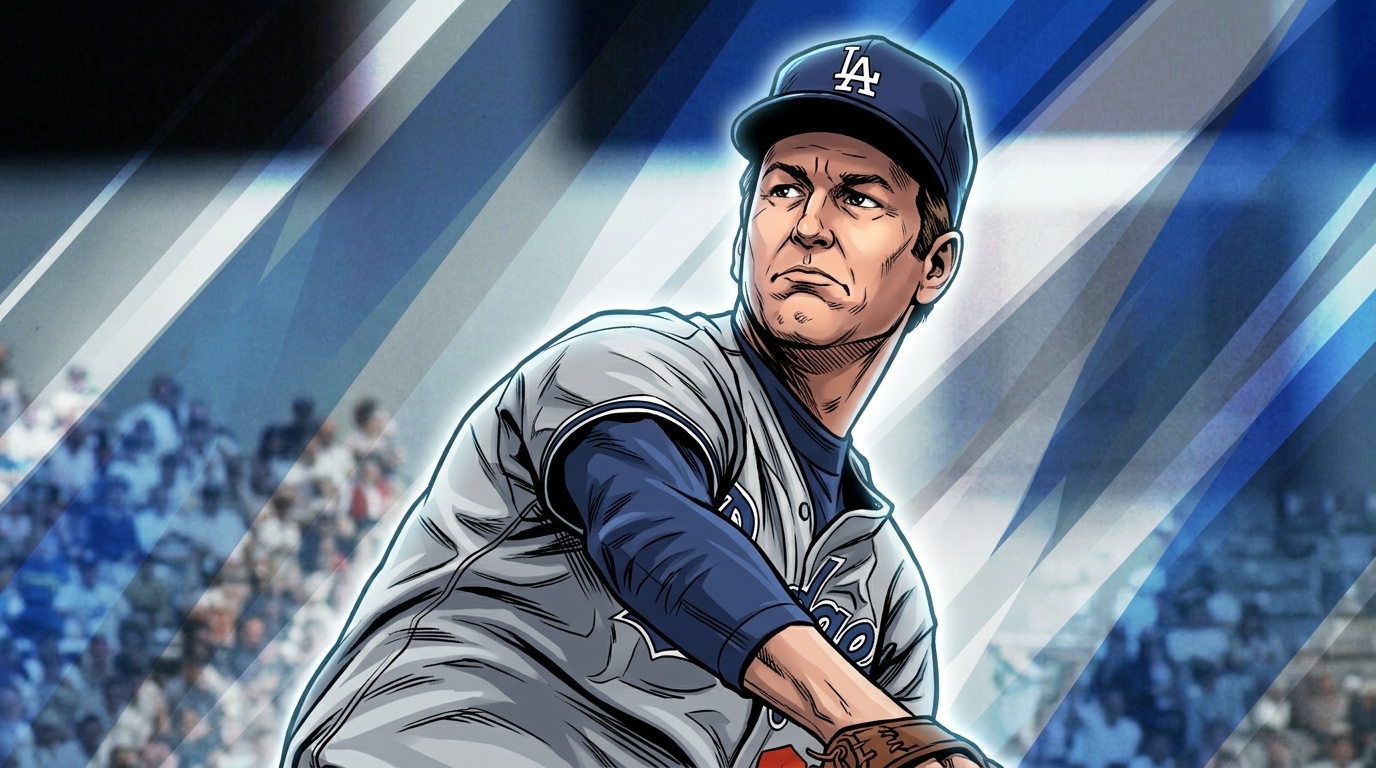
We use his name so often that it stopped sounding like a name a while ago. “He’s getting Tommy John.” Not “Tommy John surgery,” just Tommy John, first and last, as shorthand for ulnar collateral ligament reconstruction, the way people say “a Xerox” instead of “a photocopy.” The man attached to that shorthand died Saturday at his Florida home, at 83, and the strange part of writing this obituary is that the surgery has been famous for longer than most fans have known whose name was actually on it.
His agent, Mike Maguire, confirmed the death in a statement, with John’s wife, Cheryl, and sister-in-laws Judith Florentino and Karen Jordan at his side. He had been in hospice care after health issues in recent years, and that’s as much as needs saying about the end of it. What matters here is the middle: the fourteen extra years nobody, including the man who operated on him, thought were coming.
John was 31 and pitching for the Los Angeles Dodgers when he threw a fastball to Montreal’s Hal Breeden on July 17, 1974, and felt something tear in his left elbow. He’d later describe it as a crash. The diagnosis was a complete tear of the ulnar collateral ligament, which in July of 1974 was, for a pitcher, essentially the end of the conversation. There wasn’t a rebuild option. There was retirement.
Dr. Frank Jobe, the Dodgers’ team physician, had another idea. On September 25, 1974, he performed a four-hour, entirely experimental procedure: harvesting a tendon from John’s right forearm and threading it through drilled holes in the humerus and ulna of his left elbow, a graft technique Jobe had previously used on polio patients. He gave John a 1-in-100 shot of ever pitching in the majors again. John’s response, as he later recounted it: “You’re a great doctor and I believe in you. But you’re wrong. I will come back.”
He missed the entire 1975 season rebuilding the arm from nothing. In 1976 he returned and went 10-10 with a 3.09 ERA over 31 starts for a Dodgers team that had more or less written him off, and somebody started calling him the Bionic Man.
It stuck.
John pitched 14 more seasons after the surgery that was supposed to end his career, winning 164 of his eventual 288 games on the rebuilt elbow. He made three of his four career All-Star teams after the reconstruction, not before it — 1978, 1979 and 1980, against just the one, in 1968, before anyone had heard of Frank Jobe.
That’s the actual headline, buried in career totals: 288-231, a 3.34 ERA across 760 games and 700 starts, 162 complete games, 46 shutouts, better than 2,200 strikeouts over 26 seasons that started with Cleveland in 1963 and ended with the Yankees in 1989. Those are Hall of Fame-adjacent numbers compiled by a pitcher who, by his own doctor’s math, had a 99 percent chance of never compiling any of it.
The surgery didn’t get named “Tommy John” because he invented it. Jobe did that, with no real precedent to lean on beyond a technique used on polio patients. It got named after John because he was the proof of concept, the only data point Jobe had for years before enough other pitchers went under the knife to make it a category instead of a miracle. Ulnar collateral ligament reconstruction is the accurate term. Nobody uses it. Baseball named the procedure after the guy who survived it first, which says something about how the sport actually thinks: less interested in the mechanism than in whether it worked on somebody real.
It worked often enough that it stopped being a novelty and became infrastructure. Roughly 35 percent of active MLB pitchers had undergone some version of the surgery as of 2023, per the American Medical Association, a rate the doctor who once quoted 1-in-100 odds could not have imagined. Shohei Ohtani has had the procedure twice and is still the best player in the sport. Nobody stops to credit a specific person for that anymore. It’s just how pitching works now.
John got to say his own goodbye before this one. Too unwell to attend Yankees Old-Timers’ Day in person on August 8, he released a farewell message through the team’s channels, thanking the organization, the Steinbrenner family and the fans who followed him through a 26-year career spread across six organizations. He singled out Jobe by name. Here’s the message the Yankees shared, a week before he died.
https://twitter.com/Yankees/status/2086116517595209831
Dodgers president Stan Kasten called his role in the surgery’s origin story impossible to overstate. The Yankees’ own statement remembered him more simply, as a bedrock of the rotation and a longtime favorite during his years in pinstripes. Both are true, and neither fully explains why his death registers the way it does for people who never watched him throw a single inning.
There’s a coda to his life away from the mound that deserves a sentence and not much more. John and his family founded the “Let’s Do It” Foundation in 2010, after his youngest son, Taylor, died at 28, to support suicide-prevention awareness. He spent his post-playing years broadcasting for the Twins and Yankees, coaching in the Expos’ and Yankees’ minor league systems, and managing the independent Atlantic League’s Bridgeport Bluefish. None of it made news the way the elbow did.
Every pitcher who takes a big-league mound for the next decade will pitch in a sport this man’s arm helped build, whether or not anyone says his name out loud while it happens. That’s the real measure of the 14 extra years — not the 164 wins, but the fact that hearing you’re “getting Tommy John” stopped being a euphemism for the end of something and became, for most pitchers, the start of a second act nobody in 1974 thought was writable. Watch how much higher that 35 percent climbs before the decade is out, and check MLB coverage for how the next generation writes theirs.