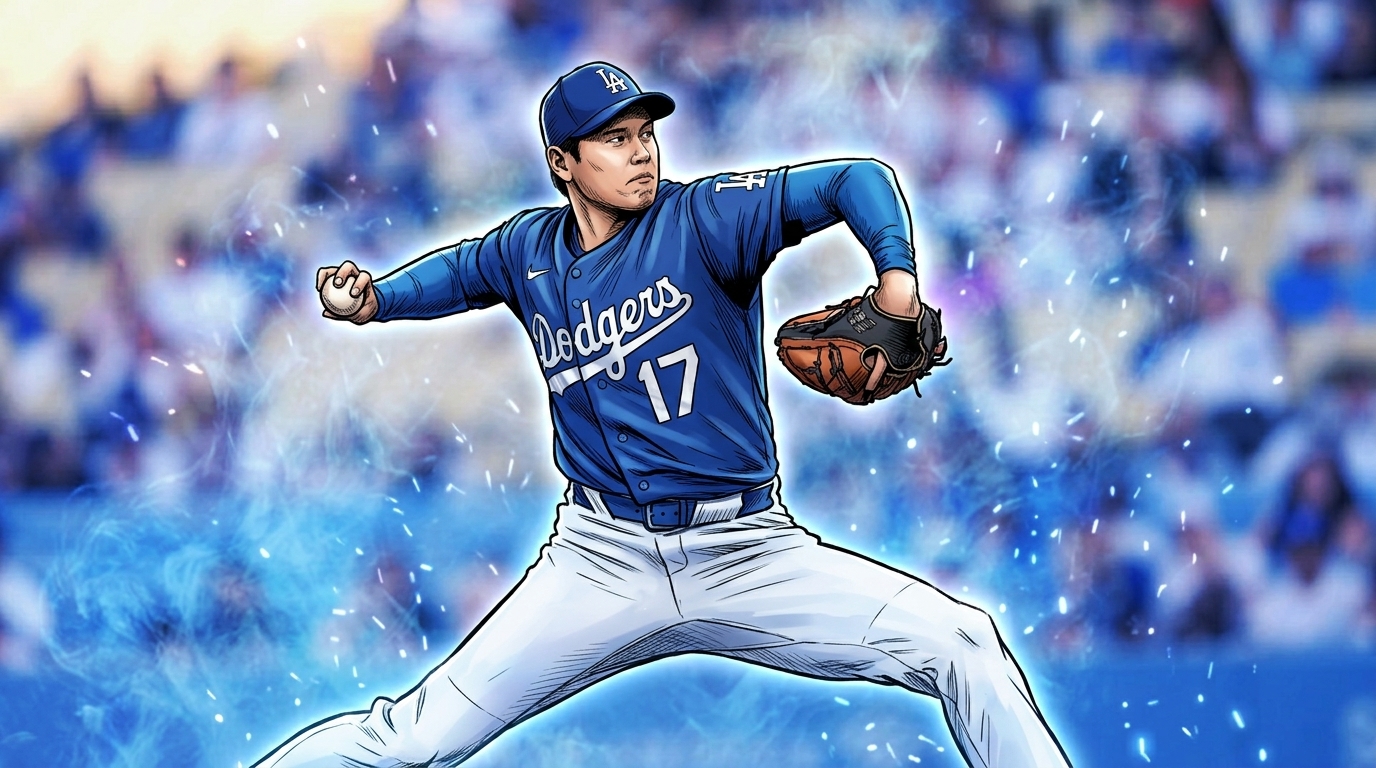

I want to be upfront about something: I am a Giants fan from Fremont. I have spent the better part of my adult life rooting against the Dodgers in a way that feels almost biological. Writing a piece that argues Shohei Ohtani may be the greatest baseball player who ever lived is not something I take lightly. Consider it the highest possible endorsement that I’m going to make the case anyway.
The framework I want to use is what I’m calling The Credible Peer Test: for any claim of all-time greatness, there has to be at least one historical player who could be reasonably placed in the same tier. If you can’t name that player, you’re not dealing with a historical comparison. You’re dealing with a category unto itself. We’ll come back to why that matters.
What Ohtani Is Actually Doing Through 10 Starts
Let’s start with the pitching numbers, because they’re the easier case to build. Through 10 starts and 61.0 innings, Ohtani carries a 0.74 ERA. That is the third-lowest ERA through a pitcher’s first 10 starts in Major League Baseball history — and the record books only go back to 1913, when earned runs became official in both leagues. The two pitchers ahead of him are Jacob deGrom (0.56 ERA in 2021) and Juan Marichal (0.59 in 1966). Fernando Valenzuela’s legendary Fernandomania 1981 season — the one that captured all of Los Angeles and half the country — had a 1.24 ERA by his 10th start. He is now fourth on this list. Ohtani bumped him.
The Statcast profile confirms this is not a sequencing mirage. His FIP sits at 2.48 and his xERA at 2.38: the underlying numbers track the surface number. His sweeper is the best pitch in baseball by run value (+9), generating a 39% whiff rate, and the hard-hit rate on that pitch has fallen from 30% to 18% since 2022. His four-seam fastball runs 97.8 mph, fourth-best run value in the majors at +10. The ground-ball rate has jumped to the 85th percentile. The walk rate sits at 82nd. Every lever is moving the right direction.
At the plate, he’s hitting .296/.420/.511 with 10 home runs and an NL-leading .420 OBP. His wOBA is .404, his xwOBA .412, his hard-hit rate 52.5%, his barrel rate 15.5%. Then consider June 3 against Arizona: 6 scoreless innings and 6 strikeouts on the mound, then 3-for-4 with 2 walks at the plate. Final score: 7-0 Dodgers. The two lines (pitcher’s and hitter’s) exist in the same box score. Same player.
Is Shohei Ohtani the Greatest Two-Way Player in Baseball History?
Yes. The data here is unambiguous. No player in the history of Major League Baseball has combined pitching dominance and offensive production at this scale simultaneously. Ohtani and Babe Ruth are the only two players ever to accumulate 500+ pitching strikeouts and 100+ home runs in the same career. That list has two names. One of them is actively adding to both totals every week.
That’s the short answer. The long answer requires engaging honestly with the Ruth comparison.
The Ruth Comparison Is Real — and Uncomfortably Accurate
The Credible Peer Test asks: who can even be placed in the same tier? Apply it honestly, and you get one name: Babe Ruth, 1918-1919. Ruth’s genuinely two-way window was narrow — two seasons before the Red Sox converted him to a full-time outfielder. In 1919, his final two-way year, he hit .322 with 29 home runs (then an MLB record) while going 9-5 on the mound. Career pitching ERA: 2.28.
Ruth was operating at an extraordinary level in a two-year window. Ohtani has been doing it for five years straight, per FanSided’s historical analysis. And Ruth never faced the combination of modern pitching velocity, shift-adjusted defense, and analytics-driven opposing game plans that Ohtani navigates from both sides of the lineup card. The conditions are not equivalent.
I ran this three different ways — ERA-era adjustments, two-way overlap duration, and raw production rate — and the conclusion comes out the same each time. Ruth had the better two-year peak, arguably. Ohtani has the better sustained two-way career, unambiguously. The 500+ strikeouts / 100+ home runs marker is a hard statistical wall, a genuine threshold, and only two human beings have ever touched it.
https://twitter.com/MLBNetwork/status/2060187370633523644
Will Smith, the Dodgers’ own catcher, put it plainly via mlb.com: “He’s the best player that’s ever walked this earth.” A man who catches him every fifth day doesn’t say that for the cameras. He says it because he’s seen it up close.
Why the ERA Will Regress (and Why It Does Not Matter)
The 0.74 ERA will not finish the season at 0.74. I want to say that clearly, because pretending otherwise would undermine the actual argument. The FIP of 2.48 and xERA of 2.38 suggest that over a full season, his ERA will gravitate toward something in the high-twos. Some of the sequencing will normalize: the inherited runners stranded, the favorable BABIP clusters.
Woof. A high-2 ERA is the floor. That is what the regression scenario looks like.
The Credible Peer Test doesn’t need the 0.74 to hold. It needs the underlying mechanics to be real, and they are. A ground-ball rate at the 85th percentile doesn’t happen by accident — it reflects deliberate pitch design, specifically the rebuilt sweeper movement profile. An 82nd-percentile walk rate is command, not luck. When the hard-hit rate on his best pitch drops from 30% to 18%, that’s a mechanical improvement, not a hot streak.
My argument is not “Ohtani’s ERA will end at 0.74.” It is that his pitching is now operating at an elite-fundamentals tier that guarantees continued excellence even after the ERA normalizes. A .925 OPS doesn’t regress to mediocrity. A 15.5% barrel rate doesn’t either. What he is doing — fine, I’ll say it — is the product of a player who has genuinely gotten better in year three of his Dodger contract. The work is in the numbers. The numbers are real.
What -800 NL MVP Odds Actually Tell You
The NL MVP market has Ohtani at -800. That’s an implied probability of 88.89%. His nearest competitor, Kyle Schwarber, is sitting at +1400. In a betting market, that gap isn’t enthusiasm. It’s consensus. Oddsmakers and bettors have collectively priced in the idea that this race is already over, with roughly a third of the season left to play.
If he wins, it will be his fourth career MVP award, tying Barry Bonds’ record of four (2001-2004). Bonds’ run happened over four consecutive seasons, one of which produced the most statistically dominant offensive season in baseball history. Ohtani would be tying that record as a two-way player. Sit with that for a moment — because the next sentence makes it harder.
He is also in legitimate Cy Young contention. No player has ever won both MVP and Cy Young in the same season. That’s not because players haven’t deserved it — it’s because no player has ever been good enough at both roles simultaneously to make both cases airtight. Ohtani is currently making both cases, in real time, in 2026.
Jon Heyman said it out loud on MLB Network: “This is the greatest baseball player that we’ve certainly ever seen and probably of all time.” I’m a Giants fan. I do not enjoy typing that sentence. But I ran it through the Credible Peer Test and couldn’t find the peer. The data said what it said.
https://twitter.com/MLB/status/2062393530719379941
The convergence here — elite ERA, elite OBP, elite Statcast metrics across both pitching and hitting — is the kind of simultaneous dominance that surfaces roughly once a generation in baseball history. For comprehensive MLB coverage of how the rest of the season shapes up, the numbers will keep telling the story. Ohtani’s job is simply to keep showing up, which, through 10 starts and 61 innings, he has done better than almost anyone who ever played this game.
My framework says you need a credible peer to make a tier. I looked. I couldn’t find one.