
The Cleveland Browns drafted Shedeur Sanders and then held a quarterback competition the way a Soviet election holds a vote: the process was visible, the outcome was predetermined, and everyone involved understood the relationship between those two facts.
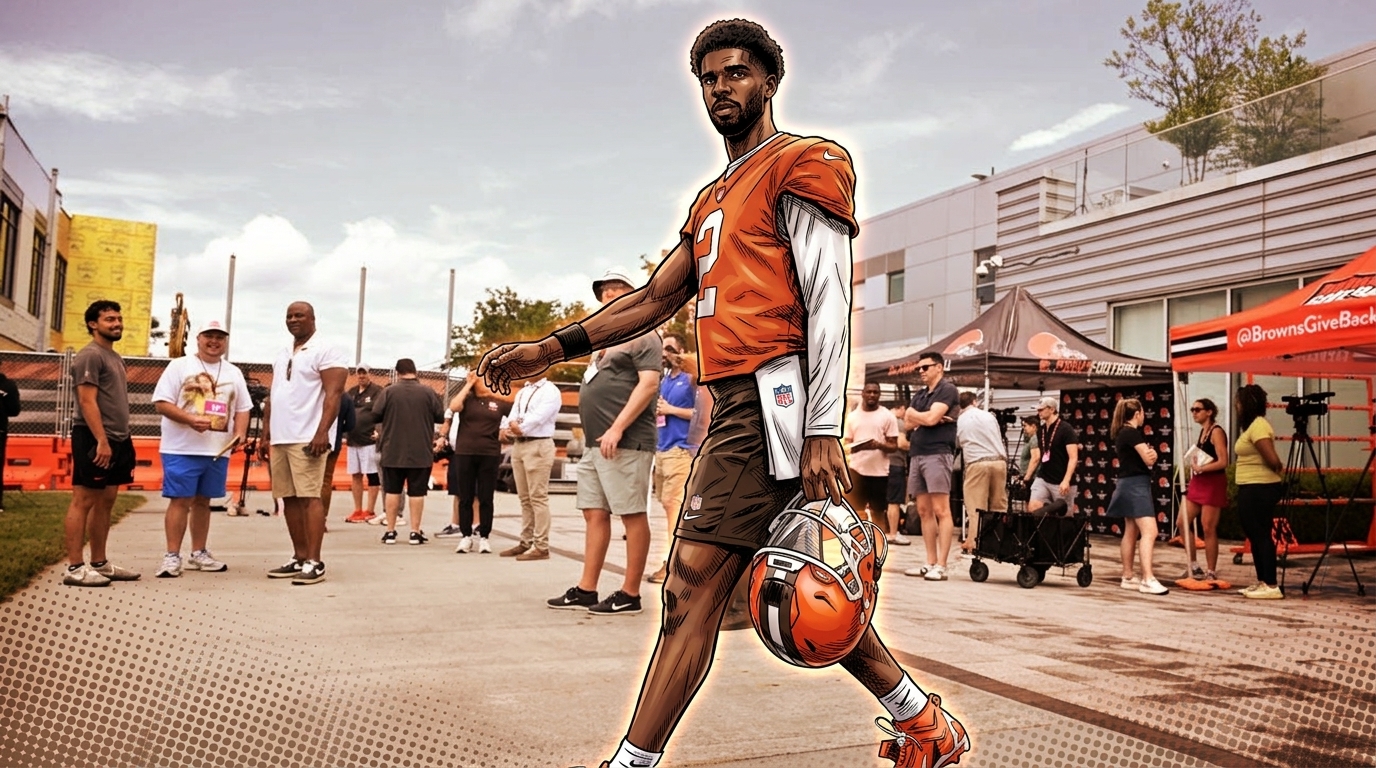
Sanders went public about it this spring. He told reporters he didn’t get a fair shake in his 2025 rookie training camp. He’s not wrong; Cleveland insider Anthony Lima said it plainly: “This was not a fair quarterback competition.” Zac Jackson at The Athletic reported that Sanders, as the fourth quarterback in line behind Flacco, Pickett, and Gabriel, never accumulated the first-team reps required to make a meaningful impression. Day one of camp, Pickett had the ones while Sanders worked mostly with the third unit. Day two, Flacco entered and split the first-team snaps with Pickett. Sanders rotated between the second and third units. Then he strained an oblique in August and that was essentially his rookie year. Joe Flacco won the starting job primarily by staying healthy, which is its own kind of commentary.
Head coach at the time Kevin Stefanski had announced an “open four-way competition” before camp. He said it out loud; he probably even believed it on some level, the way institutions believe their own press releases long enough to distribute them. But the competition was open in the same sense that a restaurant is open when the kitchen closed an hour ago: technically accurate, functionally misleading, and you’re going to feel like an idiot if you planned your evening around it.
This is not a novel criticism of the Browns. The franchise has been calling things what they aren’t for the better part of a quarter-century. Rebuilds that were retooling. Retooling that was rebuilding. Quarterback controversies that were settled decisions waiting for the paperwork. The institutional habit of announcing something fair and then doing something else is so deeply embedded in the organization that it doesn’t even register as dysfunction anymore; it registers as culture.
What makes Sanders’s complaint notable isn’t its accuracy — it’s its timing. He’s airing a grievance about 2025 while 2026 is, apparently, genuinely different. New coach Todd Monken has actually given him first-team reps. Monken said in May that Sanders has “come miles” in terms of his progressions and understanding of concepts. Mary Kay Cabot reported that Sanders has closed the gap enough that the Browns are now legitimately uncertain about their starter.
https://x.com/923TheFan/status/2062513958112665924
ESPN’s Jeremy Fowler noted that Watson went into the spring as the clear favorite and Sanders has at least bridged the distance. When Sanders was asked post-minicamp whether he had summer plans, he said: “If I’m thinking about summer plans right now, my mind is in the wrong space.” That’s a guy competing, not auditioning.
So here is the tension: Shedeur Sanders, a second-year quarterback who has earned real consideration in what is now a real competition, is choosing this moment to relitigate the process that failed him a year ago. He’s right about what happened. He is also choosing to be right about it out loud, in public, while his current coaches are watching, which is the kind of thing that gets quarterbacks quietly demoted in ways that look like performance evaluations.
The counterargument is that he had a right to say it and it needed to be said, that organizations behave better when players push back on organizational bullshit rather than absorbing it silently. That’s a coherent position. The problem is that the NFL is not an environment that rewards coherent positions about organizational accountability; it rewards quarterbacks who keep their heads down and win.
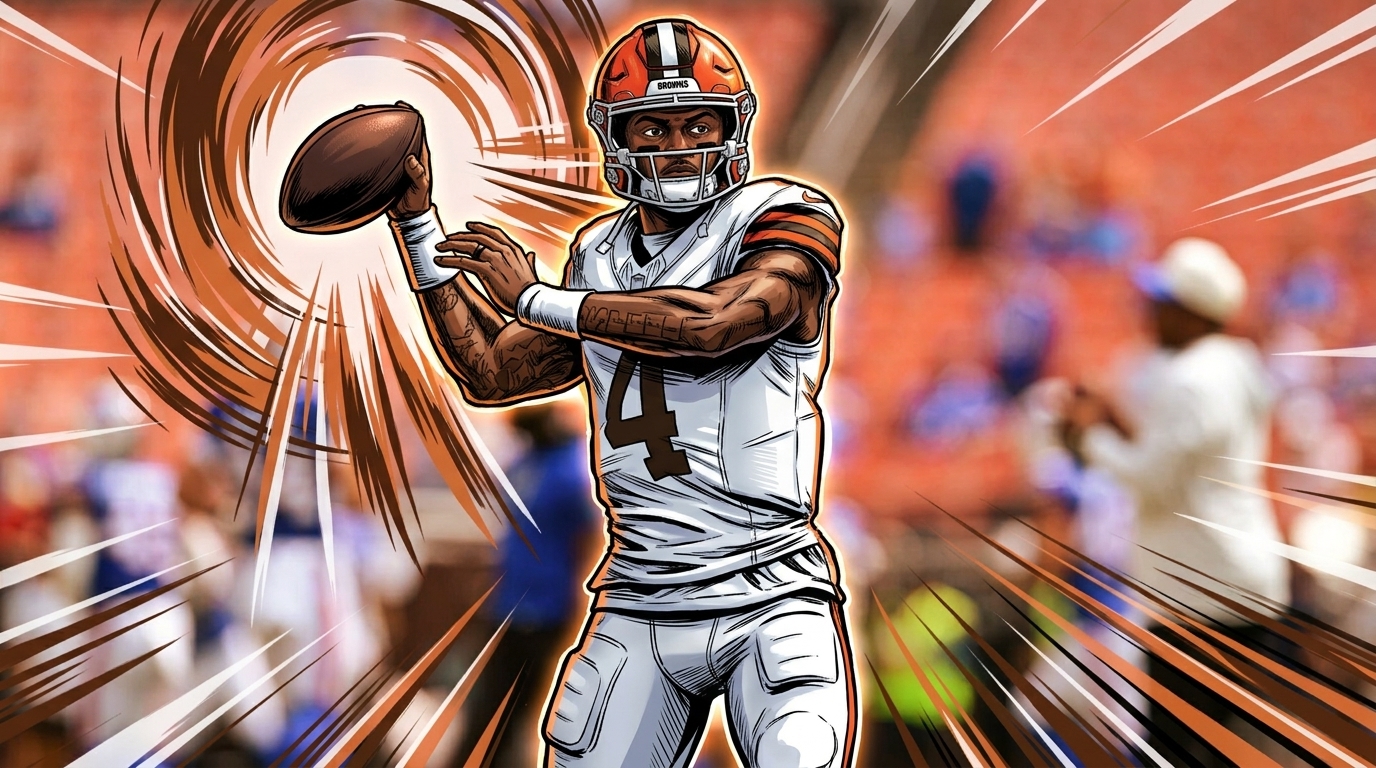
There is no version of this Browns situation that resolves cleanly. Watson is returning from an Achilles injury with a guaranteed contract that dwarfs any roster logic. Sanders is a fifth-round pick with leverage proportional to his performance and nothing else. The 2025 competition was theater. The 2026 competition might be real. Going on the record about the theater, now, while the real thing is happening — that’s not wrong, exactly. It’s just the kind of noise that the franchise dysfunction generated, that Shedeur absorbed, and that he’s now redistributing into an environment where the dysfunction is finally, maybe, temporarily, in remission.
The Browns failed him first. He’s just making sure we remember it. The question is whether the organization is going to take the note.