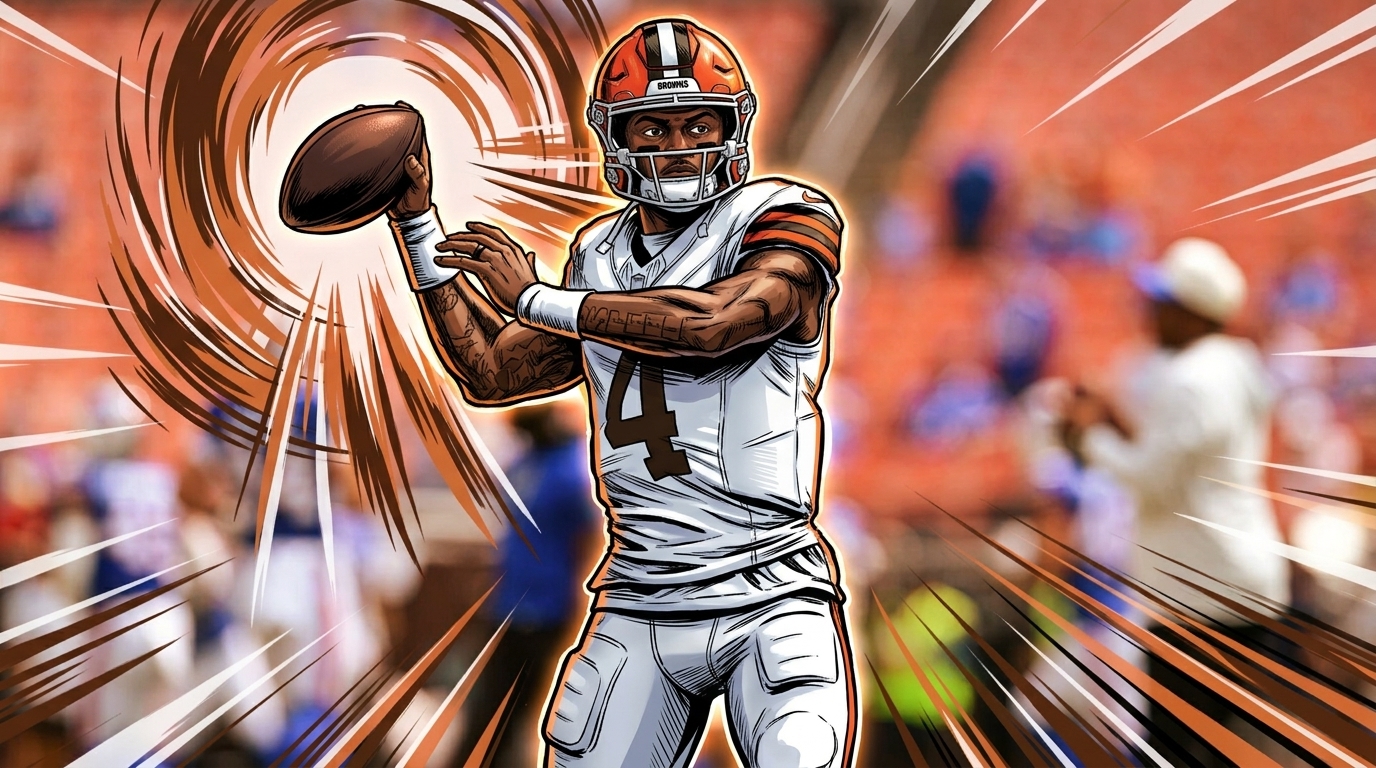

We’ve seen this before — a team manufactures a “competition” it doesn’t actually want, and then the wrong guy starts winning it. The Cleveland Browns are living that right now, except the stakes are $230 million fully guaranteed and a franchise that has spent four years rationalizing decisions it knew, on some level, were indefensible. Shedeur Sanders looked sharper than Deshaun Watson at Browns minicamp. Three beat reporters said so, independently, in almost identical terms. The organizational response has been something close to studied silence, and that silence is doing a lot of heavy lifting.
This is not a story about who’s winning a quarterback competition. It’s a story about an organization that structured itself so that there is no winning outcome — for anyone — regardless of which quarterback eventually takes the Week 1 snap.
What Three Beat Reporters Actually Saw at Minicamp
On June 3, Mary Kay Cabot of the Cleveland Plain Dealer watched Sanders run first-team offense in virtually every competitive drill and described what she observed this way: “I felt there was a paradigm shift Wednesday in this whole thing. It just felt like things were different.”
That’s a precise word choice from a reporter who has covered this franchise for decades. “Paradigm shift” is not a phrase veteran beat writers deploy carelessly. Her colleague Ashley Bastock was more granular: “Any drill they were going at full speed, any team drill, it seemed like Shedeur was the one who was going first Wednesday.” And Dan Labbe completed the trifecta: “Wednesday felt different. We saw something different… it was interesting that this was the very first time that we’ve seen Shedeur take those reps.”
Three reporters, one practice, one conclusion. Sanders — a 24-year-old fifth-round pick (which is its own separate conversation about draft positioning and organizational messaging) — was operating ahead of the highest-paid player in NFL contract history.
ESPN’s Jeremy Fowler subsequently reported that Sanders has “bridged the gap” with Watson heading into training camp. That framing — “bridged the gap” — implies there was a gap to bridge, which itself implies the Browns never fully bought into Sanders as the answer. They were just hoping Watson would be too healthy to ignore. He wasn’t.
https://x.com/923TheFan/status/2062513958112665924
Head coach Todd Monken, for his part, offered the kind of answer that only makes sense when you’re managing an impossible situation: “I don’t even know if I will be able to set it by the end of minicamp… Each day that changes.” That’s honest. It’s also a description of a franchise that has no roadmap and is aware of it.
The $80.7 Million Problem Nobody Can Solve
Watson’s 2026 cap hit is $80.7 million — the largest single-season cap charge in NFL history, the result of restructuring a contract that was already the largest fully-guaranteed deal ($230 million over five years) in league history when Cleveland signed it in 2022. If the Browns release Watson post-June 1, they absorb $80.7 million in dead cap this year and another $50.4 million in 2027. That’s $131 million in dead money spread across two seasons for a quarterback who last played a full, healthy season in 2020 — in Houston, before the suspension, before the ACL, before the Achilles.
Watson tore his ACL in Week 3 of 2023. He reinjured his Achilles in 2024. He now claims to be fully healthy for the first time since that Week 3. That claim may be entirely true. It also has no bearing on the financial trap Cleveland built around it.
The Browns traded away Myles Garrett — the one player who made losing seasons watchable — in part because the Watson contract had already constrained how they could build a roster. The cap consequences of that deal don’t disappear if Watson sits. They don’t disappear if Sanders starts. They just change shape.
Monken’s quote about both players — “They’ve both played well enough to earn the right to compete to start” — is the most politically functional sentence anyone connected to this team can say. It’s neither false nor useful.
Will Shedeur Sanders Start Over Deshaun Watson?
The honest answer, as of minicamp, is: he might. Three credible reporters observed Sanders taking first-team reps in competitive drills while Watson did not, and ESPN’s Jeremy Fowler reported that the gap between them has closed significantly. Sanders has shown enough that the Browns’ own beat press has started framing this as a genuine competition rather than a coronation in waiting for the veteran. Training camp will be the real test. But if the trajectory from June holds, Cleveland enters the preseason with a genuine two-quarterback situation that the organization has every incentive to make look like a non-decision for as long as possible.
Why Cleveland’s Front Office Has No Exit Ramp
Run the scenarios. All of them end somewhere uncomfortable.
Watson starts and plays well: Cleveland survives 2026 with its talking points intact. The $80.7 million cap hit still evaporates into dead money in future years regardless. The Watson era costs them competitive flexibility until at least 2028. They bought a season.
Watson starts and struggles: The front office absorbs a full year of fan pressure, beat reporter scrutiny, and the perpetual background noise of Sanders on the sideline. A mid-season switch triggers the same dead cap math and adds the organizational embarrassment of a public course correction.
Sanders wins the job outright: This is the scenario Cleveland’s front office should most want from a pure football standpoint — a cheap, young quarterback on a rookie deal while the roster rebuilds — and it’s also the one that generates the most institutional discomfort. Every single week that Sanders plays, a reporter will note that Watson is drawing his contract. Every injury. Every interception. Every three-and-out. Watson’s guaranteed money doesn’t stay in the background. It moves to the foreground.
There’s no clean path. There’s a competition the organization didn’t design for a result it can’t cleanly absorb, and three beat reporters who watched one practice and saw what they saw.
A clip of a Sanders interception from minicamp went viral — 6.7 million views, which is a remarkable number for a June practice that officially means nothing. Remarkable, and telling. There’s an audience that wants this to be the Sanders era. Whether Cleveland’s front office has the stomach to let the field make that decision for them is the question that training camp will start to answer.
What to watch: Monken said the starter might not be named by the end of minicamp. That’s almost certainly true, and probably true into August. Watch whether the first-team reps distribution in training camp looks anything like what reporters described in June. If Sanders is still going first in competitive drills by the third week of camp, the organizational pressure to make it official will be harder to resist than any cap calculation.