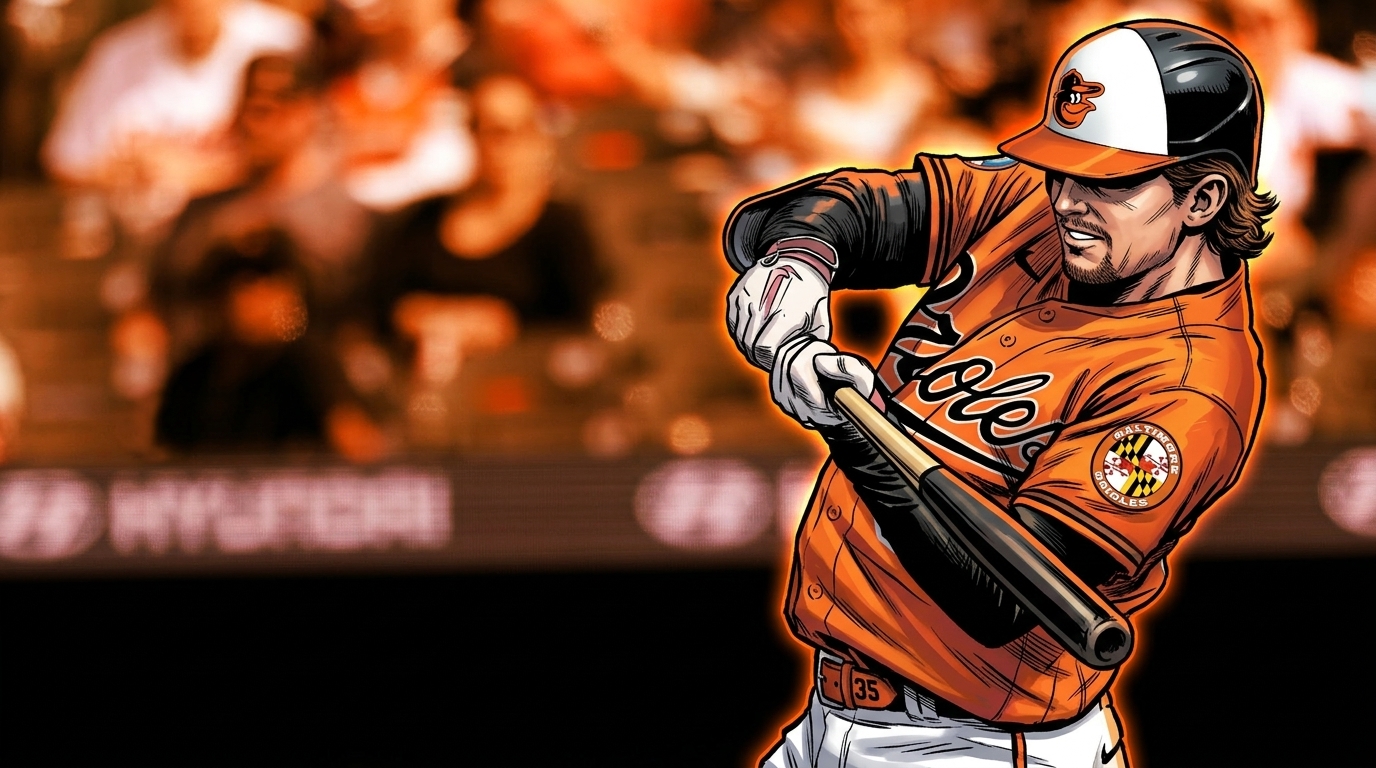

There’s a stat line that decides whether Boston’s trade for Adley Rutschman was smart business or an overpay, and it has nothing to do with what happens at Rogers Centre tonight. Boston sent four players, including its own No. 2 organizational prospect, to Baltimore for Rutschman and backup catcher Jake Rogers. The only question worth asking right now is whether Rutschman’s numbers from before his wrist injury ever supported giving up that much for a catcher, not how tonight’s debut goes.
The prospect cost isn’t up for debate. Anthony Eyanson was Boston’s clear No. 2 organizational talent before the deal, a rotation-caliber arm the industry rated inside the sport’s top 40. That’s established value walking out the door, not depth-chart filler. This trade hinges on whether his pre-injury production clears the bar a return that steep should require, not on the injury that delayed Rutschman’s first game in a Red Sox uniform. If it doesn’t clear that bar, the price was the problem long before anyone got hurt.
What Boston Actually Gave Up for Rutschman
Start with the full inventory, because “gave up some prospects” undersells it. Boston sent right-handers Anthony Eyanson and Kyson Witherspoon, outfielder Enddy Azocar, and catcher Carlos Narvaez to Baltimore in the trade that brought him to Boston, a seven-player deal that came together roughly an hour before the August 3 deadline, with cash or a player to be named later still to be settled.
Witherspoon and Azocar both landed inside Baltimore’s top 10 organizational prospects after the trade. Those are real complementary pieces, but they’re not what makes this deal expensive. Eyanson is. He ranked No. 33 overall on Baseball America’s Top 100 before the trade and is now Baltimore’s top prospect in the entire system. He’s a starter Baltimore is projecting into a rotation spot, not a lottery ticket.
Boston got Rutschman and Jake Rogers back for that package, and Rogers barely factors into the price tag. Baltimore had just acquired him from Detroit, where he’d hit .161, and flipped him again days later. This is a Rutschman trade in every sense that matters. Rogers is a rounding error attached to it.
Does the Pre-Injury Data Support Frontline-Catcher Value?
Not conclusively. Rutschman hit .251 with a .764 OPS in 67 games before the wrist injury, comfortably above this year’s league-average catcher mark of .684. But that bounce-back follows a career-low .673 OPS in 2025, and it came across three separate injured-list stints interrupted by an ankle problem, a concussion, and the wrist injury that ended his Baltimore season early.
Judged purely on rate production, Rutschman’s bat plays like one of the better catchers in the sport, and it made him Baltimore’s only All-Star selection this season, a marker of how thin the roster around him had gotten as much as how good he was. The complication isn’t ability. It’s durability. Three separate injured-list trips in one year is the actual risk Boston bought, not whether Rutschman can hit when he’s on the field. Baltimore, in the middle of Baltimore’s deadline sell-off, had every incentive to sell high on a talented, oft-injured catcher heading into the tail end of his team control. Boston bet that health, not talent, was the outstanding question. Both bets are defensible on their own terms. Only one of them required surrendering a top-40 prospect to make.
Was Anthony Eyanson Really ‘Damaged Goods’?
Not everyone thinks Boston overpaid. Red Sox alumnus Jonathan Papelbon posted his approval of the framework within hours of the trade, framing Eyanson and Witherspoon as expendable in exchange for a proven catcher.
https://twitter.com/TheRealJPap58/status/2084394214486413758
That’s opinion, and it doesn’t hold up against what Eyanson actually did on the mound this year. Across his first 16 professional outings this season at High-A Greenville and Double-A Portland, he carried a 1.32 ERA. Zoom into his final five High-A starts and it sharpens further: a 0.44 ERA, a .104 opponent batting average, and a 0.49 WHIP, with 34 strikeouts against three walks in 20.1 innings. Batters facing him were close to automatic outs. Scouts don’t rank an arm 33rd overall in the sport because it’s damaged. Whatever health concern prompted Papelbon’s read, it isn’t showing up on the stat sheet, and no reporting beyond that tweet has surfaced one.
What Tonight’s Debut Can and Can’t Answer
Boston’s catchers hit a combined .222 before the trade, which is the plain baseball reason the front office prioritized the position at the deadline regardless of price. That number explains the urgency. It doesn’t retroactively justify what got paid to fix it.
Rutschman is expected in the lineup tonight against Toronto’s Dylan Cease at Rogers Centre, on a night Boston enters having dropped three straight and sitting third in the AL East. He looked ready in a two-game rehab stint with Triple-A Worcester over the weekend, going 1-for-7 with a double and two walks. None of that changes what’s actually being evaluated here. Tonight’s box score will tell you whether Rutschman can hit Cease. It won’t tell you whether Boston should have given up a top-40 prospect and two more legitimate pieces to find out over a full season, and that answer was already sitting in the pre-injury data before Rutschman ever put on a Red Sox uniform.
My own fantasy league’s projection model, the one I’ve been tuning since my Berkeley days mostly to beat the guy who drafts by jersey sales, treats a healthy version of this Rutschman as one of the better bats at his position in the sport. What it can’t price is three separate injured-list trips in a single year, and neither, it turns out, could Boston’s front office. The debut is worth watching. The bill is already paid, and that .764 OPS says the front office bought a real player at a real position of need. Whether it paid the right amount for him is a question next season answers. Tonight can’t.