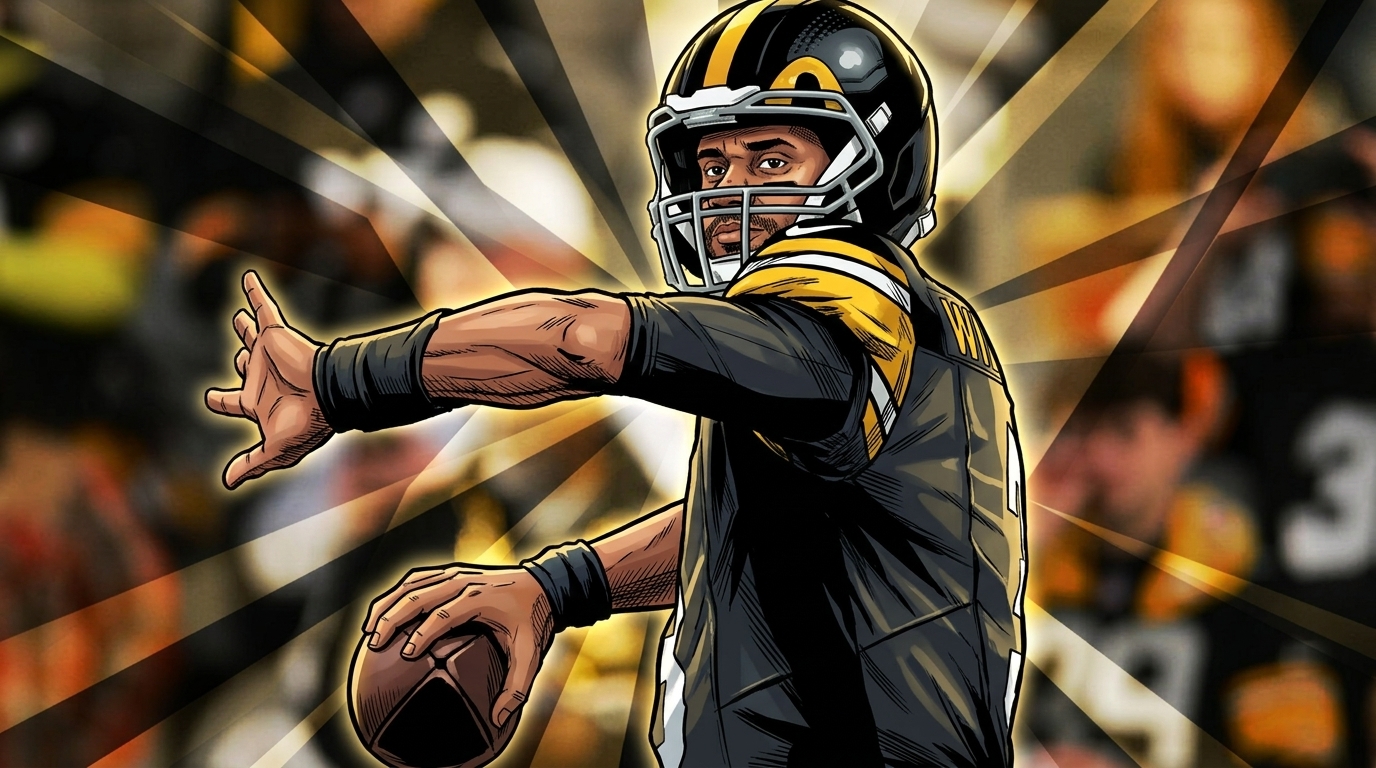

Russell Wilson retired on June 3, 2026, with a video titled “Thank You, Football,” 14 seasons, a 99.8 career passer rating, and a CBS NFL Today studio chair waiting for him. The retirement announcement landed quietly: no drama, no leaked texts, no beat reporters camped outside a facility. Just a clean, produced, emotionally calibrated piece of content.
That last detail is not incidental. It is the argument.
https://twitter.com/DangeRussWilson/status/2062298629071601828
Wilson’s career, viewed end-to-end, is the most instructive case study in NFL history of the gap between QB self-marketing and measurable production. Not because the self-marketing was dishonest during his peak. It wasn’t. The Seattle numbers were real. But at some point after he left the Pacific Northwest, the brand and the player began diverging, and Wilson kept performing the first role with an intensity that the second role could no longer justify. CBS didn’t hire a quarterback. They hired a man who always understood, on some cellular level, that presentation was the job.
The Career Stats Don’t Lie, But They Don’t Tell the Whole Story
Start with the aggregate. A 99.8 career passer rating ranks fifth all-time, behind Aaron Rodgers (103.1), Patrick Mahomes, Lamar Jackson, and Joe Burrow. Ten Pro Bowls. 353 touchdowns. 46,966 passing yards. One Super Bowl ring. A 121-80-1 record as a starter. Jordan Schultz called Wilson “a surefire Hall of Famer” in retirement coverage, and you can understand the impulse. Those are Hall of Fame-adjacent numbers on their face.
But career aggregates have a core problem as analytical instruments: they blend eras that should not be blended. Wilson’s career passer rating is not uniformly distributed across 14 seasons. It is heavily weighted toward Seattle, where he posted a ~101.8 rating across his tenure. The aggregate number is a palimpsest, the Seattle version of Wilson showing through the later years.
The frame I keep returning to is what I’d call a “brand-production alignment curve.” Every athlete has one. During Wilson’s Seattle peak, specifically 2019 (106.3 rating, 31 TDs, 5 INTs) and 2020 (105.1 rating, 40 TDs), his brand claims were nearly perfectly calibrated to his output. He said he was elite. He was elite. The curve was flat. The gap was zero.
After Seattle, the gap opened. And it kept opening.
What Went Wrong in Denver: The $245M Cautionary Tale
The Russell Wilson Denver Broncos decline is not complicated analytically, though it remains genuinely hard to explain as a football phenomenon. Wilson arrived in 2022 with a $245M extension (his agent had initially asked for $350M, which tells you something about where Wilson’s self-assessment was anchored). The season that followed was one the Denver organization is still financially digesting: an 84.4 passer rating, 16 TDs, 11 INTs, and a team record of 4-11 that coincided with the worst scoring offense in the NFL that year at 16.9 points per game.
The $245M extension was signed in September 2022. The season collapsed before the ink was dry.
By 2023, Wilson was posting a 6.9 yards-per-attempt average (22nd in the NFL, a career low) and was benched with two games remaining for Jarrett Stidham. The Broncos released him in March 2024, absorbing an $85 million dead-cap hit that was, at the time of release, the largest in NFL history. Approximately $32 million remained on Denver’s books into 2025. They paid Wilson roughly $37.8 million in 2024 while he was on a cheap deal in Pittsburgh.
This is the moment in Wilson’s arc where the “Mr. Unlimited” alter ego (a self-coined brand launched via social media video in 2018, before any of this happened) became genuinely uncomfortable to observe. “Broncos Country, Let’s Ride” had been introduced at media day with the kind of performance-confident delivery that works when the product matches the pitch. By the time Denver was 4-11, the phrase had become a punchline so total that Wilson quietly replaced it with “Go Broncos” by 2023 training camp. The brand did not adapt. It retreated.
What the Denver collapse clarified is something that teams negotiating with quarterbacks should consider carefully: self-image metrics do not discount over time the way production metrics do. Wilson’s conviction that he was a $350M quarterback did not update when the evidence suggested otherwise. Compare this to the AJ Brown trade to New England, where a team paid for documented, current production at a premium: a very different calculus than paying for a quarterback’s belief in his own ceiling.
The Pittsburgh 2024 interlude deserves an honest reading. A 95.6 passer rating on a one-year prove-it deal, 16 touchdowns, 5 interceptions, a 10th Pro Bowl: that is competent quarterbacking. Wilson was diminished, not washed. Those are different things, and the Pittsburgh numbers proved it: a diminished version of an elite player can still move the chains, still make a Pro Bowl, still win games. But the 2025 Giants stint (0-3 as starter, benched in Week 3 for rookie Jaxson Dart, a 66.1 PFF grade through three weeks) confirmed that Pittsburgh was a maintenance window, not a recalibration.
After the Giants benched him, Wilson said: “I’m not blinking. I know what I’m capable of.” He then declined a Jets backup offer under Geno Smith and took the CBS chair instead. That sequence is the most revealing data point of his final two years.
Is Russell Wilson a Hall of Famer?
Russell Wilson is a borderline Hall of Fame candidate whose case was significantly damaged by the post-Seattle chapter of his career. His Seattle-era production, a ~101.8 passer rating, one Super Bowl ring, consistent top-ten efficiency across a decade, constitutes a legitimate argument. The aggregate career numbers are strong. But Tony Gonzalez has publicly questioned Wilson’s case, noting that Wilson “played himself out of a Hall of Fame,” and the framing is accurate: the Denver collapse, the dead-cap disaster, and the increasingly short tenures in Pittsburgh and New York all complicate the verdict. The new 2025 HOF rule changes make admission harder. Wilson’s case is real but not automatic.
The complicating factor for Hall of Fame evaluators is the same one running through this entire piece: the underlying distribution matters. The peak was concentrated and brilliant. The decline was precipitous and expensive. Richard Sherman, who played alongside the peak version, has also expressed skepticism. Evaluators will need to decide whether the Seattle decade is sufficient on its own, or whether the post-Seattle narrative shifts the verdict enough to keep him waiting at the door.
Why CBS Hired the Brand, Not the Quarterback
There is a revealing comparison available here, and it requires precision to make correctly. When Tony Romo joined CBS as a lead game analyst in 2017, he was immediately celebrated for a specific cognitive skill: predicting plays before the snap. Romo was in a booth, in real time, decomposing defensive alignments and offensive tendencies while the play clock ran. That is an X’s-and-O’s processing job.
Wilson is joining CBS NFL Today as a studio analyst. This is a different job entirely. Studio analysis is about opinion formation, narrative framing, and presence: being watchable and credible while discussing football at remove. The skills that make someone exceptional in a studio are not identical to the skills that make someone a great quarterback. They are, however, closely related to the skills that make someone exceptional at managing their own public image.
Wilson guest-analyzed for CBS NFL Today during a Giants bye week in 2025. This was effectively a tryout, and he got the chair. Matt Ryan, Wilson’s predecessor at the CBS desk, was solid and professional and unmemorable in the role. He left for the Falcons’ front office. The network needed someone who would be watchable on a Sunday morning in October. Wilson has been performing that function (managing presentation under conditions of public scrutiny) since at least 2014.
The CBS quote from Wilson at announcement: “As I enter this next chapter with CBS Sports and ‘The NFL Today,’ I’m so blessed to continue doing what I love most, being around the greatest game in the world.” Clean, calibrated, professionally warm. The same register he’s been working in for a decade. He didn’t say he was done playing. He said he was blessed to continue doing what he loved most.
The framing erases the benching. The brand performed continuity.
The Lesson Every NFL Team Should Take From Wilson’s Arc
The lesson from Wilson’s career is not about talent. The Seattle version of Wilson was genuinely talented — one of the most efficient passers in NFL history during a sustained peak, and the only player to post 30-plus touchdowns with fewer than 15 interceptions in four consecutive seasons. The lesson is about the feedback loop between self-image and contract valuation, and what happens when that loop is allowed to run unchecked.
Wilson’s agent asking for $350M in 2022 is the number that will define how NFL front offices discuss this era. The Denver organization gave him $245M with $165M guaranteed — driven, at least partly, by the accumulated brand equity of the Seattle years. They priced a quarterback whose self-assessment had not discounted for the possibility that the environment (Pete Carroll, a dominant defense, a complementary running game) had been load-bearing in ways the market wasn’t pricing.
When that environment was removed, the production gap became visible. The brand did not update. The contract could not be unwound.
Russell Wilson’s career legacy, viewed cleanly, is a two-part story: a peak so efficient it anchors a top-five all-time passer rating, and a descent so expensive it set a dead-cap record. Both parts are real. The difficulty is that Wilson himself only seemed to fully inhabit the first narrative, right up to the moment he chose a CBS chair over a backup role in New York.
That choice is not a failure. It is a conclusion — the logical endpoint of a career built on the understanding that performing quarterbacking and doing it are related but separable skills. The brand outlived the production. CBS will be fine with that.
They’re in the business of the first thing.