
Norway has appeared at three World Cups: 1938, 1994, and 1998. In 1938, they played Italy in the knockout round and lost 2-1 after extra time. In 1994, they were eliminated in the group stage and never played a knockout game at all. In 1998, they played Italy again in the Round of 16 and lost 1-0. That is the entire history. Three tournaments; two knockout appearances; zero wins. The record sat there, accumulating dust and not much else, for eighty-eight years.
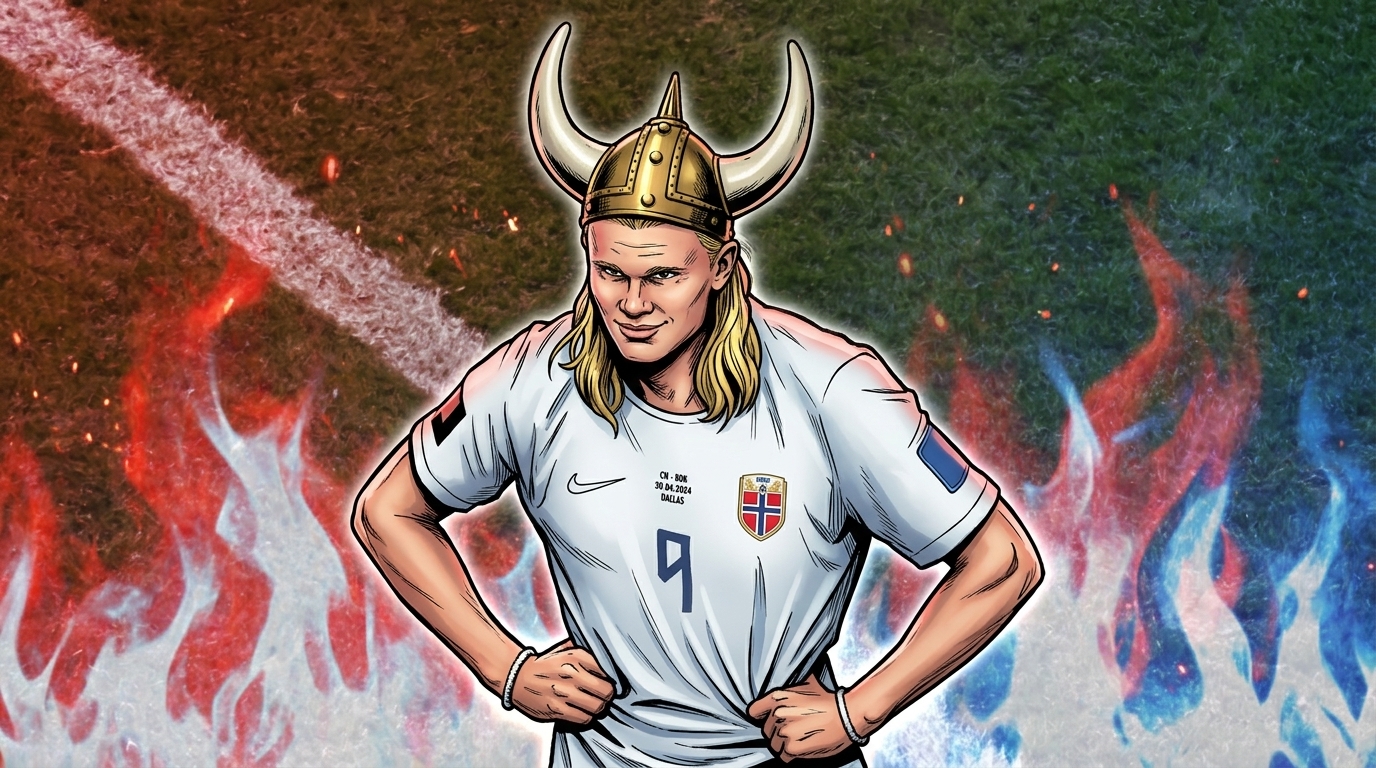
Erling Haaland ended it in the 86th minute against Ivory Coast, on June 30, 2026, at AT&T Stadium in Dallas. He tapped the ball in from a cross, put Norway up 2-1, and then stood there with his hands on his hips in a golden Viking helmet, looking like a man who had just completed a reasonable Tuesday afternoon task.
He did not celebrate like a man who understood what he had just ended. He should have.
Antonio Nusa had opened the scoring in the 39th minute — Norway’s first World Cup knockout-stage goal in eighty-eight years, a fact that deserves a beat of silence before you keep reading. The last man to score for Norway in a World Cup knockout game was Arne Brustad, who did it against this same Italy side in 1938.
Amad Diallo equalized for Ivory Coast in the 74th minute. Then Haaland, four minutes from regulation, closed the loop.
The easiest frame for this is Haaland’s individual brilliance: his place in the big-tournament narrative, his inevitable presence in the Golden Boot race. That frame is accurate and also completely misses the point. Haaland being good at football is table stakes. The interesting question is what one generational player means to a country that has never developed the institutional machinery of football greatness.
Think of it this way: Norway is not Germany. It is not Brazil, or Argentina, or France. It does not produce lineages of greatness; it does not have a deep tradition of World Cup runs that players inherit as cultural expectation. What Norway has is Haaland, singular, once a generation — an accident of geography and genetics that landed a six-foot-four striker from Bryne, a town of twelve thousand people, into the upper echelon of the sport. The three previous Norwegian World Cups produced no knockout wins not because Norway lacked effort or ambition, but because the machinery was never there; you need certain kinds of footballing infrastructure, certain depth of talent across a squad, certain historical confidence in high-leverage moments, to win knockout games at World Cups. Norway has had precisely none of that. It still doesn’t, not really.
What it has is Haaland. And what the 86th minute proved is that sometimes that is enough. One player, one goal, and a loop that has been open since Arne Brustad was young and the world was different.
The honest coda is that this is not the end of the story; it is the beginning of a harder one. Norway faces Brazil in the Round of 16 at MetLife Stadium, and Brazil is not Ivory Coast. The machinery question does not go away because Haaland tapped in a cross in the 86th minute in Dallas. The depth questions remain. The squad questions remain. Whether Norway can win two knockout games at a World Cup, whether one generational talent is enough for that, is a question this tournament is not yet done asking.
But eighty-eight years of nothing, and then something. The loop closes. Haaland put his hands on his hips in a golden Viking helmet and looked like he had done it a hundred times before.
He hadn’t. Nobody from Norway had. That is the whole point.