
Every July 1, both the NHL and NBA open free agency simultaneously. This year, that overlap means something, because the contrast between them has never been easier to explain.
The question worth asking isn’t which league had a bigger day. It’s this: what does $2 billion in player commitments look like when it’s genuinely distributed across 32 teams? And what does it reveal about the single most important design decision in professional sports?
The Number That Explains Everything
The NHL’s 2026-27 salary cap sits at $104 million. The floor is $76.9 million. That $27.1 million gap, the maximum distance between the richest and poorest roster in the league, is the number that explains everything about what happened today.
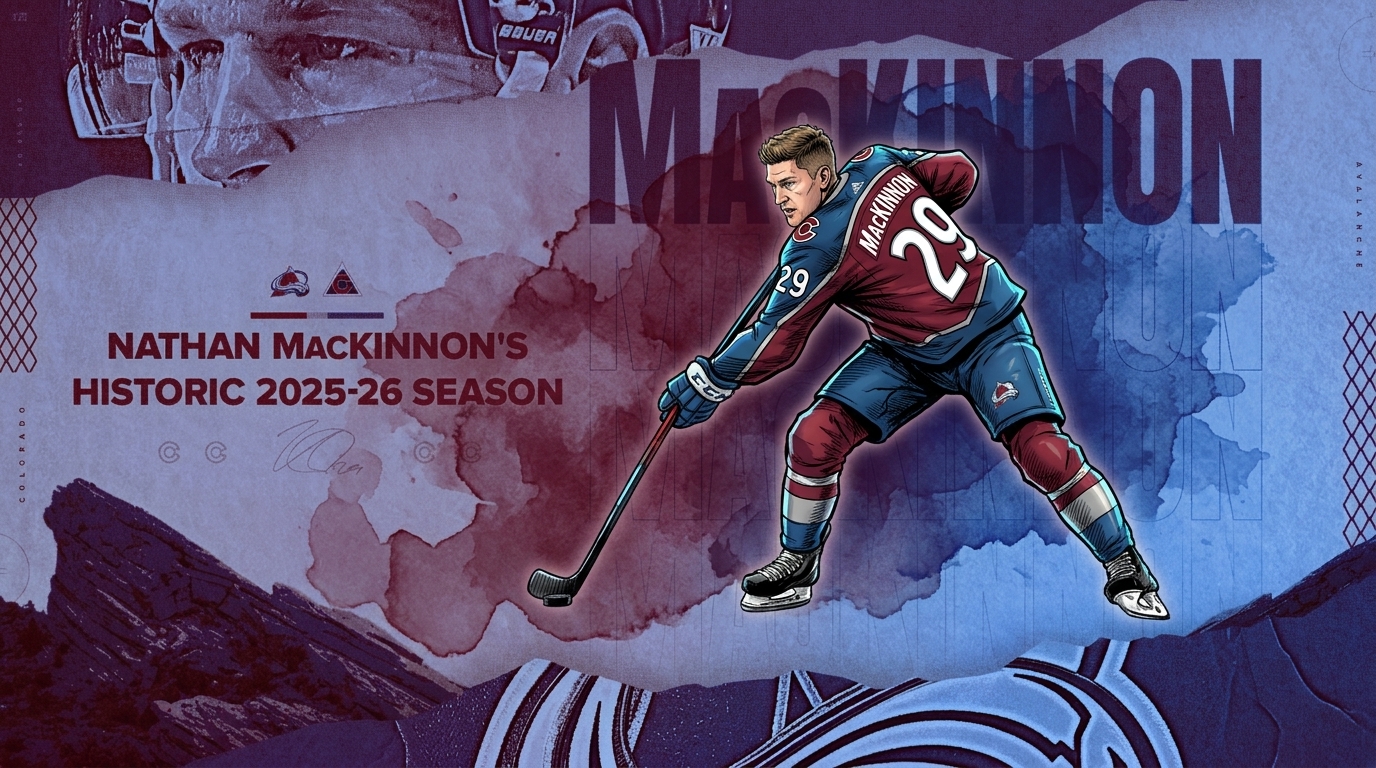
Consider what that constraint produces in practice. Colorado committed to Nathan MacKinnon at $12.6 million per year through 2030-31. MacKinnon led the NHL with 53 goals last season, won the Rocket Richard Trophy for the first time, and carried the Avalanche to the Presidents’ Trophy. He is, by any measure, worth every dollar. Colorado’s current cap table shows $101.6 million already committed, with $2.38 million remaining for 23 roster spots.
That is the hard cap doing exactly what it was designed to do. Even the best player on the best team in the best regular season compresses his franchise’s flexibility to nearly zero. Nobody forms a superteam around MacKinnon. Nobody can afford to. The arithmetic doesn’t allow it.
Why Is the NHL More Competitive Than the NBA?
The NHL produces more genuine competitive uncertainty because its hard cap forces every team, regardless of market size, ownership wealth, or fan base, to operate within the same $27.1 million band. There are no luxury tax workarounds, no Bird Rights exceptions, no apron tiers that let deep-pocketed owners outspend the field. Every dollar committed to one player is a dollar unavailable for another. Talent concentration is mathematically constrained, not culturally discouraged.
That design choice cascades through the entire sport. Teams build through the draft first (as Gavin McKenna’s draft night made clear) because free agency can only add pieces, never foundations. Carolina’s 12-1 playoff run didn’t happen because the Hurricanes outspent anyone. It happened because the cap made their patient build sustainable while their opponents simply couldn’t purchase a solution.
What July 1 Looked Like in Both Leagues
The NHL free agency tracker reads like a well-curated grocery list. Sergei Bobrovsky to Toronto. Ivan Demidov to Montreal on an 8-year, $9.125 million deal. Bowen Byram to Chicago at 6 years, $12.5 million, briefly the highest-paid defenseman in the league. Nico Hischier re-upped in New Jersey at 5 years, $11.7 million. Mason Marchment signed in San Jose at 5 years, $6.75 million. Rasmus Andersson went to Vegas at 7 years, $8.5 million.
Every one of those signings is targeted. Every one fills a specific hole on a specific team. None of them shift the power balance meaningfully. That’s not a bug. That’s the product of 32 teams operating in the same fiscal universe, none able to simply outbid the rest.
Then there’s the NBA. According to the NBA free agency tracker, Giannis landed in Miami via trade. LaMelo went to Minnesota. Kawhi returned to Toronto. LeBron departed the Lakers with the Warriors, Cavaliers, and Heat all in pursuit. Walker Kessler moved to the Lakers on a 4-year, $130 million sign-and-trade.
The NBA’s entire Western Conference reshuffled in roughly 24 hours.
https://twitter.com/32HockeyUpdates/status/2072290390179225614
I ran through the cap space distribution before NHL free agency opened: Anaheim at $40.4 million in space, San Jose at $39.4 million, a ladder of teams with real flexibility spread across the league. Twenty different franchises with a legitimate path to meaningful improvement. The NBA doesn’t produce that map because the NBA doesn’t require it.
The Tradeoff: Competition vs. Cultural Heat
The counterargument deserves a direct answer: yes, the NBA generates more cultural heat. Tracking LeBron’s next destination drives more conversation than every NHL signing combined. Growing up in San Jose, I watched the Sharks compete in an arena that was half-empty whenever the Warriors played across the bay. Hockey doesn’t colonize casual attention the way basketball does, especially when there’s a transcendent individual to follow.
The NBA’s soft cap, Bird Rights, luxury tax tiers, and apron exceptions were designed to allow superstars to chase rings without being fully punished for it. The result is a sport built around individual narratives. People watch LeBron the way they watch a movie. The outcome matters less than the performance.
The NHL built something different on purpose. Competitive uncertainty is the product: genuine, mathematical, not manufactured drama. I ran the playoff odds across the last decade both ways: the NHL’s champion-to-champion variance is wider, the conference finals matchups less predictable, the Stanley Cup field more genuinely open year to year.
The data here is unambiguous. When every team operates within the same $27.1 million band, talent cannot pool. When talent cannot pool, any team that builds correctly can win. When any team can win, the competition itself is the draw.
The NBA is must-see television built around appointment viewing for individual stars. The NHL is a sport where the hard cap forces every franchise to earn it. July 1 proved both things true at the same time.
One league spent $2 billion today and distributed it across 32 teams. Nobody stacked. Nobody formed a superteam. Nobody had to announce a press conference.
The cap didn’t limit spending. It limited stacking. That distinction is worth understanding — it’s the reason Carolina ran 12-1 through the playoffs, and it’s the reason the team that wins the Stanley Cup next June will have earned it the only way the NHL allows.