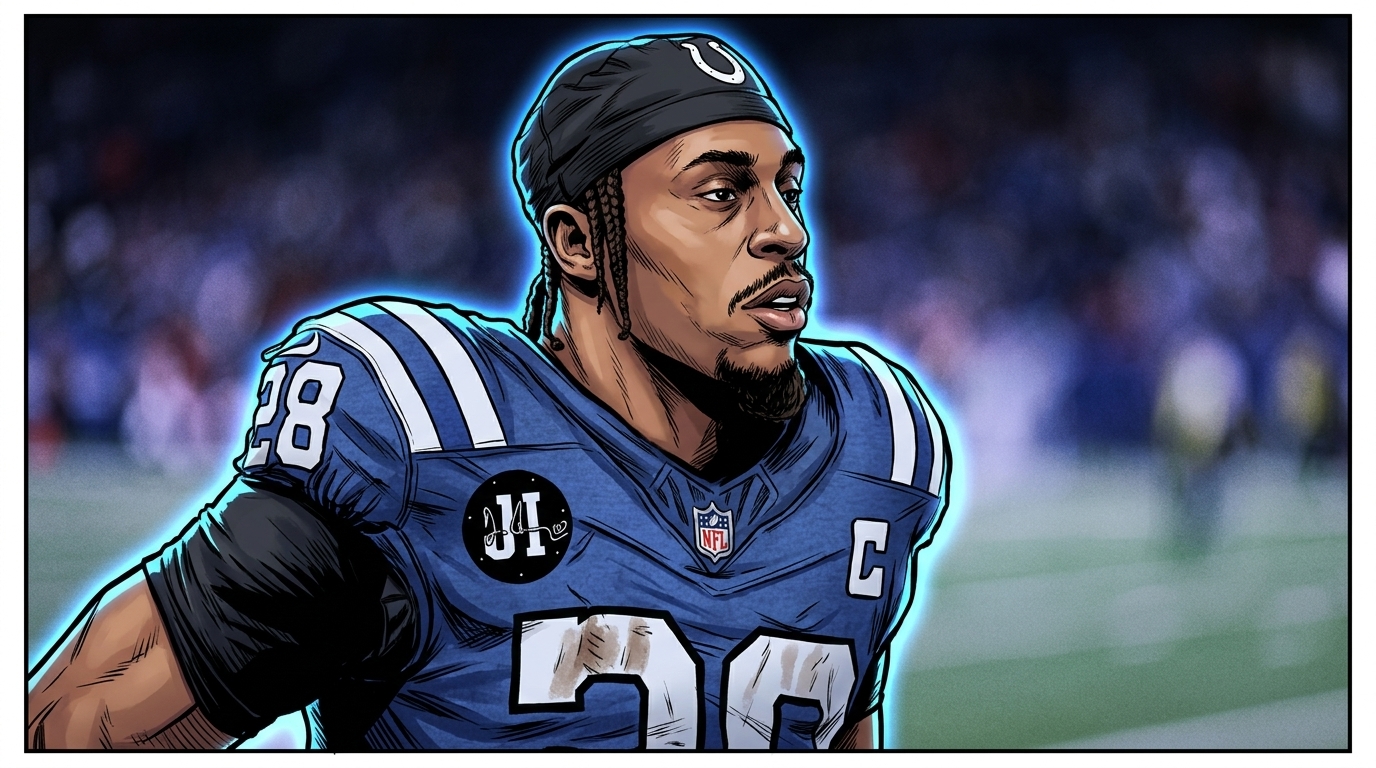

Two running backs just posted the two richest annual-value contracts the position has ever seen, in the same 48-hour stretch, from two front offices with no reason to coordinate on anything. Jonathan Taylor and the Colts agreed to a two-year, $44 million extension this week, worth up to $47 million with incentives, $39 million guaranteed, and $22 million a year in average annual value, keeping him under contract through 2028. That figure is the second-highest AAV any running back has ever signed for, trailing only the $22.25 million a year Bijan Robinson got from the Falcons two days earlier.
One record-setting running back deal could be a fluke: a general manager who fell for his own player, or a contract year that got out of hand. Two of the three richest running back deals in history landing 48 hours apart, negotiated independently by front offices in different cities with nothing to gain from making each other look smart, is not a fluke. It’s a market finding its real price. The “don’t pay running backs” doctrine that shaped roster-building for the better part of a decade didn’t quietly bend in Atlanta and then again in Indianapolis. It broke, and it broke everywhere at once.
What Is Jonathan Taylor’s New Contract With the Colts?
The deal itself, as first reported by ESPN, runs two years for $44 million, with incentives that can push it to $47 million, and $39 million of it is guaranteed. Divide it out and you get $22 million a year, a number that, three years ago, no running back in the league was within $6 million of touching. Taylor was staring down the final year of his old contract at $11.98 million for the 2026 season before this extension replaced it, which means the Colts didn’t hand him a raise so much as tear up the old number and start over.
Schefter broke the numbers within minutes of the deal getting done:
https://twitter.com/AdamSchefter/status/2085333832077602867
The production behind it isn’t in dispute. Taylor led the NFL last season in carries (323) and rushing touchdowns (18) across 17 starts, with 1,585 rushing yards that ranked third in the league behind James Cook’s 1,621 and Derrick Henry’s 1,595. It was his third Pro Bowl selection, and a follow-up to the 2021 first-team All-Pro year that first put him in this conversation. Asked about the new deal, Taylor pointed the credit outward rather than in, saying guys like Bijan “work really hard to put a great product on the field.” Days earlier, asked whether Robinson’s deal could speed up his own, he’d said he had “faith” something would get done with the Colts. Both quotes read differently once you know the order things happened in.
Why Did Bijan Robinson’s Deal Move the Market So Fast?
Because it landed first, and because of how big it was. Robinson signed a three-year, $75 million extension with the Falcons on August 4: $51 million guaranteed, a $37 million signing bonus, and a $22.25 million AAV running through 2030 that currently stands as the richest annual rate any running back has ever earned. Robinson’s $75 million extension didn’t just pay one player well. It reset the number every other back’s agent could point to in a negotiation, immediately, in real time.
Taylor felt that shift within days, not offseasons. Asked directly whether Robinson’s deal could accelerate his own, Taylor said, “I’ve got to go talk to him and see where things are at.” Two days later he had his answer, and it landed roughly $250,000 a year behind the exact figure Robinson set. That’s not a gap a front office can explain away as coincidence. It’s the Falcons and the Colts arriving at almost identical math for two different players in the same week, without ever sitting at the same table.
Is the Running Back Market Actually Fixed?
It looks that way. Two front offices reset the running back pay scale twice in 48 hours (the Falcons at $22.25 million, the Colts at $22 million) on top of Saquon Barkley’s $20.6 million benchmark from 2025. Three of the league’s best backs have each landed at or within a quarter-million dollars of the position’s all-time high within about a year and a half.
That last part is what turns a good week for two players into a trend. Barkley’s two-year, $41.2 million extension with the Eagles in March 2025 was the deal that first broke the $20 million-a-year ceiling: $20.6 million a year, $36 million guaranteed, signed by a team that had just won a Super Bowl with him in the backfield. At the time, it was easy to read as the Eagles paying a premium for one irreplaceable player. Robinson and Taylor are the confirmation that it wasn’t a premium. It was a floor.
Set that trio against the running backs who used to define the top of the position. Christian McCaffrey’s deal sits at $19 million a year. Derrick Henry’s two-year, $30 million extension with the Ravens works out to $15 million a year with $25 million guaranteed. Both looked enormous when they were signed. Barkley, Robinson, and Taylor have now all passed them, and two of the three did it in the same week.
Call it the 17-month reset: Barkley in March 2025, then Robinson and Taylor seventeen months later, two days apart from each other. A market doesn’t move that specific number that many times, that close together, by accident.
Who Gets Paid Next?
Every running back entering a contract year just got a stronger argument, and their agents already know it. Expect the pressure to surface first in camp, where the wave of camp holdouts across the league has already shown that backs are done waiting quietly for their number to come up. A player two years from free agency now has three recent data points (Barkley, Robinson, Taylor) showing exactly what a top-tier season is worth to a back willing to hold out for it.
The next domino won’t need Robinson’s ceiling or Taylor’s exact figure to fall. It just needs a general manager watching two peers pay $22 million a year for a position he’d spent a decade being told not to pay, and deciding he’d rather move first than get bid up later. That GM is out there right now, on a roster with a running back quietly outperforming his current deal. The only real question is which one blinks next, and what it costs him to wait.