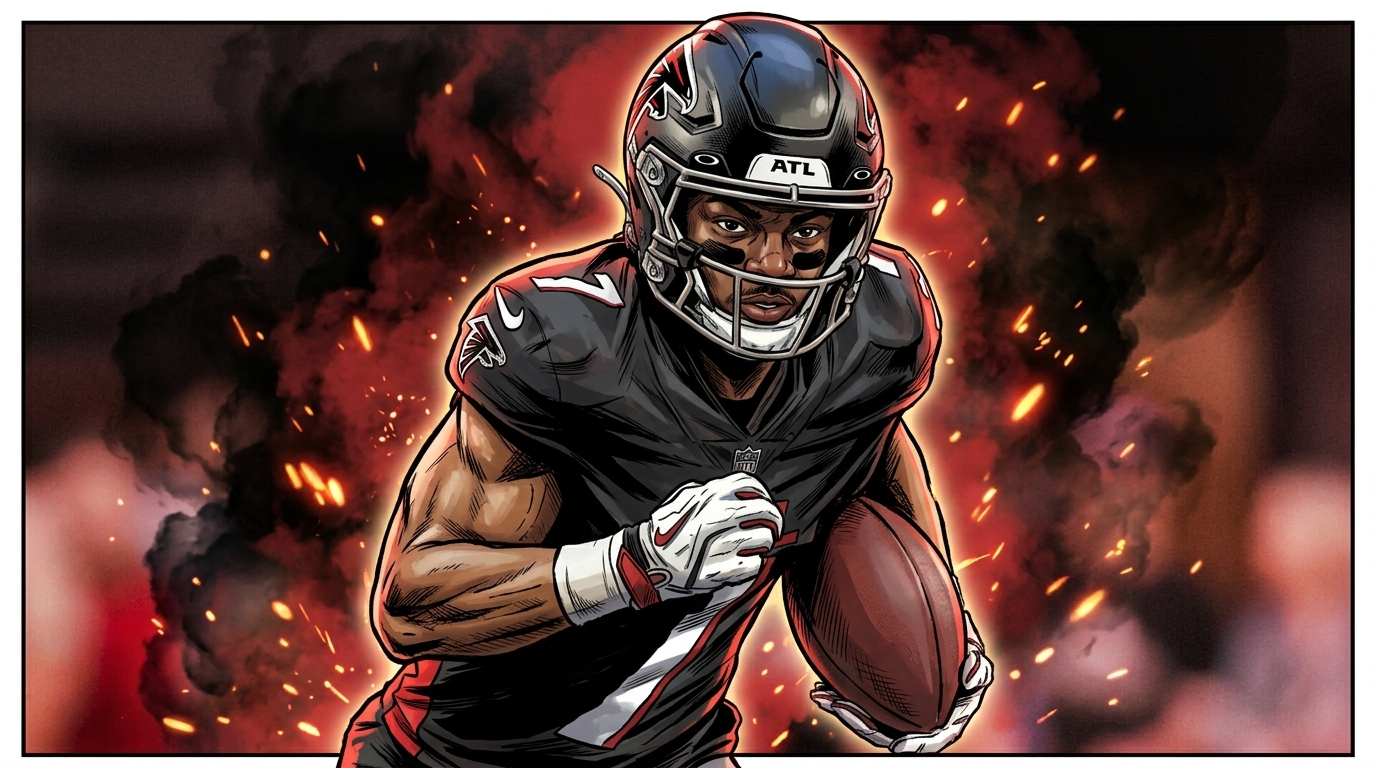

There’s a number inside Bijan Robinson’s new contract that matters more than the $75 million on the cover, and it’s not the $51 million guaranteed either. It’s 103. That’s how many times Robinson was targeted in the passing game last season, and it’s the real reason the Falcons just made him the highest-paid running back in NFL history.
For three years, the league has repeated the same line: running backs are dead. What that phrase actually meant, if you followed the money instead of the headlines, was that replaceable running backs are dead. Robinson’s receiving profile, 79 catches on 103 targets for 820 yards, is essentially WR1 usage stapled onto a rushing role, and it’s exactly the kind of player the “RBs are dead” market was always built to price differently. Atlanta just wrote the check that proves it.
How Much Is Bijan Robinson’s Contract Extension?
Bijan Robinson signed a three-year extension with Atlanta worth up to $75 million, including $51 million guaranteed and a $37 million signing bonus. The deal runs through 2030 and carries a $22.25 million average annual value, the highest of any running back in NFL history, surpassing Saquon Barkley’s $20.6 million.
Nicole Lynn of Klutch Sports negotiated the deal, first reported by ESPN’s Adam Schefter and NFL Network’s Ian Rapoport, with CBS Sports confirming the terms shortly after. It also ended a weeklong hold-in that had loomed over Atlanta’s offense for days: Robinson reported to camp on schedule but withheld his practice reps until the deal was done.
https://twitter.com/AdamSchefter/status/2084608880076615682
Line the AAV numbers up and the gap is not subtle. Robinson’s $22.25 million is $1.65 million more per year than Barkley just got from the Philadelphia Eagles, $3.25 million more than Christian McCaffrey’s $19 million, and roughly $6 million more than Devon Achane’s $16 million. Derrick Henry ($15 million) and Breece Hall ($14.5 million) aren’t in the same neighborhood.
https://twitter.com/AdamSchefter/status/2084609882393620576
On guaranteed money, Robinson’s $51 million is the most any running back has received on a non-rookie deal. The only back with more guaranteed dollars anywhere in football is Jeremiyah Love, still on his rookie contract, which is a different kind of deal entirely, one team control and a slotted rookie scale, not a market negotiation.
Why Robinson Broke the Market the 2023 Crash Built
To understand why this number is a statement and not just a big paycheck, rewind to February 2023. Barkley, Josh Jacobs, and Tony Pollard were all hit with the franchise tag, and none got a long-term deal before the deadline. Derrick Henry, watching from the sideline of that market, said the league might as well “just take the RB position out the game then.” Ezekiel Elliott and Dalvin Cook, both recent Pro Bowlers, became cap casualties within months. Cook, a year removed from a Pro Bowl season, settled for a one-year deal with the Jets worth up to $8.6 million, a fraction of what Robinson just got in guarantees alone.
That crash wasn’t really about running backs as a position. It was about running backs as a commodity, interchangeable pieces a team could find on Day 3 of the draft and plug into a zone-blocking scheme for a rookie salary. The Falcons had been dragging their feet on an extension through the standoff, and the deal they eventually signed reads like an admission that Robinson never fit that commodity description in the first place.
Put Elliott, Cook, and Robinson side by side and the split gets obvious fast. Elliott and Cook were pure early-down runners whose value cratered the moment their per-carry efficiency dipped. Robinson’s efficiency matters too, his 5.1 yards per carry is well above replacement level, but it’s not the only column that pays him. It’s the second column, the receiving column, that a rookie on a cheaper deal genuinely cannot replicate.
What the Receiving Numbers Actually Prove
Here’s where the analytics get interesting. Robinson led the NFL in scrimmage yards last season with 2,298, ran for 1,478 yards (fourth in the league) on 5.1 yards per carry, and scored 11 total touchdowns, including a 93-yard rushing score against the Rams that stood as the league’s longest rushing touchdown of 2025. He’s a two-time Pro Bowler and a first-team All-Pro. Through his first three seasons, he’s compiled 5,648 scrimmage yards, the fourth-most in NFL history at that career stage.
None of that alone explains a $22.25 million AAV. Plenty of backs have posted big rushing seasons and still watched their value evaporate at the negotiating table. What separates Robinson is the 79 receptions on 103 targets, a target share that would be respectable for a team’s second wide receiver, attached to a player who also leads the backfield. I ran the comp against Barkley’s and McCaffrey’s receiving lines from their extension years and got the same answer each time: the running backs who’ve actually reset the market all share this profile. It isn’t rushing volume that buys the extra guaranteed millions. It’s proof a player can’t be schemed off the field on passing downs.
Call it the Replaceable Back Index, if you want a name for it: how much of a back’s production disappears when you swap in a cheaper rookie. For a straight-ahead runner, the answer is not much, which is why that tier of back kept losing leverage after 2023. For Robinson, whose receiving work is load-bearing for Atlanta’s entire passing game, the answer is a lot. The evidence suggests that’s the whole basis for the price.
It also explains why the accolades stacked up the way they did. First-team All-Pro. Two Pro Bowl selections. A 93-yard touchdown run that no defense in the league stopped all season. Those are volume-and-explosiveness numbers a good scheme and a healthy offensive line can help produce. The 103 targets are not. Targets get earned in the meeting room, not handed out by a play-caller trying to pad a stat sheet.
Who’s Next After Robinson?
NFL Network’s pregame and studio voices have already framed this deal as a reset for the league-wide running back pay scale, and the next data point arrives fast. Jahmyr Gibbs, who held in alongside Robinson at the start of this camp cycle, is the obvious test case, a receiving-heavy back on a rookie deal about to watch a direct positional comp sign for $22.25 million a year in Atlanta.
Gibbs won’t get exactly Robinson’s number. Every negotiation carries its own leverage, timeline, and team-specific cap math. But the framework Atlanta just validated, pay for receiving value on top of rushing volume, gives Gibbs’ camp a real number to point to instead of an abstract argument about a dead position. Teams that still believe the position itself is dying will keep letting pure rushers walk in free agency. Teams paying attention to what just happened in Atlanta will start scouting the receiving profile as closely as the 40 time.
The next running back to break this market won’t be the best pure runner available. It’ll be the next back a defense can’t afford to leave on the field on third down, and Atlanta just put a $22.25 million price tag on exactly what that’s worth.
For more on how the league is handling its running back market, check out the rest of our NFL coverage.