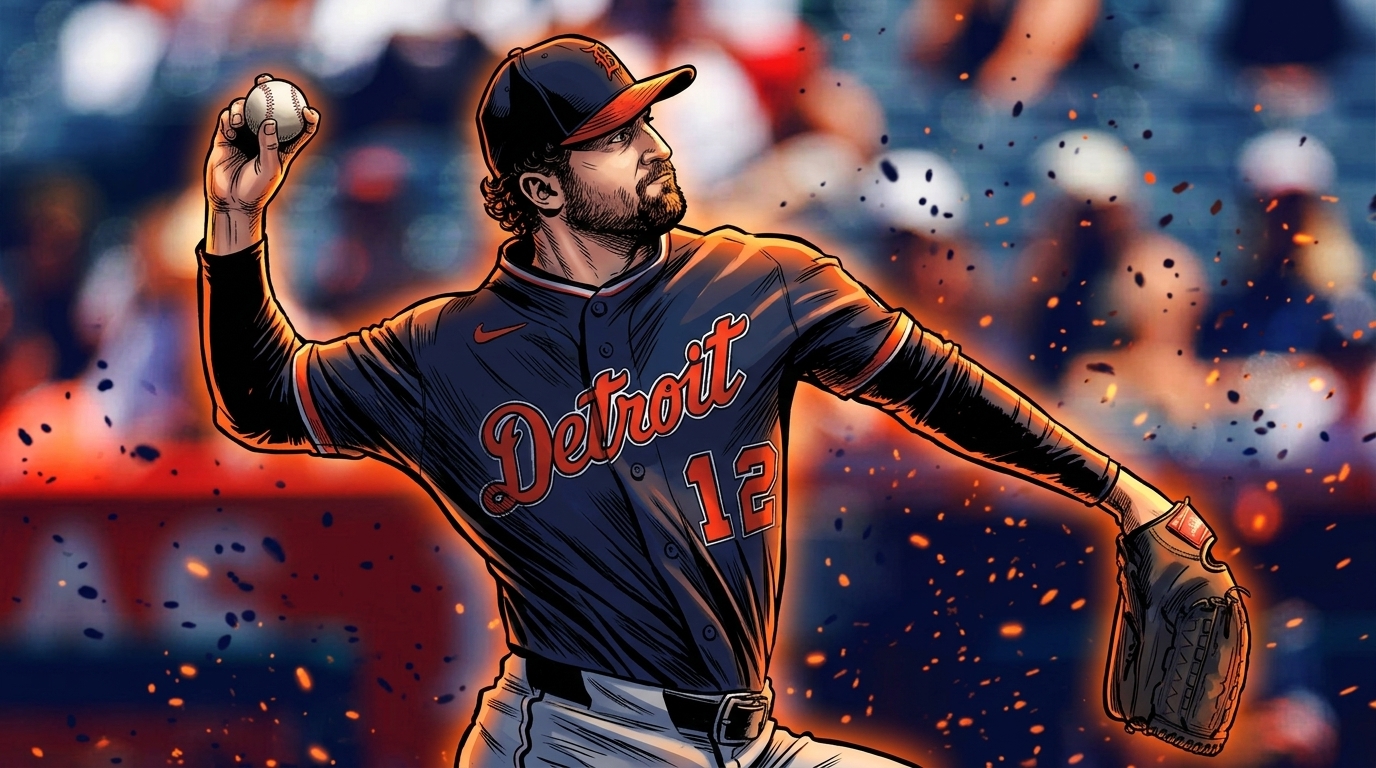

We’ve spent the past week treating Tarik Skubal’s situation as the whole Detroit Tigers trade-deadline story, and Friday afternoon Detroit quietly reminded us it isn’t. The Tigers scratched Casey Mize from his start against the Athletics in Sacramento, no injury involved, no explanation beyond precaution, and used a bullpen game instead. If that sounds familiar, it should: Detroit ran the identical play with Jack Flaherty in 2024, days before shipping him to the Dodgers.
As MLB.com reported, the move is trade-value protection, not health management, though Mize carries a real injury history that complicates the framing (more on that shortly). Chris McCosky of the Detroit News, who covers the club daily, laid out the mechanics in real time.
McCosky spelled out the contingency in a single post Friday afternoon.
https://twitter.com/cmccosky/status/2083191585035235605
The plan there is plain. Mize isn’t hurt, he’s on the trade market, and Tuesday’s turn against Seattle is what happens if nobody meets Detroit’s price by Monday.
Whatever Detroit is protecting here is worth protecting. Mize, 29, is in the best stretch of his career: a 2.70 ERA through 16 starts and a career-best 24.9 percent strikeout rate, a season good enough to remind people he was the No. 1 overall pick in the 2018 draft. He’s a pending free agent making $6.15 million this year, with roughly $2 million left on the deal if he’s traded, which is exactly the profile contenders like buying in July: two months of a frontline arm without a long-term commitment attached.
The Atlanta Braves are the team making the loudest push, and it isn’t subtle (subtlety was never really the plan). Heavy.com has described the Braves as making a big push for Mize, citing organizational familiarity that predates this trade season. ESPN’s Jeff Passan went further, naming Atlanta the best trade fit for Mize. Passan and Kiley McDaniel put the odds of Mize getting traded at 60 percent in their trade-candidate rankings.
That number matters. A well-sourced reporter doesn’t attach 60 percent to one specific team three days before a deadline unless the groundwork underneath it is real.
Mize and Skubal are two names. They aren’t the only ones. Detroit has already traded catcher Jake Rogers to Baltimore, and per MLB Trade Rumors, the front office is shopping reliever Kenley Jansen, reliever Kyle Finnegan, and infielder Gleyber Torres alongside its two best starting pitchers. That’s the detail that reframes everything else. A team doesn’t scratch a starter to protect trade value unless it’s already fielding calls on him, and Detroit is fielding calls on five players at once.
The Skubal half of this is still the bigger name. Passan has reported the decision is made, that Detroit intends to trade its two-time reigning AL Cy Young winner, with the Dodgers, Brewers, and Rays most connected and a deal possibly landing within a day or two, per a Yahoo Sports relay of his reporting. CBS Sports has the Dodgers as favorites to land him, for what a back-to-back champion with that farm system usually is: the team nobody wants to bid against. If you want the day-by-day of how we got here, we’ve tracked three truths and zero answers on the Skubal talks as the market circled him all month, and Detroit’s white flag on the Skubal trade talk went up earlier than a lot of people expected.
Health is the fair pushback here, and it deserves real consideration rather than a wave-off. Mize has been on the injured list twice this season for groin issues, and he left his July 19 start early with soreness; his fastball velocity was down in the outing that followed. A team benching a pitcher who’s dealing with something physical isn’t automatically running a trade-value play. I think the health story is real. I also think it’s a secondary reason, not the primary one. Detroit ran this exact scratch, same non-injury language, on a fully healthy Flaherty two years ago for the sole purpose of protecting trade value. The health angle adds a layer. It doesn’t replace the incentive sitting underneath it.
None of this is happening in a vacuum, either. Detroit has lost four of its last five games, and a fade like that changes a front office’s math fast. A five-game stretch this deep into July doesn’t just sting; it answers the buyer-or-seller question front offices have been dodging for weeks. This is a team reading the standings, accepting the season it’s actually having, and deciding to get what it can while Skubal and Mize still have starts left to sell — not a front office quietly protecting one uncomfortable situation on principle.
So here’s where I land: the Skubal rumors were never the whole story, and the Mize scratch is the proof. A team quietly protecting the trade value of a second starter, while also shopping a closer, a setup man, and a starting infielder, isn’t managing one uncomfortable situation. It’s clearing out a rotation core and the roster around it in the same week. Call it a sell-off, not a Skubal trade with a footnote.
Think about what that list of subtractions actually looks like by next week: a closer, a primary setup man, an everyday infielder, and a starting catcher already gone or in serious talks, on top of two starting pitchers good enough to headline other teams’ rotations. Four days is fast for a roster to get rebuilt around whatever comes back in return, and that’s the pace Detroit is setting.
Monday is the hinge. If the Braves land Mize before the deadline, the closing argument writes itself: two ace-caliber arms gone in the same week, plus whatever comes back for Jansen, Finnegan, or Torres. If he’s still in Detroit’s rotation Tuesday against Seattle, it won’t mean the sell-off stalled. It’ll mean this particular deal didn’t clear at Detroit’s price. Watch Jansen, Finnegan, and Torres too, not just the two starters — if more of those names move by Monday night, the sell-off framing stops being a take and starts being simple math. Keep an eye on the rest of our trade deadline coverage as Monday closes in.