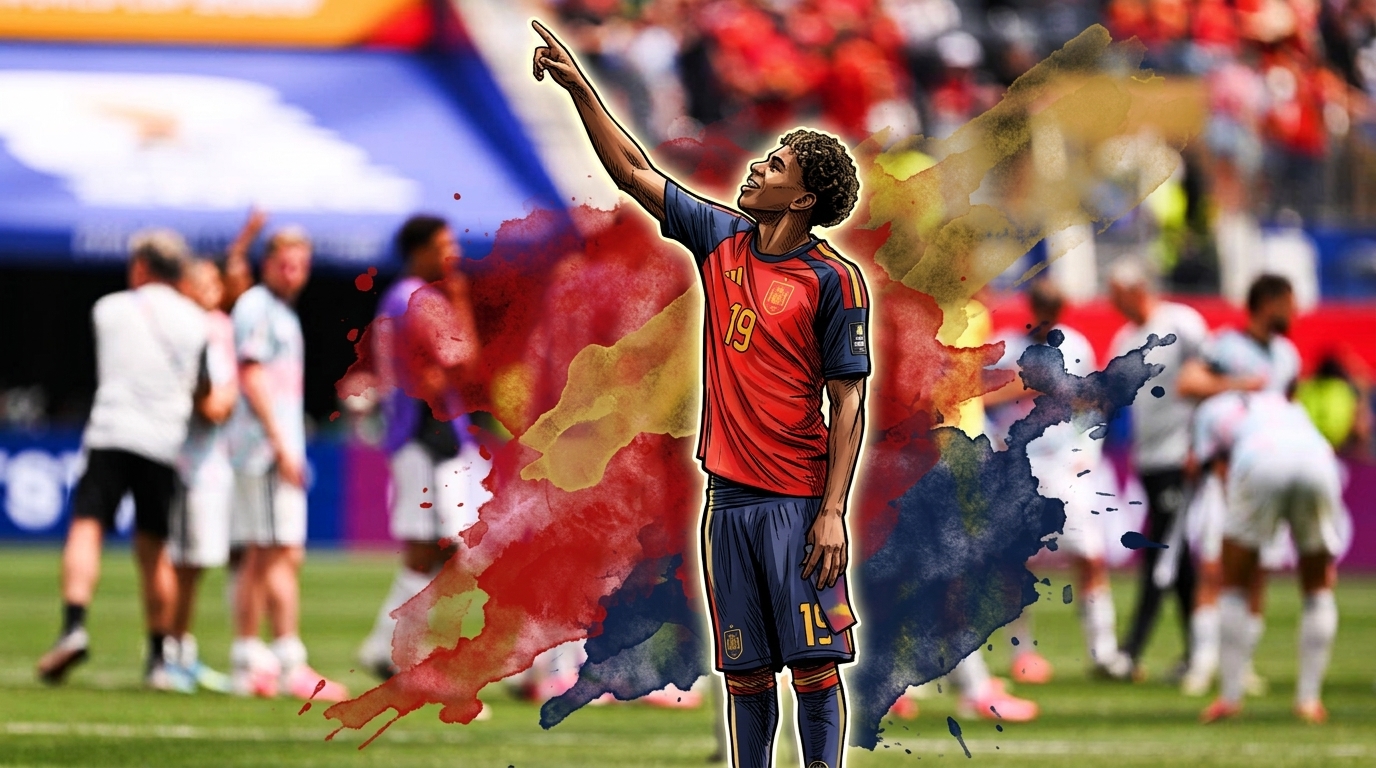

Here is the question that actually matters on Sunday: can a team that has perfected the art of not conceding hold a lead — or a draw — for exactly 75 minutes?
Because that is precisely how long Spain needs to survive. After that, Argentina becomes a different team.
Half of Argentina’s 18 goals at this World Cup have come in the 75th minute or later. Not “mostly late” in a vague narrative sense. Half. Of eighteen goals. The number shocked even me when I first pulled it up. And when you map it against the knockout round specifically, the pattern sharpens into something almost algorithmic: a 90+2 winner against Egypt, a 112th-minute and 120th-minute pair to eliminate Switzerland, and then against England in the semifinal, goals at 85 and 92 minutes that turned a deficit into an advance. Three consecutive knockout ties. Three consecutive second-half explosions.
This is not clutch mythology. This is a designed system.
https://twitter.com/FIFAWorldCup/status/2077508603687121126
Argentina’s Late-Game Pattern Isn’t Luck
What Lionel Messi’s Argentina does tactically is something you rarely see articulated clearly: they build for attrition. They absorb pressure. Scaloni’s team held 88% of possession from England’s goal until Argentina equalized, which means they weren’t panicking, they were waiting. Then in the final half-hour, fresh legs arrive and tired legs don’t.
Lautaro Martínez entered against England in the 81st minute. He headed in the winner at 92’. That is the blueprint, compressed into eleven minutes. Argentina became the first team in World Cup history to record multiple stoppage-time game-winning goals by substitutes in a single tournament. Lautaro also became the first Argentine to score multiple World Cup goals as a substitute in the same tournament. These are not coincidences. They are the output of a rotation strategy that treats the final twenty minutes as a second match entirely.
Thirteen consecutive World Cup matches with two or more goals. An all-time record. And Messi (eight goals in seven matches, tied for the Golden Boot) is still the threat that every defense must account for first, which is exactly what opens the space for everyone else.
The question for Sunday is whether Spain’s structure can hold all of that at bay for 75 minutes. And that requires understanding what Spain has actually done this tournament.
What Spain’s Zero-Goal Tournament Means Tactically
Spain have conceded one goal in seven games. One. Against Belgium in the quarterfinals. Before that, 600 consecutive minutes without conceding. Unai Simón now holds the record for most clean sheets in a single World Cup tournament with six. These are not numbers that happen by accident or by goalkeeper heroics alone.
Rodri, the 2024 Ballon d’Or winner, sits at the base of Spain’s midfield and functions less like a player and more like a traffic management system. Spain’s defensive organization against France in their 2-0 demolition of France was a clinic: Kylian Mbappé, the most dynamic attacker in Europe, managed three shots, none on target. Fabián Ruiz and Rodri owned the middle of the pitch so completely that France never found a clean entry line. That midfield pair didn’t just defend; they made the French feel like they were playing uphill.
Spain’s theory of winning is suffocation. Control possession, compress space, restrict the opponent to low-probability chances, and then let Lamine Yamal and Mikel Oyarzabal create something in transition. Oyarzabal has five goals in the tournament, three in the knockout stages. Yamal has one goal in seven appearances but leads the tournament in successful dribbles and won Spain a penalty against France almost singlehandedly. Spain doesn’t need to score three goals to win. They need to keep Argentina from scoring any.
That 37-game unbeaten streak, matching Italy’s 2018-2021 run, is the statistical signature of a team that has internalized defensive discipline at an almost cultural level.
Can Argentina Break Spain’s Defense in the World Cup Final?
Spain and Argentina have never met in a World Cup elimination game. Sunday is genuinely unprecedented.
The direct answer: yes, Argentina can break Spain’s defense, but only if the game is still level or close past the 75th minute. Spain’s defensive record was built against teams playing standard attacking patterns. Argentina’s threat isn’t standard — it’s delayed. The Scaloni system is specifically calibrated to catch tired defenders, and by the 80th minute, every back line in this tournament has started to show seams. Spain’s has been the most disciplined, but no defense is immune to the physics of fatigue.
The variable Spain hasn’t faced is a side that is actively planning to still be dangerous at minute 80. Most teams that go into defensive shells against Spain eventually lose shape trying to claw back a deficit. Argentina is comfortable in a draw at minute 70. That patience, built through the England comeback and the Switzerland quarterfinal, is a different kind of pressure than Spain has absorbed this tournament.
The One Scenario That Changes Everything
If Spain score first, Argentina’s entire architecture gets stress-tested in a way it hasn’t been before. The late-goal pattern depends on there being something to chase, but it also depends on Scaloni being able to make calculated substitutions rather than reactive ones. A two-goal deficit forces Argentina to commit earlier, which opens counterattacking space. Spain in transition, with Yamal at full speed, is a different animal than Spain sitting in their defensive block.
The data here is unambiguous: the team that scores first in this final holds a massive positional advantage. Spain’s defense becomes exponentially harder to break when they can drop into their preferred low-block shape without needing to take any attacking risk at all.
My read: Argentina’s late-game system is the most impressive thing any team has built at this tournament. But Spain’s defensive record is historic in a way that doesn’t bend to stylistic pressure alone. If this game is 0-0 at 75 minutes, Argentina wins it. If Spain lead at halftime, their 37-game unbeaten streak reaches 38.
I think it’s 0-0 at 75 minutes. And I think Argentina have been building toward exactly that moment for seven games.