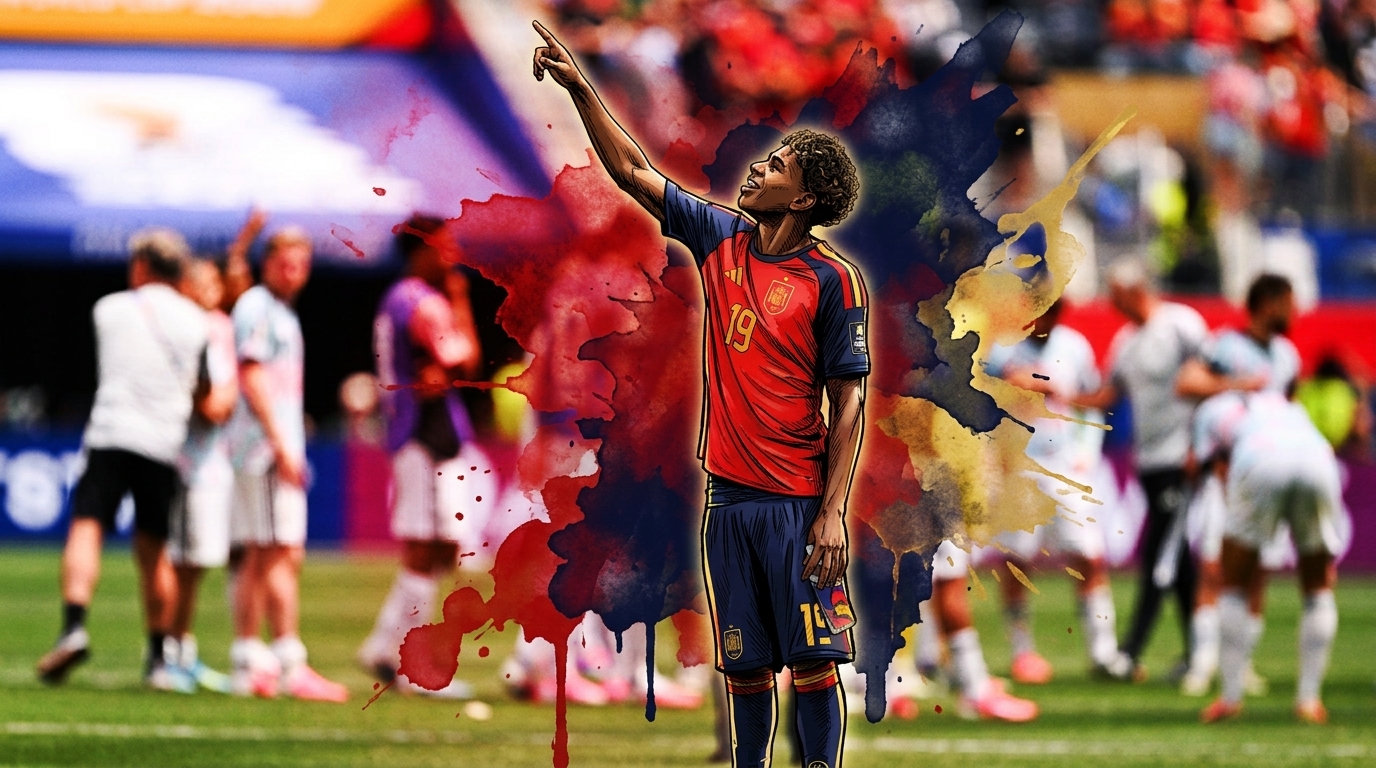

We’ve been watching this particular story get written for a long time — the one where Kylian Mbappé finally gets his defining World Cup moment. He won in 2018 at 19 years old, scored a hat-trick in the 2022 final and still lost, arrived in North America this summer with eight goals through six games, and France was the team everyone was treating as the inevitable finalist. Monday night at AT&T Stadium in Arlington, Texas, we got a different story entirely. Spain won 2-0. Mbappé touched the ball roughly 15 times in the first half and didn’t put a single shot on goal. And a 19-year-old from a neighborhood called Rocafonda, in a city called Mataró, on the Catalonian coast, left Dallas having made the most famous footballer alive look like yesterday’s conversation.
The framing coming into this match was Mbappé versus Lamine Yamal — generational titans, the torch pass, the duel the sport had been building toward. That framing was wrong. A duel implies rough parity. What happened in Dallas was something closer to an audit.
France generated an xG of 0.30 for the entire match against Spain’s 1.63. France — a team that had kept clean sheets in four of their five previous tournament games, a team that had never trailed at halftime in this tournament — went to the break down a goal, retreating, with nothing to show for their best player’s presence on the pitch. Mbappé received a yellow card, skied a free kick over the crossbar, and spent large stretches doing what star players on losing teams do: drifting toward the ball to try to feel relevant.
Meanwhile, Yamal drew the penalty that Mikel Oyarzabal converted in the 22nd minute. He had a goal ruled out for offside in the second half — one that would have made it 3-0. He led all players in the competition in successful dribbles — the kind of footwork that belongs in a different conversation than anything France could offer in response. (Yamal turned 19 the day before this game. The parenthetical is not decoration.)
https://twitter.com/AccessYamal/status/2064814636185088037
The easiest counterargument to make here is that Mbappé’s legacy is real, built on things that cannot be revised. He’s 27, he’s scored 20 World Cup goals across three tournaments, and he won a World Cup as a teenager in the same way Yamal is winning one now. The 2022 final against Argentina — where he scored three goals in the second half and nearly pulled off the greatest individual comeback in the history of the sport — was the kind of performance that gets remembered for decades. You cannot write that out of the ledger.
I think the honest reckoning, though, is that the conversation has been lapping him for a while. Mbappé has been “the next one” since he was 18, which means he’s been carrying that designation for nine years now — an eternity in a sport where “the next one” is supposed to eventually become “the one.” He’s still searching for the final that his stature demands. The World Cup in North America was supposed to be the stage where that finally happened. (This is the first World Cup final he’s missed in three tries — after winning in 2018 and losing on penalties in 2022 despite a hat-trick. The second straight tournament where the story got away from him at the critical moment.)
What Yamal represents is the end of that waiting period. Not the end of Mbappé’s career, or even his excellence, but the end of the era where he occupied the singular space at the top of the sport’s imagination. The kid from Rocafonda has gotten the better of Mbappé’s teams more often than not when their paths have crossed. He won the Kopa Trophy in 2024 and again in 2025. He was the runner-up for the 2025 Ballon d’Or — at 18 years old, in a year when he wasn’t even supposed to be eligible for the conversation. As Heavy.com noted before the match, he said he wanted “a win and to be able to go to New York for my birthday” — and that’s exactly what he got.
There is a famous photograph of Yamal as an infant with Lionel Messi, taken in 2007 — a snapshot so perfectly timed that it feels staged by the sport itself, a visual metaphor for generational handoff that nobody actually manufactured. The photo keeps resurfacing in discussions of Yamal’s rise because it captures something true: the game produces these moments of succession, and they tend to arrive before anyone is ready for them. Messi was 27 in that photo, not so different in age from Mbappé now.
Before the match, Yamal was direct about what the night meant: “If France should fear anyone, it’s us. We have knocked them out before. We have beat them two times.” He was counting. Spain had beaten France at Euro 2024, then beaten them 5-4 in the Nations League in 2025. Monday made it three straight knockout wins over the same opponent. The succession wasn’t announced — it accumulated, result by result.
Spain will play either Argentina or England in the final at MetLife Stadium on Sunday — the other semifinal goes 24 hours later. Elsewhere in this tournament, Norway and England produced their own defining images in a match that shaped the bracket getting here. Maduka Okoye’s story reminded us that this World Cup has been rich with the kind of crossover moments the sport needed to break through with new American audiences.
This is the part worth watching in the final: Yamal will play the biggest match of his life, at 19, in a stadium holding 82,000 people, against either the country that has Lionel Messi’s DNA all over it or the country that hasn’t won a World Cup in 60 years and is desperate to. Spain hasn’t been to a World Cup final since 2010, when they won their only title. The pressure on Sunday will be unlike anything this group has faced.
And I believe that’s exactly the test worth watching — not because Yamal needs to pass it to validate what happened in Dallas, but because the sport is now watching to see whether a 19-year-old from a postal code called 304 can do what Mbappé spent three tournaments trying to do. The flag is already planted. The only question left is whether he picks it up and carries it all the way.