
There is a particular kind of fame that requires no event. The camera finds a face in a crowd, the internet decides, and suddenly a person exists in a register they never applied for. I thought this was fashion’s territory. Sports cameras got there eventually.
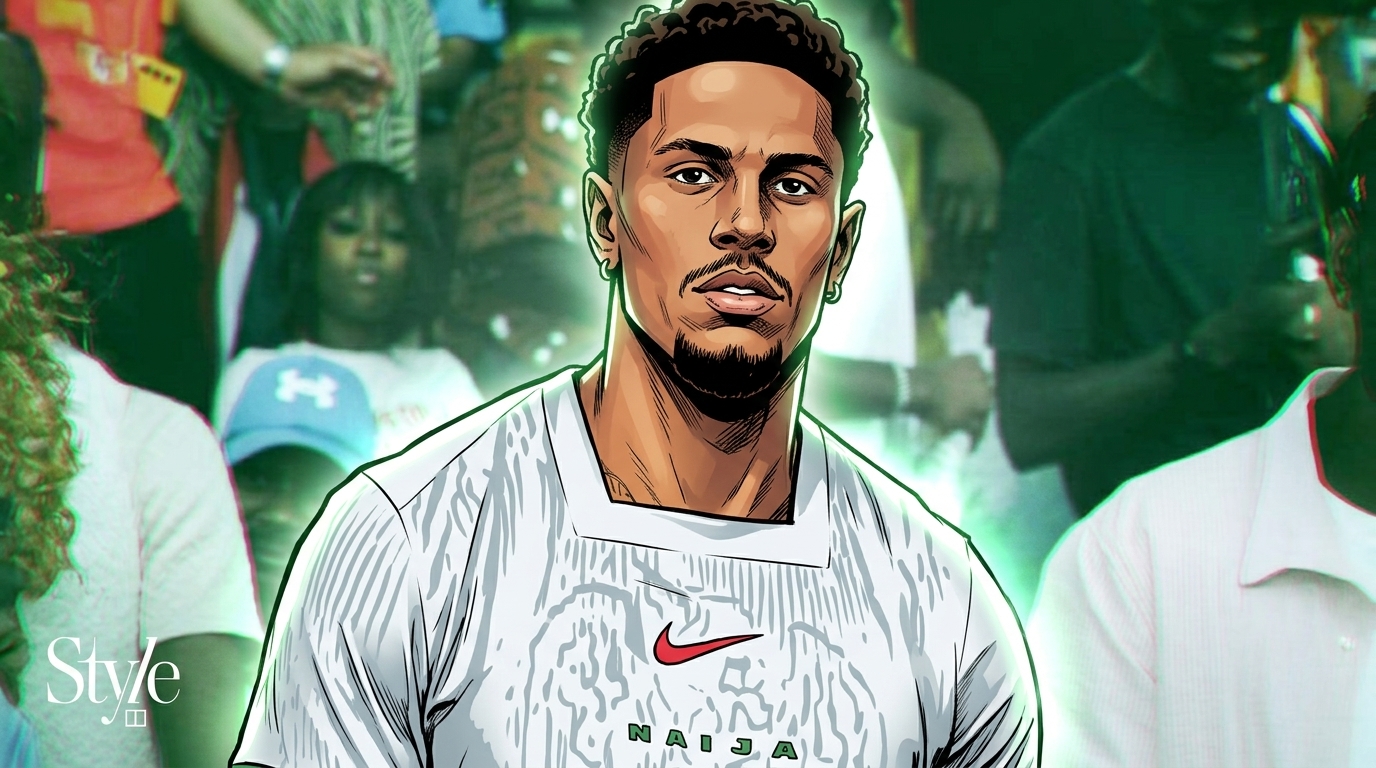
On June 10, I was watching coverage of a Portugal-Nigeria international friendly in Leiria — the kind of match that fills a Tuesday afternoon schedule and mostly functions as a vehicle for Cristiano Ronaldo to remind everyone he still exists. Ronaldo had a one-on-one chance in the eighth minute. He didn’t convert. The goalkeeper who stopped him is named Maduka Okoye, and before that night was over, the broadcast cameras had done something to his face that no save, no clean sheet, and no tournament appearance could have engineered on its own.
They lingered on it.
That’s the whole story, and it is also somehow a story about everything — about what celebrity has become, about who gets to be the face of a sporting moment they technically had no part in, and about what it means that Nigeria isn’t even at this World Cup. The Super Eagles were eliminated by DR Congo on penalties in the CAF playoff last November. Okoye has played zero minutes of tournament football this summer. He is the cultural story of the 2026 World Cup summer anyway.
The sequence of events is almost too clean to believe. Pre-match walk, broadcast close-up, clip goes wide from football communities into mainstream pop culture globally, fans label him “the world’s sexiest footballer.” His Instagram goes from 250,000 followers to over a million within roughly a week. By July he’s sitting front row at Jean Paul Gaultier’s Haute Couture show in Paris between Cardi B and Amanda Lear, wearing a teal denim set, handing Cardi B a fan because her platform boots have made sitting complicated. Dazed Digital’s headline: “He’s a keeper!”
https://x.com/Cleverlydey4u/status/2074991898842870215
At the BET Awards in late June, a reporter asked Tems — Nigeria’s most globally visible musician — whether she’d shoot her shot at Okoye. Her answer: “I wish I did, though. I wish I did. Shoot? No, no, no. We don’t shoot shots here. We’re friends.” Whether or not that’s literally true, it confirms something: Okoye had become the kind of person you get asked about at awards shows, the kind of person whose name floats through an industry that has nothing to do with football.
When asked the key ingredient to being hot, he said: “Good looks.”
He is not wrong, and he knows he is not wrong, and that confidence is doing at least some of the work here. But I want to stay with the particular absurdity of it a moment longer, because it deserves attention. The old logic of athletic fame was transactional: you performed well enough, consistently enough, in a visible enough context, and celebrity was the downstream reward. What Okoye revealed — by simply existing in front of a broadcast camera during a friendly that Portugal won 2-1 — is that the transaction is optional. His country watched this World Cup from home. He is their World Cup.
The counterargument writes itself: this is just how virality works, this is not new, we’ve always had fleeting fame. That’s true. But what’s different now is the infrastructure’s speed and the scale of crossover. Okoye didn’t get fifteen minutes and then fade. He got a TheGrio profile, a fashion week invitation, and a Juventus transfer rumor — all while his club (Udinese, Serie A, contracted through 2028) remains perfectly intact. The fame didn’t dissipate; it found new surfaces to land on. What the discourse reveals about the audience is that we are no longer using sports celebrity to ratify athletic excellence. We are using it to populate a cast of interesting-looking people we want to follow, and performance is one input among many, increasingly not the most important one.
This should probably disturb us more than it does. Nigeria’s supporters live through our World Cup coverage watching teams that qualified; they see Norway vs. England becoming the World Cup’s most compelling subplot while their own team’s goalkeeper fields fashion show invitations. There is something melancholy in that if you look at it from the inside. There is also something — and I keep coming back to this — genuinely funny about the fact that a man who stopped Cristiano Ronaldo from scoring in a meaningless friendly is now being photographed on a Paris balcony with one of the most famous women in music, neither of them commenting on what any of it means.
Okoye’s own quote on the whole experience: “Honestly, I think I wasn’t prepared for this because it was quite big.”
That’s the most honest sentence anyone has produced about the 2026 World Cup summer. The cameras found him. He wasn’t prepared. The internet didn’t care. Here he is.