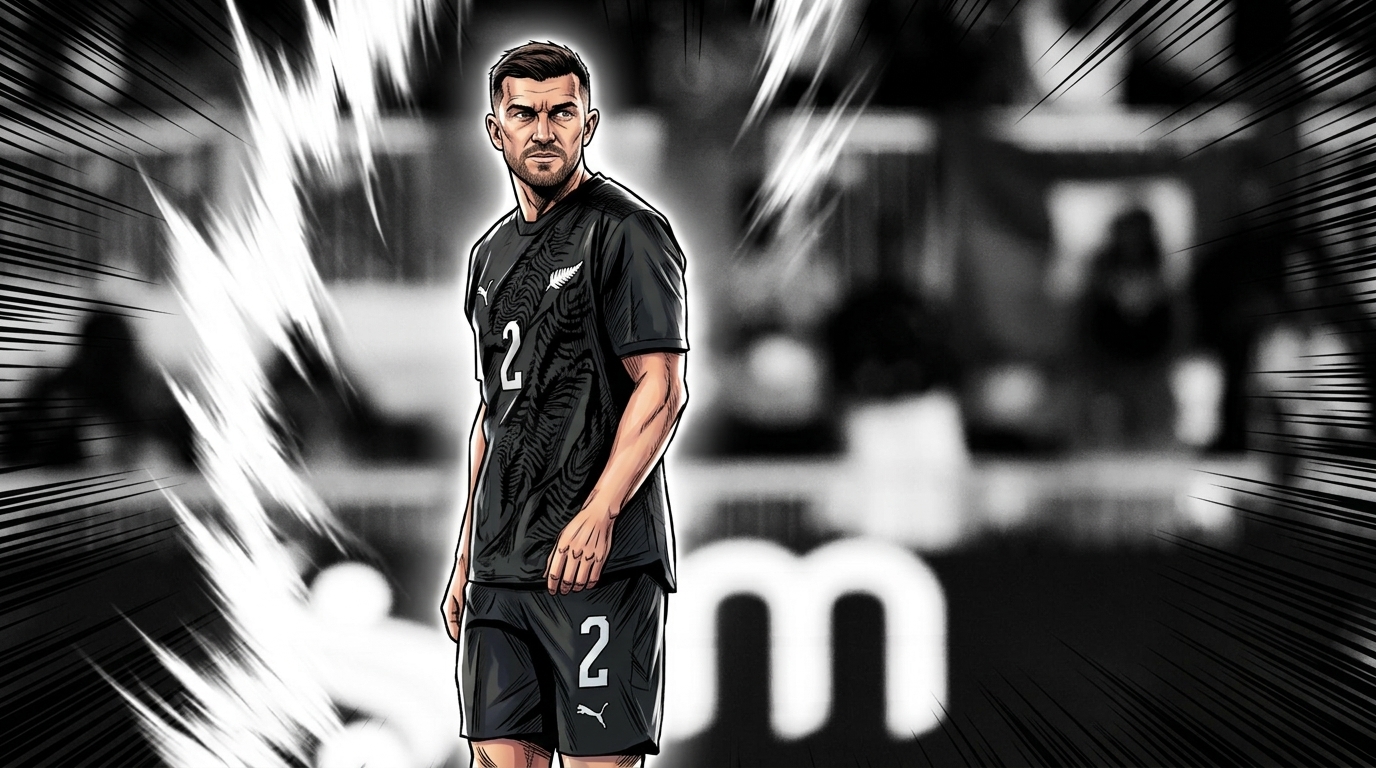

We’ve spent a lot of time at this World Cup watching fame arrive on schedule — Haaland record-chasing, Bellingham doing Bellingham things, Yamal becoming the youngest player to do something every other week. That’s the machine working as designed. What happened to Tim Payne was something else entirely. An Argentine content creator named Valen Scarsini, known as El Scarso, posted a video on May 28 identifying Payne — a 32-year-old center back from Auckland playing for New Zealand — as the least-known player at the World Cup, with 4,715 Instagram followers to his name. Scarsini told his millions of followers to go find him. They did. Inside 48 hours, Payne had 2.4 million followers. The number eventually settled somewhere north of 5.6 million.
Nothing about Tim Payne changed. He didn’t score a famous goal. He didn’t get into a controversy. He existed, at a World Cup, in a kit, on a pitch — and the internet decided that was sufficient grounds for stardom.
The mechanics of what El Scarso did are worth understanding, because this wasn’t a fluke. Scarsini had run this play before, growing FC Balzers — a fifth-division club from Liechtenstein — from 15 likes to 440,000 followers through sheer directional energy. He identified an underdog, pointed his audience at it, and watched the math do what math does. The Payne video hit 18.5 million views on Instagram alone, with additional amplification from TikTok creators Javier Ibarreche and Iker Ruiz del Barco — whose combined audiences run to roughly 26 million. KitKat commented on Payne’s posts. So did Samsung, Pizza Hut, and NFL Mexico. The Official World Cup Instagram featured him. The whole thing had the structure of a brand campaign except nobody planned it.
Payne’s response to learning about this was, by most available evidence, bafflement. “Was wondering why my socials were blowing up and found your post, man,” he DM’d El Scarso. “Appreciate the love! Gracias, hermano.” When he got in front of cameras, he was no more poised about it: “It’s been a crazy 48 hours, to say the least.” And: “I didn’t know what to feel, because it’s so foreign to me. Still processing, but it’s amazing.” These are not the quotes of a man who saw this coming. They’re the quotes of a man who went to bed with 4,700 followers and woke up inside a phenomenon.
On June 4 — New Zealand had just taken a 4-0 loss to Haiti in a warmup match, the kind of result that makes a player want to disappear — Payne met El Scarso at the team hotel in Boca Raton, Florida. He gave him a signed All Whites No. 2 jersey. Whatever you think about internet fame, there’s something genuinely decent about that image: the guy who became famous because of you, giving you his shirt, in a hotel lobby in South Florida, days before a World Cup group stage that probably wasn’t going to go well.
https://twitter.com/Tim_Payne7/status/2066899317999177973
The fan movement that formed around Payne — and “movement” is not too strong a word — carried the slogan “No Payne, No Gain.” Argentine-style banderazo flag ceremonies were held for him in Miami and Los Angeles. Someone tried to get Tim Hortons to rename a Vancouver location after him. Argentina’s fans had shown up to this World Cup in enormous numbers, flooding New Jersey and Miami and Dallas, and at some point their surplus energy needed somewhere to go. They chose a 32-year-old New Zealand center back who had been playing professionally for over a decade without accumulating the social media presence of a mid-tier podcast host.
That detail — Payne had 52 international caps before any of this happened, 143 club appearances for Wellington Phoenix, a contract through 2028, a wife and a newborn — is important context. He wasn’t obscure because he was bad. He was obscure because New Zealand football is, to put it plainly, not a destination for global sports media. The All Whites have made it to three World Cups. They’ve never advanced past the group stage. The infrastructure for turning a New Zealand defender into a household name simply did not exist. El Scarso built one in an afternoon.
I think what this World Cup revealed — through Payne, and through Maduka Okoye’s own moment, and through Cape Verde’s Vozinha — is that the fandom is now capable of generating its own main characters, independent of team success or broadcast hours. Al Jazeera’s rundown of the tournament’s social media stars placed Payne alongside Yamal, Haaland, and Bellingham. Payne’s 5.8 million followers exceeded the combined Instagram following of USMNT standouts Timothy Weah, Gio Reyna, and Matt Turner. The Argentine fans did not give him those followers because New Zealand won anything. They gave them because they could, and because something about the story — least-known player at the biggest sporting event in the world — hit a nerve that no algorithm had predicted.
After the tournament, Payne signed with Olimpia in Paraguay for a reported transfer fee of around $500,000. His follower count is still there. “I’m still the person I am,” he told reporters. “I just keep trying to play football.” The Olimpia move means he’s now doing that in a higher-profile league, in front of a bigger market, with a social media presence that no New Zealand defender has ever had. The question going forward isn’t whether Tim Payne deserved any of this — the word “deserve” doesn’t really apply to viral moments. The question is what it means that this can happen now: that a creator with the right instincts, a willing audience, and a 60-second video can redirect millions of followers toward a guy who was just doing his job, and that player comes out the other side with a new contract in South America and a second career as an accidental icon. New Zealand football gets a spotlight it has never had. And somewhere in all of this, there’s a version of this story that gets repeated — probably at the next World Cup, probably at the one after that — because El Scarso proved the template works. For more on the stories defining this summer, check out our World Cup coverage.