Serena Williams won her first professional match in nearly four years last week, then was knocked out of the tournament anyway. Her response: sign up for Berlin, with Wimbledon next on the calendar.
The media has been calling it a comeback arc. It isn’t. A comeback arc requires someone to be gone, and Serena Williams never announced she was done with tennis. She just stopped playing for a while. There’s a difference, and it matters if you want to understand what’s actually happening here.
Her last professional match before this was the 2022 US Open, nearly four years ago, a loss in the third round the sports world immediately narrated as her farewell. Nobody asked her. She never said it was. The entire Serena Williams comeback 2026 narrative exists because the press needed a retirement to have been announced. When one wasn’t forthcoming, they announced it themselves.
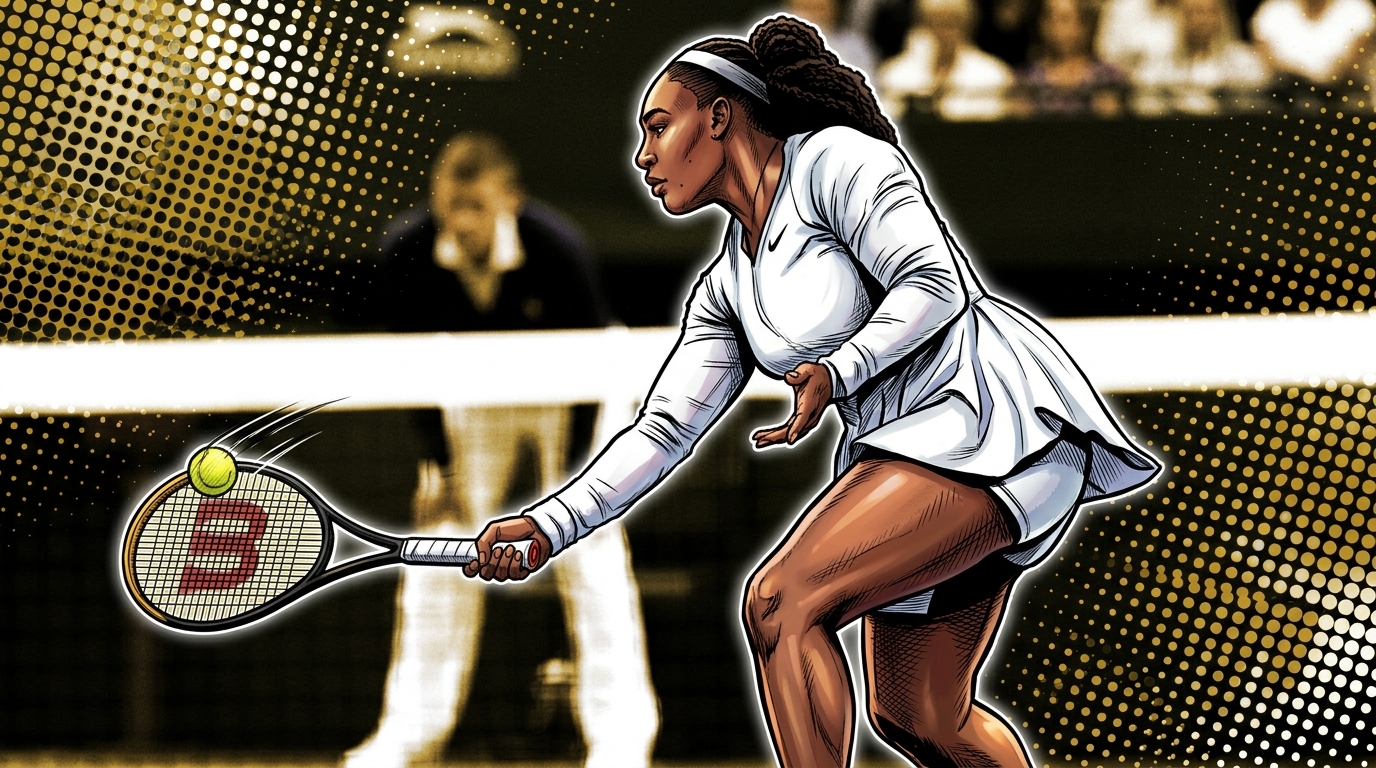
She came to London for the HSBC Championships at Queen’s Club, 44 years old, paired with 19-year-old Canadian Victoria Mboko for doubles. They beat the 3rd seeds — Nicole Melichar-Martinez and Erin Routliffe — 7-6(2), 6-2. It was not a sentimental performance. They won convincingly in straight sets against legitimate opposition, in a format that demands genuine coordination between partners. Mboko is 25 years younger than Williams.
https://x.com/QueensTennis/status/2061450214012022826
Then Mboko hurt her knee in a singles match against Karolína Plíšková and had to withdraw.
Williams was not beaten. She was eliminated because her partner couldn’t continue. Those are not the same outcome, and collapsing them into the same sentence tells you more about the storytelling instinct than about Serena Williams. The reflex to frame everything as tragedy-or-triumph is its own failure of imagination.
“I got tired of sitting at home,” she said. “My kids are out of school for the summer, so why not?” That’s the entire comeback narrative everyone wanted to find. She was bored. She wanted to play tennis.
I freelanced for two years after graduation — $50, $75, $150 a piece, writing stories that mostly nobody read, pitching into inboxes that mostly didn’t respond. I kept going not because I had some grand statement to make about my career, but because I wasn’t ready to stop and wasn’t going to let someone else’s timetable decide that for me. Serena Williams didn’t pick up a racket to prove she belongs. She knows she belongs. She picked it up because she wanted to.
Queen’s Club is historically a men’s grass-court event, and as our earlier coverage of her Queen’s Club return noted, she had never competed there before. “I never got to play here, it was always just the men,” she said. “It feels really special.” That’s genuine. It is not, however, the reason she’s here.
She was nervous going in. “I just thought about having fun,” she said, which is athlete-speak for the nerves being real and needing somewhere useful to go. She won anyway. Nearly four years removed from professional competition, on a surface she had never played before, against the 3rd-seeded doubles pair. The nerves were not a new obstacle. She managed them the same way she always has.
Now she’s confirmed for the Berlin Open, reportedly with a new partner in Karolína Muchová per The Times of London, with Wimbledon on the horizon after that. The ESPN report on Mboko’s withdrawal noted she was also out of Wimbledon, which tells you they had already planned that far ahead. This was never a one-week experiment. For more on what the rest of the summer looks like on tour, see more from the tennis world.
Serena Williams is 44. She won. Her partner got hurt through no fault of her own, she lost her spot in the draw, and then entered the next tournament with Wimbledon after that.
Everyone framing the Serena Williams comeback 2026 story as redemption or defiance is missing the point by about three time zones.
She never left.