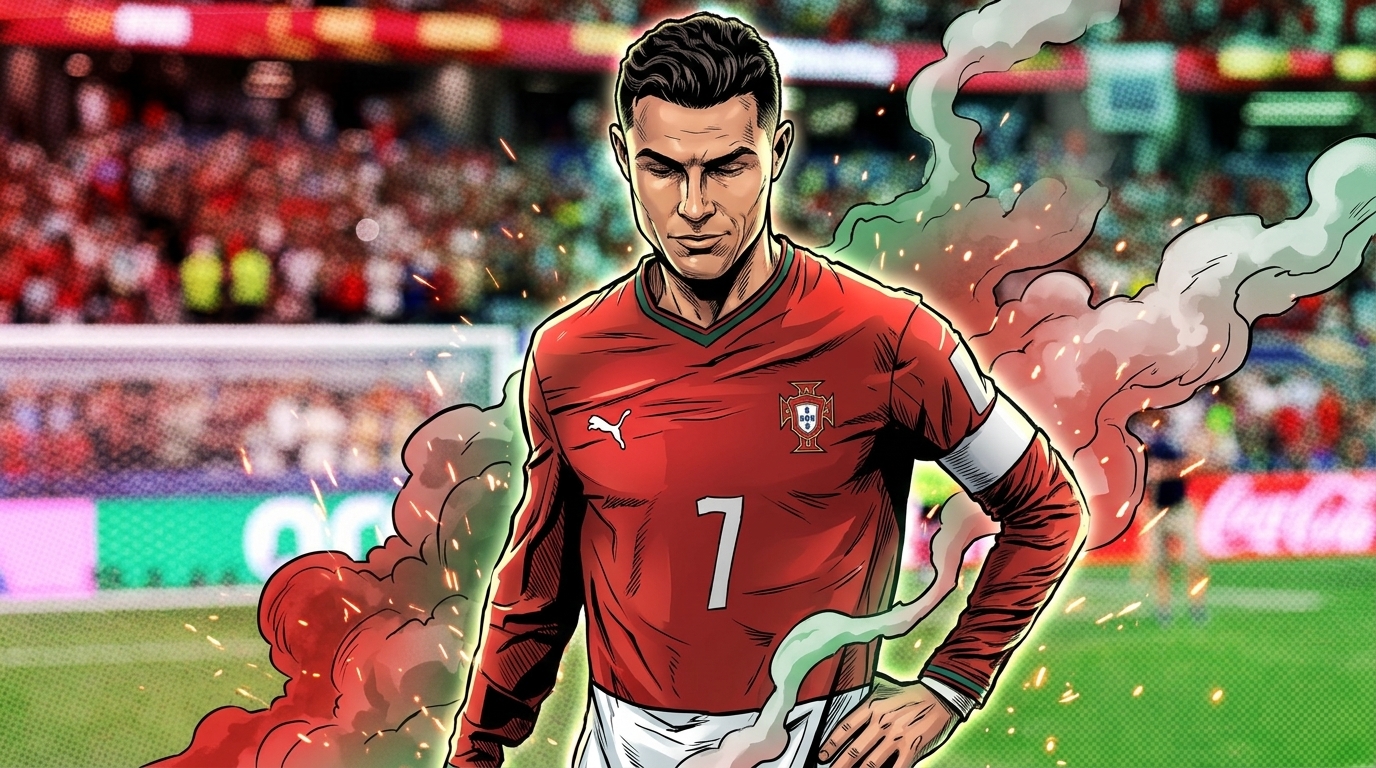

The saddest part of Cristiano Ronaldo’s last World Cup is not that Spain beat Portugal 1-0 in the Round of 16 on Sunday; it’s that the loss was administered by a man who had been on the pitch for six minutes.
Mikel Merino came on as a substitute in the 85th minute of a scoreless match, found the ball in the 90th, and put it in the net at 90+1’. He was not warm. He had not settled. He barely had time to register that he was playing in a World Cup before he had decided one. That is the specific, exact detail that the Ronaldo narrative needed for a conclusion, because the narrative was never really about Portugal — it was a decades-long argument Ronaldo was having with doubt, and doubt answered with a substitute who got six minutes.
Consider what Ronaldo built this entire late career around. The goal record — 146 international goals across 233 caps — was supposed to be the monument that made the argument for him. Numbers on a leaderboard that no one could contest, no matter what they thought of his performances in big knockout matches, no matter how many World Cups came and went without a trophy. The record was the proof; the proof would settle it. Except the record never settles anything, because individual accumulation and collective achievement are priced differently in the market where these arguments are conducted. You can be the all-time scorer and still never win the one tournament that functions as the sport’s canonical verdict. Ronaldo understood this better than anyone, which is why he kept showing up — at 37, at 39, at 41 — because the only answer to the World Cup question was to win a World Cup.
He didn’t win a World Cup. Spain’s goalkeeper, Unai Simón, had not conceded a goal in 609 tournament minutes entering the match. Ronaldo had 19 touches. Three shots. One saved by Simón in the 37th minute, which is as close as Portugal got. Roberto Martínez, doing the work of a man who needs to say something diplomatic, offered this afterward: “When you’re a team and you need a goal, you can’t take Cristiano Ronaldo off. He’s a presence, he opens space.” That is a polite sentence. Translated: his value in the 89th minute of a scoreless elimination match was spatial, not technical; he occupied a coordinate, and that coordinate drew defenders, and those defenders were not near Merino when Merino scored.
https://x.com/FOXSports/status/2074239829462724992
Ronaldo stood on the pitch afterward, wiped his eyes, hugged Lamine Yamal — the 17-year-old who will presumably be doing this for the next fifteen years — and walked into the tunnel. He had confirmed before the match that this was his final World Cup. He confirmed it again afterward: “It’s been my last World Cup, yes. But now I will have time to think, stay with my family and life continues.” The equanimity is either genuine or the only available performance at that moment; it doesn’t much matter which.
He also said: “The biggest title I won in the national team was 2016. Which for me, has the same dimension as a World Cup.” This is the line that requires the most care, because it is not defensible on its face and Ronaldo knows it — no one needs to argue that Euro 2016 has the same dimension as a World Cup if they actually believe it. What it is, instead, is the statement a person makes when the thing they came for has definitively not arrived and they need a framework that allows them to leave. The Euro 2016 title is real; the two Nations League titles are real; the 146 goals are real. The World Cup was always the one that got away. It got away six more times.
There is a legitimate version of this where Ronaldo’s career, assessed honestly, is one of the greatest in the history of the sport; where the World Cup gap says more about the gap between individual and team performance than it does about him specifically; where crying on the pitch after your sixth and final attempt is simply what grief looks like when it arrives on schedule. That version deserves acknowledgment, and you can find a fuller account of the Portugal-Spain tension that built to this moment in our preview of this exact matchup.
But the tears are not about the loss. They are the first public acknowledgment — at 41, on the field, in front of everyone — that the project did not close the case. He spent years insisting there was something left to prove. He was right that there was. He just couldn’t prove it. Spain sent on a substitute, the substitute scored, and Ronaldo finally stopped arguing; that’s the World Cup 2026 ending he got, and in some unsparing way, it was the only one available. For a full picture of who actually won this tournament’s argument, Jude Bellingham has a strong claim, as we laid out earlier this week.
The goal record stands. The case remains open.