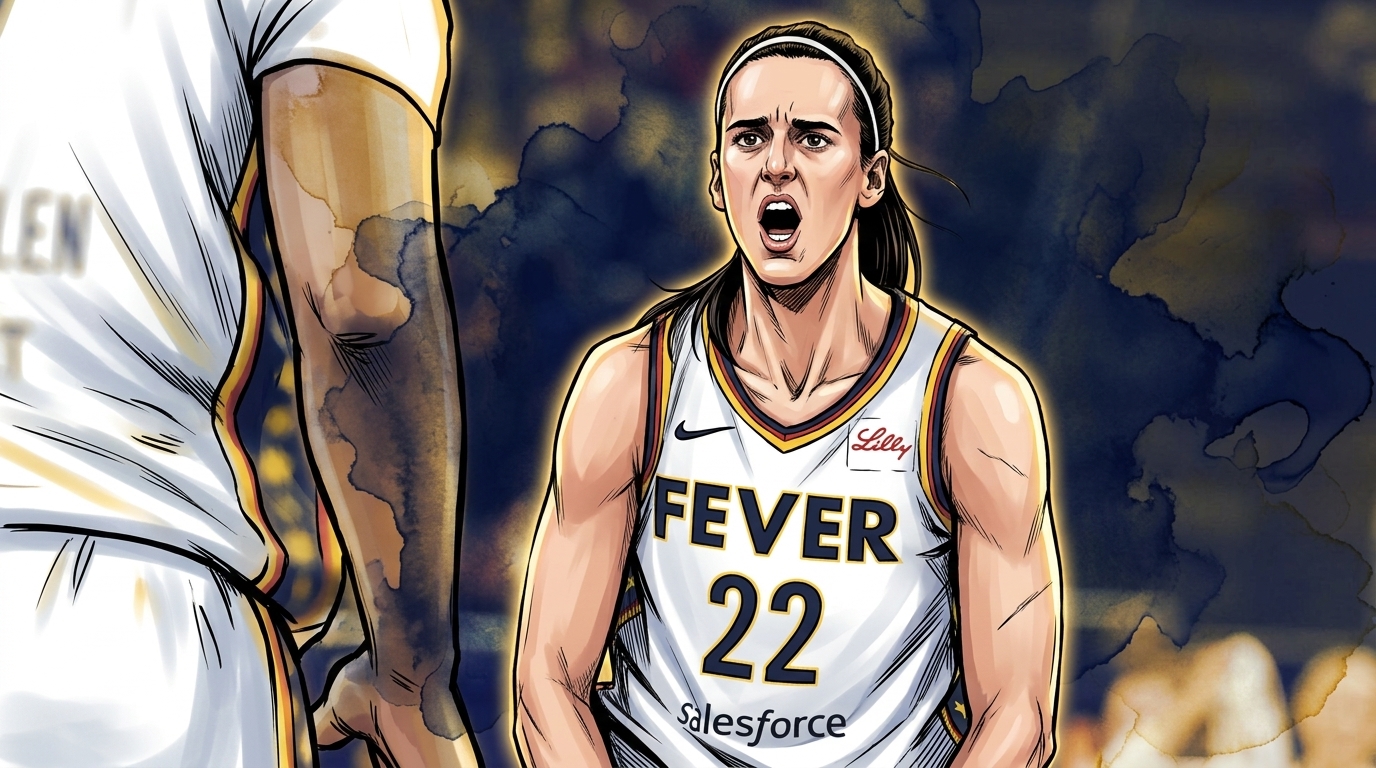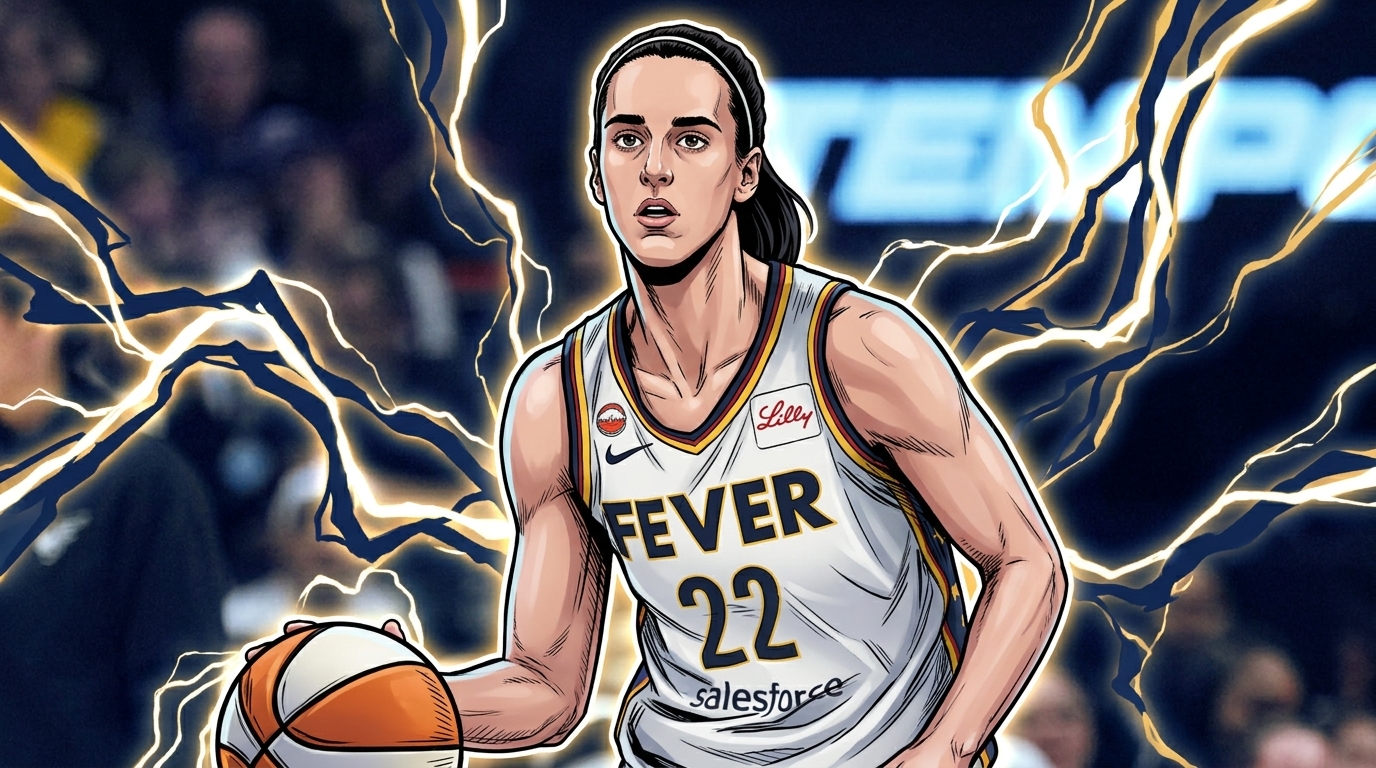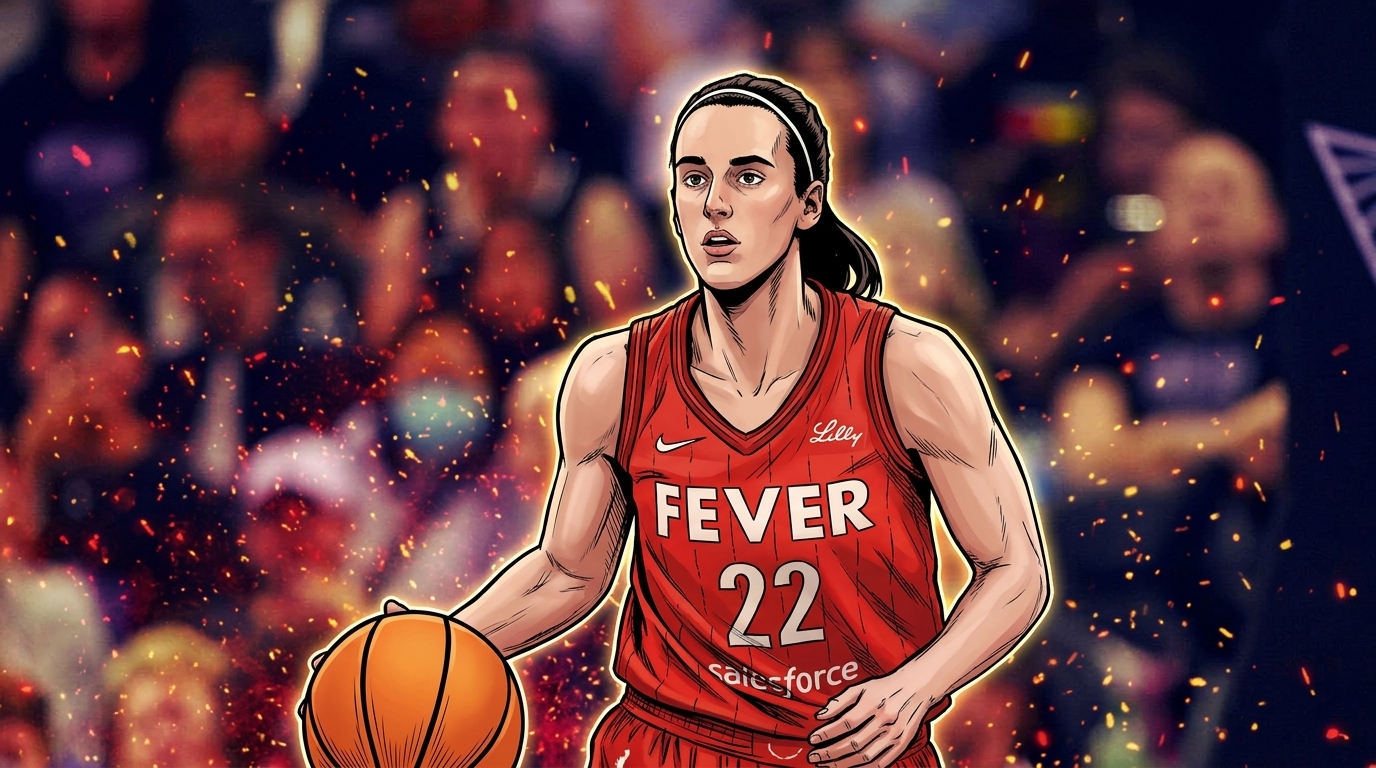

We’ve been watching this build since the friendship bracelets appeared. Two bracelets, handed out as Caitlin Clark walked into an Indiana Fever arena before a game against the Toronto Tempo. One read “CAITLIN1.” The other: “10-01-26.” Taylor Swift rollout energy, deployed in service of a basketball shoe — and somehow, that framing is both a little absurd and exactly right. Because what Nike is about to attempt with the Nike Caitlin 1 release date of October 1, 2026, is not really a product launch. It’s a culture experiment. The WNBA’s commercial ceiling gets tested every time something like this happens, and this time the stakes are larger than any previous test.
The shoe itself (Racer Blue lead colorway, $140 adult unisex, built around a Kobe 5/Kobe 6 silhouette that Clark preferred on court, featuring metallic double Swoosh and rubberized upper in repeating “CC” and “22” patterns) is by all accounts a serious piece of basketball footwear. Clark said at the press conference, via James Boyd of The Athletic, that “the technology we’re putting into my shoe isn’t anything Nike has ever put into a basketball shoe before.” She also said she “probably was never a kid that grew up thinking that this was gonna be in the cards for me.” These are not the quotes of someone going through marketing motions. They’re the quotes of someone who understands the weight of what’s actually happening.
The weight is this: the men’s basketball sneaker market is a $4.5 billion ecosystem, and almost none of that was built on team loyalty or league affiliation. It was built on the Air Jordan model. One player. One shoe. One cultural identity that transcended sport and became fashion, status, and community simultaneously. The WNBA, in 29 years of existence, has never had that.
What Is the Release Date for the Nike Caitlin 1?
The Nike Caitlin 1 releases on October 1, 2026, available via Nike.com and select Nike Basketball retailers. The lead colorway is “Racer Blue.” Adult unisex pricing is $140, with grade school ($115) and preschool ($105) sizes also available, a deliberate signal that Nike is marketing this to the broadest possible audience, not just serious ballers. The CC logo features interlocking double-Cs with a hidden third C between them, designed collaboratively with Nike’s design team. Clark called it “more than just a logo, it’s a dream come true.”
The Air Jordan Blueprint the WNBA Has Never Had
The Air Jordan 1 released in 1985. Nike paid Michael Jordan $250,000 per year plus royalties (the NBA almost immediately fined him for wearing non-standard shoes) and built an entire subsidiary brand around a single player’s identity. Within two years, Air Jordan was generating more revenue than the entirety of Nike’s basketball division had before Jordan arrived. The model has been replicated dozens of times since: LeBron, Kobe, KD, Kyrie, Luka. Each time, the template is roughly the same. Find a player whose personality exceeds the sport, attach a shoe, let the cultural gravity do the rest.
The WNBA has never gotten a real iteration of that model. Not because the players weren’t good enough — Sheryl Swoopes had seven Air Swoopes silhouettes after her 1995 deal made her the first female player with a signature shoe, which remains the all-time record for any female player (this tells you something about how the industry actually valued those deals). Rather, it’s because no player before Clark had the combination of on-court moment, mainstream crossover, and platform scale that the model requires to generate real commercial gravity.
Clark has been setting WNBA records at a pace that makes the commercial argument easy. Games involving Clark now average 1.32 million viewers, up from around 462,000 before she entered the league. Indiana Fever home attendance sits at 17,035 per game, which is more than the Pacers averaged at the same arena. When the Fever visit an opponent, that opponent’s home attendance jumps 87 percent. The WNBA’s new media deal, which kicks in with the 2026 season, is worth $200 million per year, up from $60 million. That’s not a coincidence. That’s Clark’s presence reflected in contract negotiations.
Nike’s eight-year, $28 million deal with Clark, signed in 2024, was a bet on all of this materializing. The Caitlin 1 is the first real asset from that bet.
Who Else Has a Signature WNBA Shoe Right Now?
Four active WNBA players currently have signature shoes, and the landscape is worth understanding before October 1 arrives.
A’ja Wilson has the Nike A’One and A’Two, two-time MVP and three-time champion, as legitimate a signature athlete as women’s basketball has produced. Sabrina Ionescu has the Nike Sabrina line, which has become one of the most-worn shoes across both the WNBA and NBA (the first unisex Nike signature shoe for a female player, and the benchmark the Caitlin 1 will be measured against directly). Angel Reese signed with Reebok for the Angel 1, building Angel Reese’s own expanding platform from a different commercial direction. Breanna Stewart has the Puma Stewie.
That’s it. Four players out of the entire active WNBA roster have their own shoe. The Ionescu comparison matters most here because Sabrina’s crossover into NBA usage is the proof-of-concept that the Caitlin 1 is explicitly trying to build on. If a WNBA signature shoe can earn genuine adoption among male basketball players, it generates a commercial multiplier that transforms the economics of the entire category.
Why the October 1 Timing Is Not an Accident
The WNBA playoffs begin in mid-September. October 1 lands squarely in the middle of playoff competition, when WNBA viewership is at its seasonal peak and basketball conversations are happening at maximum volume. This is not a date Nike chose because it fit a production schedule. It’s a date Nike chose because it puts the Caitlin 1 drop inside the news cycle where it will generate the most sustained attention.
There’s also the league’s fraught relationship with its own star to consider. The WNBA has not always handled Clark’s commercial and media moment with particular grace. Dropping the shoe during the playoffs, when Clark is playing, when the games matter, when the league itself is at its most visible, creates a natural alignment that benefits everyone, including an organization that has sometimes seemed unsure how to fully leverage what it has.
Clark changed her Instagram handle to “caitlin1” before the shoe reveal. The friendship bracelet rollout (cute, intentional, extremely online) got the date in front of millions of people before any official announcement. Nike is running this like it runs Jordan drops. The question is whether the demand is actually there.
Clark’s quote about what she hopes the shoe means for fans is the most telling line in the whole announcement:
https://twitter.com/RomeovilleKid/status/2067002592685683126
“That it kind of gives them a superpower and they feel like they can express themselves through the shoe.” That’s not a basketball-performance line. That’s a cultural identity line. That’s Air Jordan language.
What Happens If the Caitlin 1 Underperforms?
This is the question nobody in the WNBA ecosystem wants to ask directly, which is exactly why it needs to be asked.
If the Caitlin 1 sells the way Nike is betting it will (real sellout numbers, crossover adoption, secondary market heat), it does something larger than move units. It proves that the Air Jordan model can be ported to women’s basketball. It gives every team in the league a commercial argument for investing more seriously in their players as brand entities. It tells every apparel company sitting on the sideline that there is real money in WNBA athlete partnerships. Women’s sports revenue is expected to hit $2.35 billion in 2025. A Caitlin 1 success story accelerates that trajectory in basketball specifically.
If it underperforms, if the $140 price point creates friction, if the “unisex” positioning alienates instead of including, if playoff attention doesn’t translate to retail momentum, the industry will draw its own conclusions. Not fair conclusions, necessarily. The men’s basketball shoe market has decades of brand infrastructure, cultural inertia, and retail relationships that the women’s market is still building. A single shoe cycle is not a complete test. But the industry doesn’t always grade on a curve, and a soft launch gets remembered for a long time.
Ann Miller, EVP of Nike Global Sports Marketing, described Clark as someone who “exemplifies both: an exceptional basketball player and an outstanding ambassador for the game.” That framing (player and ambassador, performance and culture) is the dual thesis of the Caitlin 1 itself. Nike needs both to work. The shoe needs to perform on court and sell off it.
The WNBA has been waiting 29 years for a moment like this one. Not just a signature shoe — those have existed since Swoopes. But a signature shoe attached to a player with the crossover gravity to actually replicate what Jordan built. October 1 is the first real data point. Watch the resale market. Watch whether the grade school sizes sell out first (they should, if this is really a cultural moment and not just a basketball product). Watch what Nike does with the second colorway announcement. All of that will tell you far more about the WNBA’s commercial future than any league press release ever will.