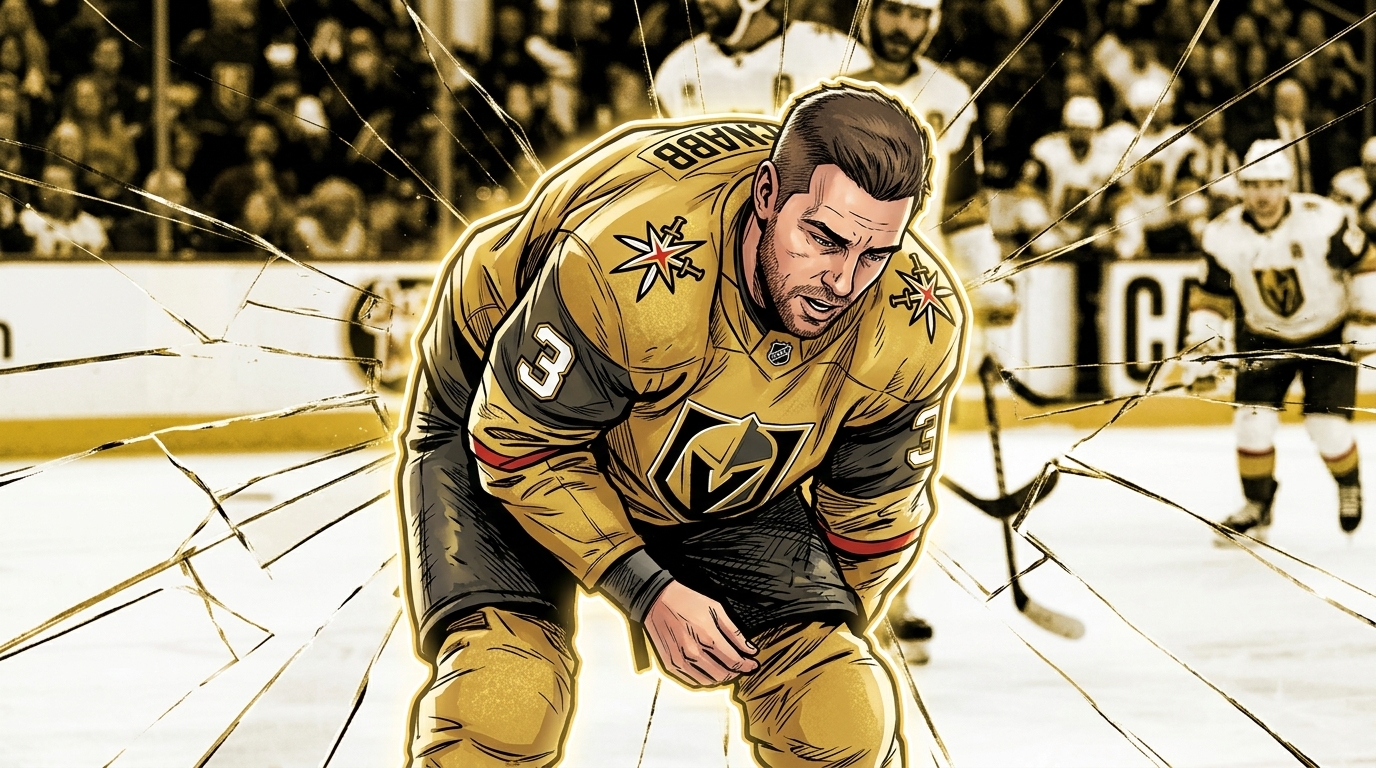

At 10:52 of the first period of Game 2 of the Stanley Cup Final, Brayden McNabb was standing in front of his own net — which is where defensemen are taught to stand — and a puck traveling at 87 miles per hour struck him in the face. He left the ice under his own power, which is the best version of that sentence. He did not return. The Golden Knights played the next two-plus periods, plus overtime, with five defensemen. They led 2-0. They lost 4-3. The series is tied 1-1.
https://twitter.com/YahooSports/status/2062709655764344922
This is a column about institutional design.
The NHL’s concussion protocol (more precisely, its head injury protocol) functioned as intended Thursday night in Raleigh. McNabb was removed from play; he was evaluated; he did not return. He was hospitalized, per ESPN, which is the kind of sentence that gets filed under “outcomes” rather than “incidents” only because he walked off under his own power and the game continued. Jesse Granger, who covers the Golden Knights, reported that Vegas players “felt they handled a tough situation well.” Mitch Marner called it terrifying. The league, for its part, offered no visible disruption to the broadcast.
The protocol worked. I want to be precise about that, because precision matters here. The system that governs what happens after a player absorbs an 87mph projectile to the face performed its function. The player was removed. The paperwork, such as it is, was followed. What the protocol does not govern — what no protocol governs, because it predates the current institutional concern with player safety by several decades — is the positional assignment that placed McNabb’s face in that location in the first place.
Defensemen stand in front of their own net. This is not a secret. It is, in fact, the job. The low defensive zone presence is a foundational element of modern defensive scheme; coaches draw it on whiteboards, players execute it ten thousand times in practice, and everyone involved understands that this position exposes the participant to exactly the category of risk that materialized Thursday. The sport has developed increasingly sophisticated protective equipment around this reality. It has not meaningfully reconsidered the reality itself.
The Hurricanes had already been questioned all season for their ability to generate high-danger chances from the perimeter. The Ehlers slap shot was neither a fluke nor a product of defensive breakdown. It was a slap shot from the high slot. It was the shot that the system invites.
What followed was, by hockey standards, remarkable; by any other standard, genuinely strange. Shea Theodore played 28 minutes and 30 seconds. The five remaining defensemen absorbed the redistribution without ceremony, because that is what professionals do, and because the alternative (pausing to consider whether it is reasonable to ask five people to cover the defensive responsibilities usually split among six, in the Stanley Cup Final, after their teammate was taken to a hospital) does not appear in the operational manual. Vegas built a 2-0 lead. The framework held. Then it didn’t. Seth Jarvis scored in overtime on the power play. The Hurricanes won 4-3.
The series preview identified this Golden Knights defense as one of the deepest in the conference. That depth was stress-tested in real time Thursday, against the best competition available, under conditions no one planned for. It absorbed the test for fifty-odd minutes. Then it didn’t, which is also a data point.
I am not arguing that anyone did anything wrong. The officials stopped play when McNabb went down. The trainers responded. The protocol was followed. Marner, set to join the Golden Knights this July, called it terrifying, per Yahoo Sports. McNabb’s availability for Game 3 will now run parallel to the series for however long the series lasts, with daily updates carrying the particular weight of questions that have no good answer. Either he plays, which means playing through something that sent him to a hospital, or he doesn’t, which means five defensemen again, in a building that will be extremely loud.
The protocol cleaned up the mess. The structure created the conditions. Both of these things can be true simultaneously; in professional hockey, they are almost always simultaneously true. McNabb stood in front of his net because that is where defensemen stand. The puck found him because pucks, at 87 miles per hour, are not selective. The game continued because games continue. The league will issue an update when there is an update to issue.
In Columbus, I watched this on a Thursday night and thought about how sports have always had a very specific relationship with the word “unfortunate,” a word that implies randomness, accident, the uncaused cause. The 87mph puck was not random. It was the predictable output of a design that everyone agreed to, everyone reinforces, and everyone will continue operating next Saturday and the Saturday after that. The protocol exists because the system produces injuries. The system produces injuries because the protocol exists to handle them.
This is the loop. It is not new. It will not be interrupted by a 4-3 overtime loss, or by the series, or by the offseason. Game 3 is Saturday. Get well, Brayden McNabb.